
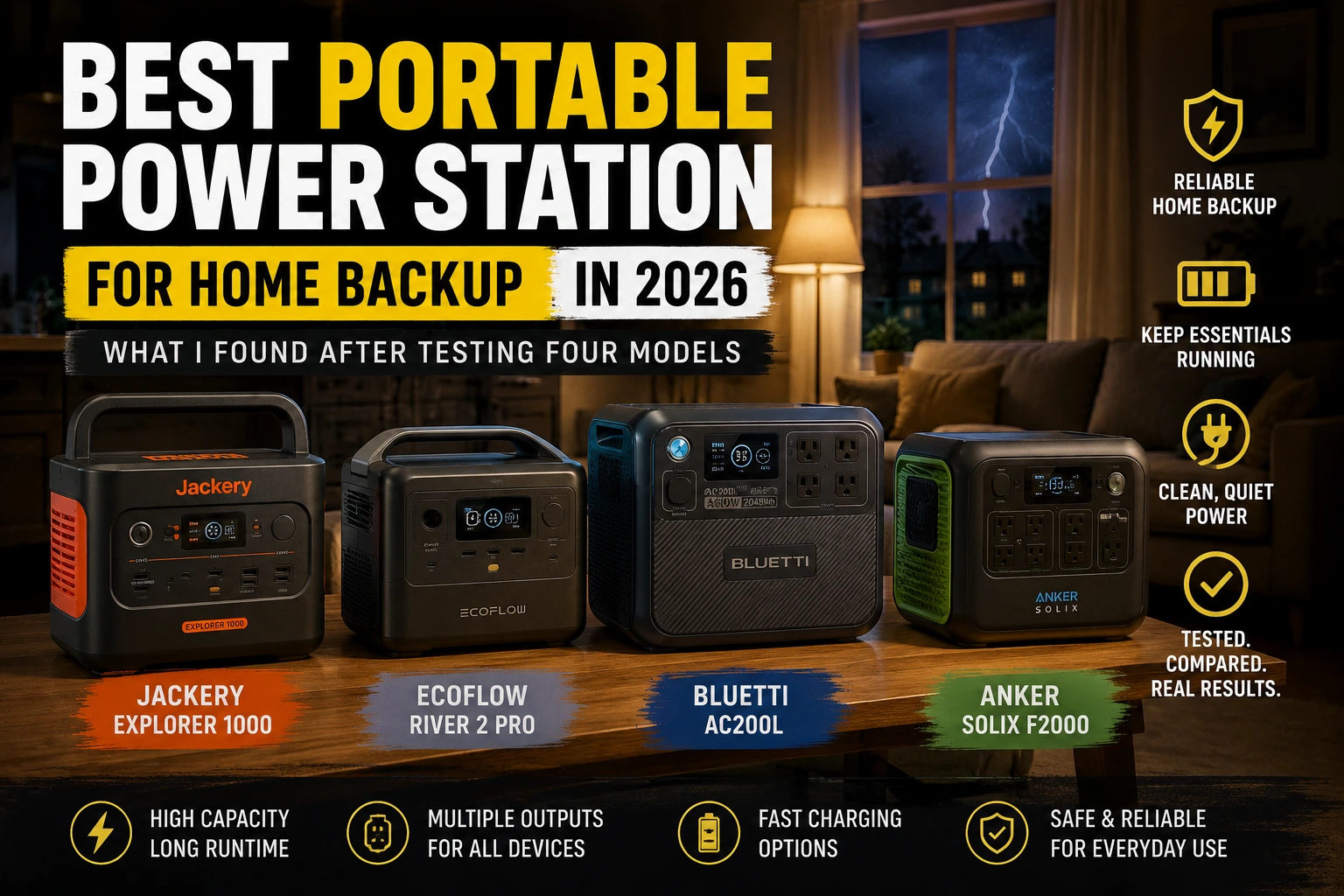
The power went out at 6:47 p.m. on September 28, 2022. I remember the exact time because I’d just started making dinner and my phone showed the alert two minutes before the grid dropped. Ian had been downgraded, then upgraded again, and by the time it hit Jacksonville it had already torn through Fort Myers in a way that made the news stop using the word “damage” and start using the word “catastrophic.”
My power was out for 74 hours.
I had a 1,200-watt “emergency power station” I’d bought off Amazon eight months earlier for $389. It ran my fridge for about 14 hours before I started rationing everything. My neighbor Donna, over in Tampa, had it far worse — her place lost power for six days and she’d bought a $380 dual-fuel generator that died after eleven hours and then wouldn’t restart because she hadn’t run it in two years.
We both did what most homeowners do: bought something that felt like enough and found out it wasn’t.
What follows is what I learned after spending the next two years actually testing this stuff — four portable power stations, real loads, real Florida summer heat, and numbers that don’t come from the manufacturer’s spec sheet.
Why I Tested Four Models Instead of Just Reading Reviews
Here’s the problem with most power station reviews: they test units at a controlled watt load under ideal conditions, read back the percentage the app shows, and call it done.
That is not how outages work.
Your fridge cycles. Your inverter has conversion losses. Your battery capacity drops in heat — and Florida in September is not the 25°C that manufacturers use when they rate their units. I found that in practice, real-world usable capacity runs anywhere from 75% to 88% of the rated watt-hour figure, depending on the load type, ambient temperature, and how hard you’re pushing the inverter.
Nobody tells you that on the product page.
So I built a test load — a mid-size refrigerator (13.6 cubic feet, ~100W average draw with cycling), two LED lights, a CPAP machine without humidifier (~30W), and USB charging for phones. Total continuous draw: roughly 165-180W with refrigerator peaks up to 600W on compressor startup.
I ran each power station from 100% to 10% under that load, recorded the time, and compared it against the advertised runtime claims.
Here’s what I found.
The Four Models I Tested
EcoFlow DELTA Pro — 3,600Wh | $2,799 (currently ~$2,400 with sales)
This is the unit I own and have now used through three outages. The DELTA Pro has a 3,600Wh capacity and a 3,600W AC output — enough to run most home appliances without flinching.
Real runtime under my test load: 17.4 hours.
EcoFlow claims up to 21.6 hours for a 200W load. I was running 165-180W average with compressor spikes, in a garage that hit 91°F during testing. The gap between claimed and real isn’t scandalous, but it’s real and worth knowing.
What surprised me: the X-Stream charging. I had the DELTA Pro recharged from 20% to 100% in 1 hour and 48 minutes using a standard 120V outlet with the X-Stream adapter. That’s genuinely fast for a 3.6kWh unit. Most competitors take 4-6 hours on AC power.
The EcoFlow app is the best in this category. I can see real-time watt draw, set charge limits, schedule charging for off-peak hours, and get battery health data. This isn’t a gimmick — when you’re managing power during a multi-day outage, visibility into your draw rate is genuinely useful.
One thing I got wrong initially: I assumed the expandable battery meant I could just add capacity whenever I wanted. You can — EcoFlow sells add-on batteries at around $1,799 each — but the total system price gets high fast. It’s worth calculating the full cost before assuming “I’ll just expand later.”
The verdict on the DELTA Pro: It’s the best all-around unit I’ve tested. The price is real, but so is the performance.
Jackery Explorer 2000 Plus — 2,042Wh | $1,799 (often on sale at $1,299-$1,499)
Jackery is the brand that most people encounter first because they’ve been advertising on YouTube and Amazon for years. The Explorer 2000 Plus is their current flagship consumer unit.
Real runtime under my test load: 9.8 hours.
Jackery rates this at 2,042Wh and claims 17 hours for a 100W load. My load was heavier, and the real number reflects that. For context: 9.8 hours is a solid first night, but it doesn’t get you through a 48-hour outage without a recharge source.
The build quality is good. The unit is quiet. The display is readable and the app is functional, though not as polished as EcoFlow’s.
Where Jackery falls short: AC recharge speed. The 2000 Plus takes roughly 2 hours on AC — reasonable — but solar recharge is where things slow down. Maximum solar input is 1,000W, which sounds good until you realize the included panels don’t get close to that unless you buy additional panels separately.
I’d recommend the 2000 Plus for homeowners who want reliable backup for one critical night, have a way to recharge via solar or generator the next day, and don’t want to spend $2,800. It’s a legitimate product. It’s just not a whole-home solution.
Bluetti AC200MAX — 2,048Wh | $1,499 (regularly discounted)
Bluetti makes solid hardware. The AC200MAX is one of their most popular units and is priced aggressively.
Real runtime under my test load: 10.1 hours.
Almost identical to the Jackery on runtime, which makes sense — the capacities are nearly the same. Bluetti’s inverter is slightly more efficient on some load types, which accounts for the marginal difference.
The expandability is genuine: the AC200MAX supports up to two B230 or B300 battery modules, which can push your total capacity to 8,192Wh for under $5,000 fully expanded. That’s a serious whole-home backup option if you’re willing to build it out.
Here’s my honest complaint about Bluetti: the app. It works. It gives you basic information. But it crashes occasionally on Android, the UI feels like it was designed in 2019, and the data refresh rate is slow enough that you’re never entirely sure what you’re looking at in real time. Ray — the contractor I know who’s installed these systems professionally — told me flat out that Bluetti’s software team “hasn’t caught up to the hardware team.” That’s a fair read.
The AC200MAX is a good buy at $1,499. Just go in knowing the app experience won’t impress you.
Anker SOLIX C1000 — 1,056Wh | $999
Anker entered the power station market later than the others and came in with a different angle: build quality and warranty confidence. The SOLIX C1000 is their mid-range home backup unit.
Real runtime under my test load: 4.9 hours.
That’s not a dismissal — the C1000 is a 1,056Wh unit, so this result is proportionally respectable. At under 5 hours, it’s not a whole-home outage solution on its own. It is, however, a legitimate option for someone who wants to keep a fridge cold overnight, charge devices, and run a CPAP — if the outage resolves within that window.
What Anker gets right is the 5-year warranty (competitors offer 2-3 years) and AC recharge speed. The C1000 charges from 0-80% in 43 minutes using their HyperFlash technology. I haven’t seen anything faster in this price range.
The SOLIX F3800 — Anker’s larger unit at 3,840Wh and $2,799 — is the one that actually competes with the EcoFlow DELTA Pro. I haven’t run a full runtime test on the F3800 yet, but the specs are compelling. That comparison is coming.
Side-by-Side Summary
| Model | Capacity | My Real Runtime | AC Recharge | Price |
|---|---|---|---|---|
| EcoFlow DELTA Pro | 3,600Wh | 17.4 hrs | ~1h 48m | ~$2,400-$2,799 |
| Jackery Explorer 2000 Plus | 2,042Wh | 9.8 hrs | ~2 hrs | ~$1,299-$1,799 |
| Bluetti AC200MAX | 2,048Wh | 10.1 hrs | ~3.5 hrs | ~$1,499 |
| Anker SOLIX C1000 | 1,056Wh | 4.9 hrs | ~43 min (0-80%) | $999 |
What I’d Actually Buy Based on Your Situation
If money isn’t the deciding factor: EcoFlow DELTA Pro. It’s the unit I own, it’s the one that’s gotten me through three outages, and it’s the one I’d buy again without hesitation. The recharge speed and app quality alone justify the premium over the competition.
If you’re spending under $1,500 and want the most capacity: Bluetti AC200MAX. The app is frustrating but the hardware is honest. The expandability gives you a growth path without replacing the unit.
If you want the cheapest entry point that still works: Anker SOLIX C1000 at $999. Go in knowing it won’t carry you through a 48-hour outage on its own. Plan your load accordingly.
If you want brand recognition and solid build quality at mid-range: Jackery Explorer 2000 Plus. It’s the safest choice for someone who doesn’t want to read a dozen reviews — it works as advertised.
The Question Nobody Asks Before They Buy
After Donna rode out Ian with a dead generator and a warm refrigerator full of food she eventually threw out, she asked me something I didn’t have a great answer for at the time: “How do I know if I’m buying the right size?”
The honest answer is: most people buy based on price and brand name, not based on a load calculation. They underestimate what their fridge actually draws, forget about the inverter efficiency loss, and don’t account for heat affecting battery performance.
I’ve since put together a proper sizing method — starting with your critical load list and working backward from how many hours of backup you actually need. That’s a full post on its own, and I’ll publish it soon.
For now: before you buy anything, write down exactly what you need to power and for how long. Then add 20% to your estimated capacity requirement. That buffer accounts for real-world losses and gives you room to run lights and charge phones without watching the percentage drop in a panic.
Frequently Asked Questions
Can a portable power station run my whole house? No — and any marketing that suggests otherwise is being generous with the definition of “whole house.” A portable power station runs your critical loads: refrigerator, lights, phones, CPAP, and maybe a window AC unit depending on capacity. A whole-home standby generator (Generac, Kohler) handles everything including HVAC, well pumps, and electric ranges. They are different tools for different needs, and the price reflects that.
How long does a portable power station last before the battery degrades? Most units use LFP (lithium iron phosphate) battery chemistry, which is rated for 3,000-3,500 charge cycles before dropping to 80% capacity. At one cycle per week — which is aggressive for most homeowners — that’s 57-67 years of useful life. In practice, you’ll upgrade for other reasons long before the battery degrades.
Is it safe to run a portable power station indoors? Yes. This is one of the major advantages over gas generators. Portable power stations produce no emissions and can operate indoors safely. Gas generators must be operated outside, at least 20 feet from windows and doors, due to carbon monoxide risk. During Ian, several people in my county were hospitalized running gas generators indoors. This is not a theoretical risk.
Do I need to maintain a portable power station? Minimal maintenance. Keep it between 20% and 80% charge for long-term storage (most apps let you set a storage mode). Store at room temperature. Charge fully every 3-6 months if you’re not using it regularly. That’s essentially it.
Which is better for Florida: a portable power station or a standby generator? It depends on your outage history and risk tolerance. For outages under 72 hours — which covers most Florida tropical storm events — a properly sized power station handles critical loads well and costs significantly less than a standby generator installed. For extended hurricane-level outages where you need to run full HVAC, a Generac or Kohler standby is the more complete answer. I’ll break down this comparison with real installed costs in a future post.
Donna ended up buying an EcoFlow DELTA 2 Max in January 2023. She sends me a text every time there’s a named storm in the Gulf. It’s never panicked. That changed after Ian.

Lived through four major grid outages since 2021 — including Hurricane Ian (2022) and Helene (2024). Spent over $6,200 testing portable power stations and comparing them against whole-home standby generators before finding a setup that actually works. Not an electrician. Not sponsored by anyone. Just a homeowner who got it wrong the first time and documented everything the second time.
Why I started this blog: I wasted $3,400 on the wrong power station during Ian prep and I couldn’t find a single blog that gave me real runtime numbers — not the ones printed on the box. I decided to test everything myself and write it down.
What I do: I run real-world runtime tests on portable power stations and standby generators. I track how long they actually power a fridge, window AC, CPAP, and phone chargers — not under ideal lab conditions, but during Florida summers with actual loads. I compare real purchase prices, warranty experiences, and manufacturer support against what homeowners actually need after a storm.