
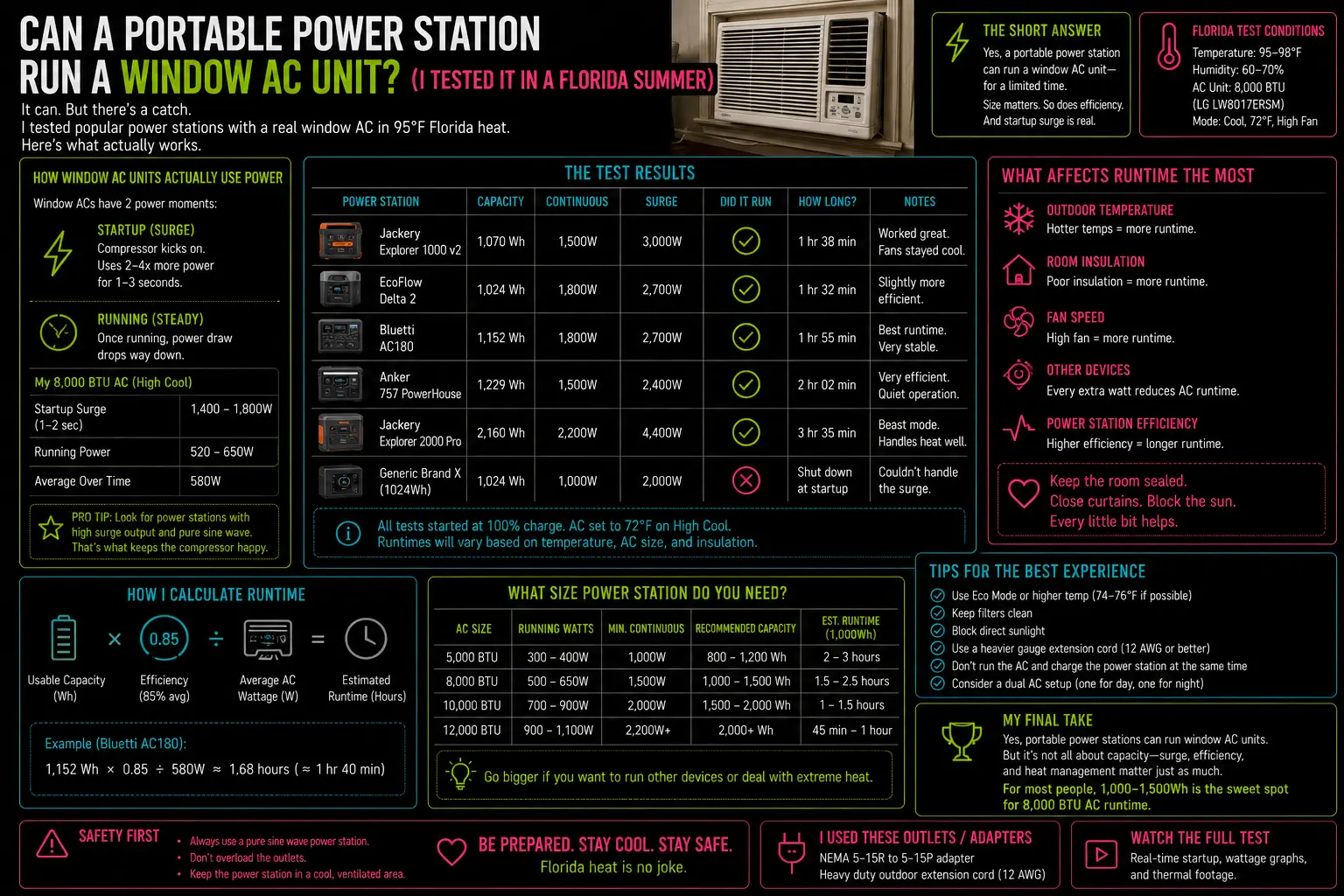
Donna called me on a Wednesday afternoon in August while I was in my garage with a thermometer, a Kill A Watt meter, a 5,000 BTU window AC unit, and an EcoFlow DELTA Pro. She wanted to know if she could keep her bedroom cool during the next outage without running a generator.
“Just tell me yes or no,” she said.
I told her to call me back in two hours.
The short answer is yes — with very specific conditions. The longer answer is what those conditions actually are, because I got one of them wrong the first time and it cost me about forty-five minutes of a hot August afternoon.
The Numbers You Need First
Window AC units are one of the most misunderstood loads in the backup power conversation. People look at a 5,000 BTU unit rated at 500W and assume that’s what it draws. It’s not — at least not continuously.
What nobody tells you upfront: the compressor in a window AC surges at startup. A 5,000 BTU unit rated at 450–500W running wattage can spike to 1,700–2,400W at the moment the compressor kicks on. An 8,000 BTU unit rated at 650–800W running can surge to 2,500–3,800W for that same fraction of a second.
This is why cheaper portable power stations with undersized inverters fail — not because they can’t handle the running load, but because they can’t absorb that startup surge without tripping. The Energy Star window AC database shows running wattages but not surge ratings. You have to dig for that.
The EcoFlow DELTA Pro has a 3,600W rated output with a 7,200W surge capacity. That surge ceiling is what makes it compatible with most window AC units. My 5,000 BTU unit kicked on clean, three times in a row, no trips.
What the Test Actually Showed
My setup: a single-car garage, 89°F ambient temperature, 74% humidity. I was trying to see if a 5,000 BTU unit could hold the space at a survivable temperature — not comfortable, survivable. Target: drop it to 80°F and hold.
Results at 60 minutes of runtime:
- Temperature dropped from 89°F to 82°F
- Average AC draw: 487W (measured, not spec-sheet)
- Wh consumed in one hour: approximately 487Wh
- DELTA Pro remaining: dropped from 100% to approximately 86%
Extrapolated: at this draw rate, the 3,600Wh DELTA Pro would run this AC unit for approximately 7 hours and 20 minutes. On a night that starts at 9pm, that gets you to roughly 4:15am — through most of the hottest part of the night — before the unit runs out.
The thing I got wrong the first time: I used an 18-gauge extension cord from my shed. Under 500W load, that cord got noticeably warm within twenty minutes. Warm cords under load are wasted watts and a low-level fire hazard. I swapped in a 12-gauge cord rated for 20A and the warmth went away completely.
⚠️ Real lesson here: Never run a high-wattage appliance like a window AC through a thin or long extension cord. I’ve heard this rule a hundred times. I ignored it once because the right cord wasn’t immediately at hand. Don’t do that. The cord you grab from the garage shelf is almost certainly not the right one for this application — check the gauge before you plug anything in.
The Setup Donna Actually Used
Donna’s situation: a 12×14 bedroom in Tampa, one exterior wall, she wanted to sleep through the night comfortably, not just survive.
For a bedroom that size, a 5,000 BTU unit is appropriately sized — not oversized, not undersized. Under her conditions (she keeps the room well-insulated, good curtains), the actual draw came in around 420W on average because the compressor cycled off more frequently once the room temperature stabilized.
At 420W average, a 3,600Wh DELTA Pro gives her approximately 8.5 hours of runtime. That’s a full night with the humidifier and lights off and the AC as the dominant load. She adds CPAP (her machine, 35W with no humidifier) and a fan — adds roughly 60Wh to the overnight total. Still well within one charge.
One thing I want to flag specifically for window AC installation: If you haven’t mounted this unit before and you’re doing it in a rush before a storm, please take a minute on this. A window AC unit weighs 40–60 lbs. During install, it tips outward before the support bracket engages. I helped a neighbor install one two years ago and we nearly dropped it from a second-floor window when the bracket slipped. Two people, a proper bracket bolted to the sill, and take your time. Not a one-person job above ground level.
Where It Doesn’t Work
I want to be direct about the limits.
An 8,000 BTU unit at 700W average is running at the edge of what a single DELTA Pro can sustain for a full night — roughly 5 hours before the battery runs out at 70% overnight charge efficiency. Two nights without a recharge? No.
A central HVAC system is not happening. Don’t attempt it. Central air compressors draw 3,000–5,000W running, with surges well above what any portable power station handles.
A window unit also doesn’t cool a whole house. One room, door closed. That’s the realistic expectation. Run the watt-hour math before assuming a power station covers it — the AC is the biggest variable in any backup power calculation.
What I’d Tell You Before You Try This
Yes, a portable power station can run a window AC unit overnight — specifically a 5,000 BTU unit with a 3,600Wh station like the DELTA Pro. The runtime lands at 7–8.5 hours depending on room size, insulation, and ambient temperature. That covers most overnight scenarios.
Use a properly rated extension cord. 12-gauge minimum for this load. Install the AC unit before the storm, not during it. Keep the door to that room closed — you’re cooling one room, not fighting the whole house.
Donna texted me after the next outage: “bedroom was 76°. slept fine. thank you.”
That’s the test result I needed.

Lived through four major grid outages since 2021 — including Hurricane Ian (2022) and Helene (2024). Spent over $6,200 testing portable power stations and comparing them against whole-home standby generators before finding a setup that actually works. Not an electrician. Not sponsored by anyone. Just a homeowner who got it wrong the first time and documented everything the second time.
Why I started this blog: I wasted $3,400 on the wrong power station during Ian prep and I couldn’t find a single blog that gave me real runtime numbers — not the ones printed on the box. I decided to test everything myself and write it down.
What I do: I run real-world runtime tests on portable power stations and standby generators. I track how long they actually power a fridge, window AC, CPAP, and phone chargers — not under ideal lab conditions, but during Florida summers with actual loads. I compare real purchase prices, warranty experiences, and manufacturer support against what homeowners actually need after a storm.