
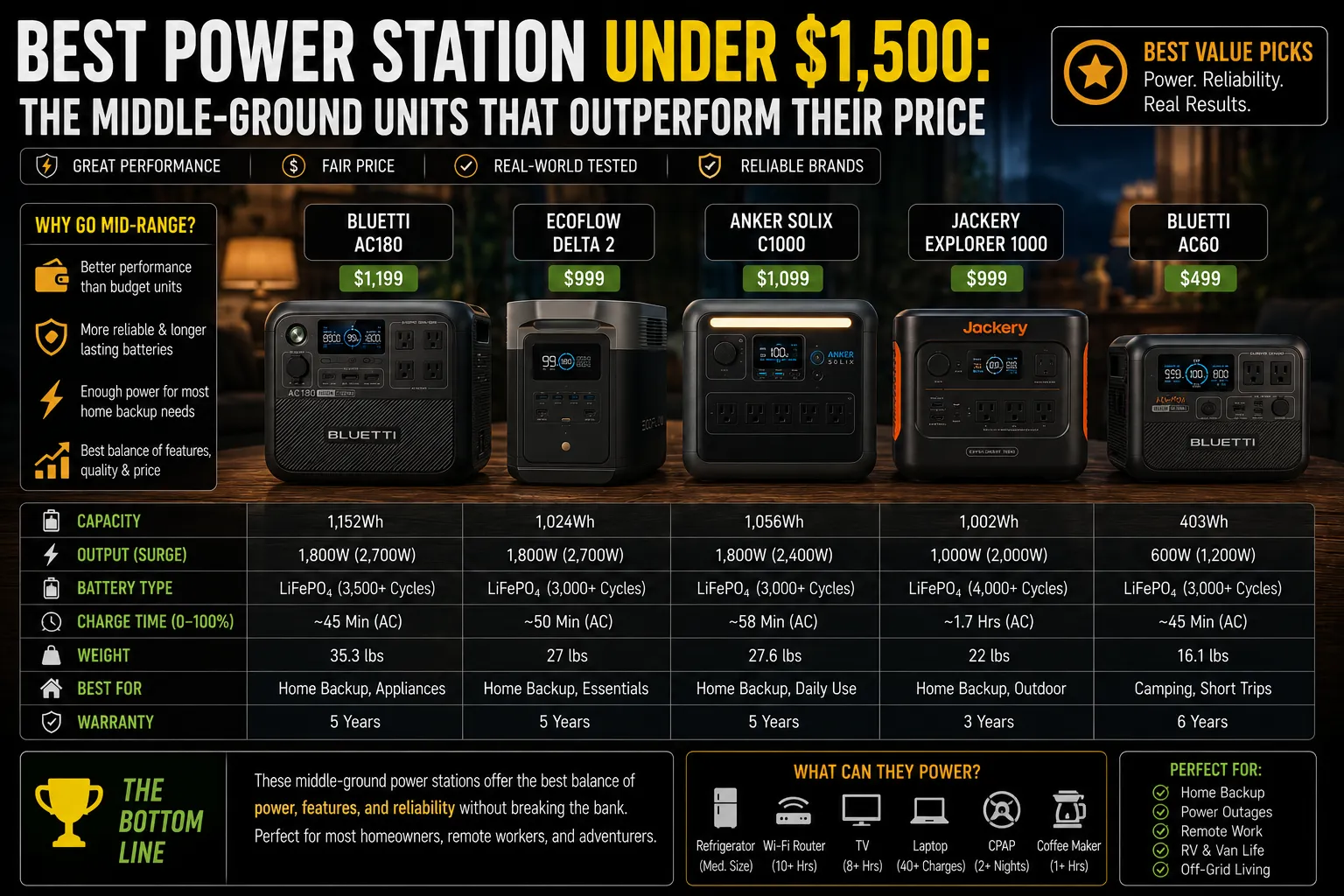
$1,099. That’s the price Donna paid for the Jackery Explorer 2000 Plus during a Prime Day sale — and her first reaction after the first real outage was to call me and say it felt like buying a safety net she didn’t know she needed until she had it.
The $1,000–$1,500 tier is where home backup power stops being a convenience purchase and starts being infrastructure. Units in this range cover 2,000Wh of capacity or more, handle window AC units (briefly), support serious solar input ceilings, and power refrigerators, CPAPs, fans, and work devices simultaneously without taxing the inverter.
Three units earn a real recommendation at this price. One popular option in the range doesn’t, and I’ll explain why.
What This Tier Should Deliver
Before the units: a clear picture of what $1,000–$1,500 buys in 2026.
At this tier you should expect: 2,000–3,000Wh of LiFePO4 capacity, a 2,400–3,000W AC output, 700–1,500W of solar input ceiling, and a chassis in the 45–65 lb range. Units that fall significantly short of these benchmarks at this price are either overpriced or represent a brand premium you’re paying for without equivalent performance.
Run the load calculator with your specific devices first. These units cover 18–30+ hours of moderate critical loads — but “moderate” varies enormously by household.
The Three I’d Recommend
Jackery Explorer 2000 Plus — ~$1,099–$1,499 on sale
2,042Wh | 3,000W output | 1,000W solar input | ~61 lbs
The 2000 Plus is the unit Donna has, and it’s earned the recommendation through real use. At her load — refrigerator, CPAP with humidifier, two fans, device charging — the 2000 Plus runs approximately 16–18 hours before reaching 10% remaining. That covers one full day of moderate load, including overnight.
The 3,000W output ceiling (6,000W surge) handles any standard home appliance including window AC units, chest freezers, and power tools. The 1,000W solar ceiling supports up to six 220W panels in an array — serious recharging capability for extended outages.
What it doesn’t do: expand beyond 2,042Wh. Jackery offers add-on battery packs that extend capacity to 5,000Wh+, but they’re priced separately and most homeowners won’t need them.
Best for: homeowners who want a single solid unit, proven brand quality, 2,000Wh capacity, and a high output ceiling. Donna’s setup is the template.
EcoFlow DELTA 2 Max — ~$999–$1,199 on sale
2,048Wh | 2,400W output (5,000W surge) | 1,000W solar input | ~48 lbs
The lightest unit in this recommendation by a significant margin at 48 lbs. The DELTA 2 Max carries the same 2,048Wh capacity as the Jackery 2000 Plus with a lower continuous output (2,400W versus 3,000W) but a higher surge rating (5,000W versus 6,000W).
The output difference matters for simultaneous high-draw loads. Running a refrigerator (50W) plus a window AC (600–750W) plus a CPAP (50W) pushes close to the 2,400W continuous ceiling. The Jackery’s 3,000W ceiling gives more headroom in that scenario.
Where the DELTA 2 Max wins: EcoFlow’s app ecosystem and expandability. It connects to the Smart Home Panel for circuit management, and it can be expanded to 6,144Wh with two add-on battery modules. If software depth and future expansion matter, the DELTA 2 Max is the stronger long-term platform.
⚠️ On the surge rating: 5,000W surge sounds higher than the 2000 Plus’s stated 6,000W, but inverter surge ratings are measured differently across brands and the comparison isn’t always apples-to-apples. In practice, I’ve seen both units start the same compressor loads without issue. Don’t make a purchase decision based on surge numbers alone — measure your actual startup loads with a Kill A Watt meter.
Best for: homeowners who want EcoFlow’s ecosystem, a lighter chassis, and a path to expansion. The software advantage over Jackery is real and matters for tech-comfortable homeowners.
Anker SOLIX F2000 — ~$999–$1,399 on sale
2,048Wh | 2,200W output (4,800W surge) | 1,500W solar input | ~61 lbs
The F2000 earns its spot on this list primarily through its solar input ceiling — 1,500W, which is the highest in this price tier. For homeowners building a solar-plus-storage setup with multiple panels, the F2000 can accept more simultaneous panel input than either of the other two units here.
The 2,200W continuous output is the lowest ceiling of the three, and the one honest limitation worth knowing about. Heavy simultaneous loads may require careful management. For the standard homeowner running refrigerator, CPAP, lights, and device charging — the 2,200W ceiling is never approached.
Anker’s fast charging carries through: the F2000 charges from AC in approximately 1 hour. Anker’s build quality is consistent with the SOLIX brand.
Best for: homeowners planning to add multiple solar panels or who prioritize fast AC recharge speed.
The One I’m Leaving Off: Goal Zero Yeti 1500X
The Goal Zero Yeti 1500X sits in this price range and gets recommended frequently because of Goal Zero’s brand reputation. My issue with it: the Yeti 1500X uses NMC lithium battery chemistry, not LiFePO4.
NMC cells have a shorter cycle life (approximately 500 cycles versus 3,000–4,000 for LiFePO4) and are less thermally stable at temperature extremes. For a unit stored in a Florida garage that hits 90°F+, and which I’m planning to rely on for years of storm seasons, NMC chemistry is a real trade-off. Goal Zero makes excellent products — but at the price point where LiFePO4 is standard from competing brands, I wouldn’t choose NMC unless the brand were the only consideration.
This isn’t a “Goal Zero is bad” argument. It’s a “NMC vs LiFePO4 at this price tier” argument, and LiFePO4 wins on longevity and thermal stability for homeowner backup use.
Side-by-Side
| Jackery 2000 Plus | DELTA 2 Max | Anker F2000 | |
|---|---|---|---|
| Capacity | 2,042Wh | 2,048Wh | 2,048Wh |
| AC output | 3,000W | 2,400W | 2,200W |
| Solar input | 1,000W | 1,000W | 1,500W |
| Weight | ~61 lbs | ~48 lbs | ~61 lbs |
| Expandable | Yes (add-on batteries) | Yes (to 6,144Wh) | No |
| App quality | Good | Excellent | Good |
| Sale price range | $1,099–$1,499 | $999–$1,199 | $999–$1,399 |
Per EIA outage data, most residential outages resolve within 24 hours. All three units cover that window at moderate critical loads with comfortable headroom. The choice between them comes down to output ceiling, weight, software, and whether you want an expansion path.
The point why the biggest unit isn’t always right still applies here: these units are appropriate for 2,000Wh-level needs. If your load calculation puts your needs above that — say, running a window AC for more than a few hours — look at the 3,000Wh+ tier instead.
Which One to Buy
No hedging: if you want the safest, most proven recommendation, buy the Jackery Explorer 2000 Plus when it dips below $1,200. The output ceiling, the build quality, the brand track record, and Donna’s actual lived experience with it through a real outage are all the evidence I need.
If software depth and expandability matter to you — if you’re planning to add panels or connect to a smart home panel — buy the EcoFlow DELTA 2 Max instead. Both are correct answers for the right homeowner.

Lived through four major grid outages since 2021 — including Hurricane Ian (2022) and Helene (2024). Spent over $6,200 testing portable power stations and comparing them against whole-home standby generators before finding a setup that actually works. Not an electrician. Not sponsored by anyone. Just a homeowner who got it wrong the first time and documented everything the second time.
Why I started this blog: I wasted $3,400 on the wrong power station during Ian prep and I couldn’t find a single blog that gave me real runtime numbers — not the ones printed on the box. I decided to test everything myself and write it down.
What I do: I run real-world runtime tests on portable power stations and standby generators. I track how long they actually power a fridge, window AC, CPAP, and phone chargers — not under ideal lab conditions, but during Florida summers with actual loads. I compare real purchase prices, warranty experiences, and manufacturer support against what homeowners actually need after a storm.