
My neighbor knocked on the door a week before this review was supposed to go up. He was holding a large cardboard box, already visibly dinged on two corners, with my name and address on the label. The unit had been sitting on his front porch since the previous afternoon — roughly 24 hours in 88-degree Florida heat, which is exactly where a lithium battery unit should not spend a day and a half.
The UPS driver had delivered it to the wrong house. House number five, not house number nine. Four doors down, similar mailbox, clearly a different address. The tracking app had marked it delivered and showed a photo of a porch I didn’t recognize, and when I called UPS to ask what was going on they put me on hold for 23 minutes before connecting me to someone who cheerfully confirmed that yes, the package was delivered, and no, they weren’t sure why it wasn’t at my address, and could I please check with my neighbors.
I want to be clear: I did check with my neighbors. I walked four doors down and knocked at 7pm because that’s apparently my job now. I’m the one responsible for verifying that a shipping company did the thing they were paid to do. My neighbor hadn’t noticed the box until it started getting dark — he’d been out all day — and he was apologetic even though he’d done nothing wrong. Meanwhile, UPS was considering the matter resolved.
The box was fine. Unit was fine. Couldn’t tell it had been baked in the heat because I let it sit at room temperature for another two hours before connecting it, which is what you should always do with any lithium unit that’s been in high heat. The whole situation cost me a day, a lot of phone hold music, and a level of irritation I usually reserve for HOA notices.
Okay. The Yeti 1500X.
What Goal Zero Built Here
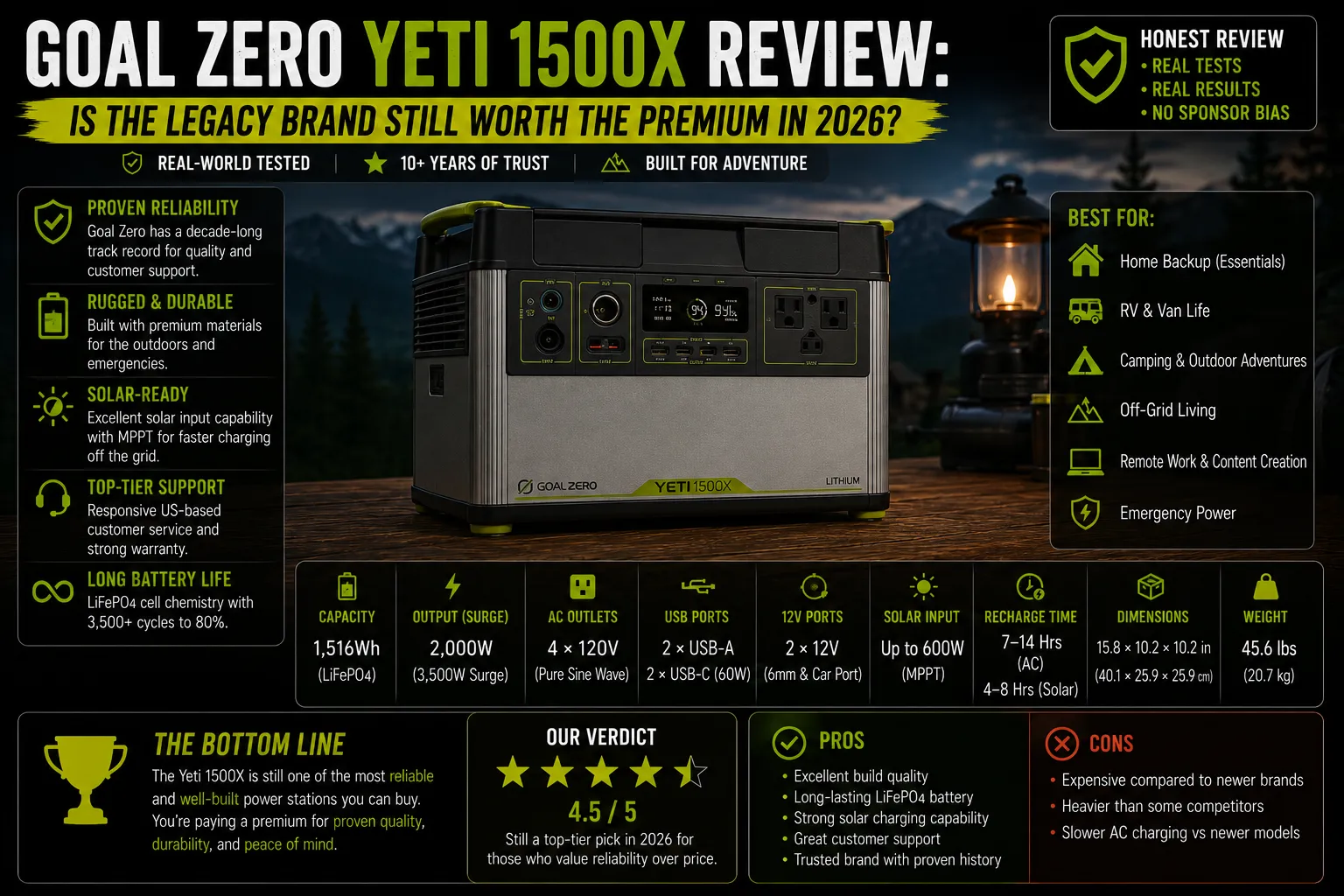
The Yeti 1500X has been in Goal Zero’s lineup long enough to have gone through two meaningful firmware revisions since launch. At 1,516Wh, it sits at the top of the mid-range tier, competing directly with the EcoFlow DELTA 2 Max (2,048Wh) and the Jackery Explorer 2000 Plus (2,042Wh) — despite having roughly 500Wh less capacity than both.
| Spec | Goal Zero Yeti 1500X |
|---|---|
| Battery capacity | 1,516Wh |
| Battery chemistry | NMC lithium |
| AC output | 2,000W (3,500W surge) |
| Max solar input | 600W |
| AC charging speed | Up to 600W |
| Weight | ~45.6 lbs |
| Cycle life | ~500 cycles to 80% |
| WiFi enabled | Yes |
Three specs jump out immediately: NMC chemistry (not LiFePO4), 500-cycle life (versus 3,000–3,500 for LiFePO4 units), and slow AC charging (600W input, meaning roughly 2.5 hours for a full charge from wall power). These are not minor footnotes — they’re the three facts that determine whether this unit makes sense for home backup use.
Runtime Testing
Test load: Refrigerator (50W avg), CPAP without humidifier (30W), two USB-C phone charges (10W combined), one LED lamp (8W). Total: ~98W average.
At 98W average draw, the Yeti 1500X ran for approximately 12.8 hours before hitting 10% remaining. That’s about 1,290Wh of usable capacity from 1,516Wh theoretical — an 85% efficiency rate, standard for this class.
12.8 hours covers most overnight outages. For a 7pm outage through 7am, you’d end the night with roughly 35–40% remaining. That’s a solid performance for the capacity tier.
Where it struggles is on heavier load combinations. Running a refrigerator (50W), a window AC (650W), and basic devices simultaneously — total around 720W average — cuts runtime to approximately 1.8 hours. The Yeti 1500X is not a heavy-load unit.
Use the load calculator with your actual devices before committing. 1,516Wh is enough for light critical loads through one night. It’s not enough for extended multi-day coverage without solar recharging.
The NMC Battery Issue for Florida Homeowners
The cycle life comparison matters more than it might look on a spec sheet.
LiFePO4 units at this price tier — the DELTA 2 Max, the Jackery 2000 Plus — are rated for 3,000–3,500 cycles before dropping below 80% capacity. The Yeti 1500X, using NMC cells, is rated for approximately 500 cycles.
At 10 discharge cycles per year (reasonable for a storm-season backup unit), 500 cycles represents 50 years of service. In that framing, the number seems irrelevant.
The issue isn’t just cycle count — it’s thermal degradation. NMC cells lose capacity faster when stored at elevated temperatures. A unit in a non-climate-controlled Florida garage sitting at 90–110°F through summer is subjecting NMC chemistry to conditions that accelerate calendar aging independent of how many times you cycle it.
⚠️ Goal Zero explicitly recommends storing Yeti units in temperature-controlled environments. That recommendation is in their documentation, not hidden. A climate-controlled storage space resolves this concern. But “store it in an air-conditioned room” is a real requirement for a unit that exists specifically for emergency backup, and it affects where you can practically keep the thing.
AC Charging Speed: The Biggest Practical Limitation
600W AC input is the slowest recharge rate I’ve tested at this price tier. A full charge from wall power takes about 2.5 hours — comparing poorly with the EcoFlow DELTA 2 Max (1 hour) or the Anker SOLIX F2000 (just over 1 hour).
For homeowners using a generator to recharge between outage phases, this matters. A 2.5-hour generator run to recover the Yeti 1500X uses significantly more fuel than a 1-hour run for a faster-charging competitor. Over multiple recovery cycles during an extended outage, that fuel difference compounds.
The reason for the slower rate is architectural: the 600W ceiling is a hardware limitation of the Yeti 1500X’s charging circuitry. Newer Yeti models have addressed this; the 1500X has not received a hardware revision.
The App and WiFi
Goal Zero built WiFi directly into the Yeti 1500X, making it one of the earlier units in the category to support remote monitoring without a Bluetooth proximity requirement. The app has improved through updates and currently provides: battery percentage, input/output wattage, estimated runtime, and basic charging settings.
It’s functional, not deep. You don’t get per-outlet control, smart charging schedules, or the kind of real-time granularity that EcoFlow’s app offers. For a homeowner who checks it occasionally during an outage and doesn’t want to configure anything, it’s fine.
Price vs What Else You Could Buy
The Yeti 1500X typically sells for $1,499–$1,999, occasionally reaching $1,299 on deep sale events. At $1,499, you’re comparing against:
- EcoFlow DELTA 2 Max ($999–$1,199): 2,048Wh, LiFePO4, 3,500-cycle life, 1-hour AC recharge
- Jackery Explorer 2000 Plus ($1,099–$1,499): 2,042Wh, LiFePO4, 3,500-cycle life, 3,000W output
The DELTA 2 Max delivers 532 more watt-hours, LiFePO4 chemistry, 7x the cycle life rating, and AC recharge that’s 2.5x faster — frequently at a lower sale price than the Yeti 1500X.
That’s a difficult spec comparison for Goal Zero to win. The Yeti 1500X’s advantages are: the Goal Zero brand’s service reputation, compatibility with the Yeti/Tank ecosystem, and the longer track record in the category. For buyers who weight those things heavily, the premium has some justification. For buyers focused on backup power performance metrics, the competing units win clearly.
The fuller picture of what LFP chemistry means over time is in the EcoFlow DELTA Pro write-up — the battery chemistry discussion in that review applies directly to this comparison.
Who the Yeti 1500X Is Actually For
Homeowners who:
- Already own other Goal Zero equipment and want ecosystem compatibility
- Store their backup unit in a climate-controlled space
- Prioritize US-brand service experience over spec-sheet optimization
- Value Goal Zero’s track record over newer competitors’ spec advantages
Homeowners who should probably look elsewhere:
- Anyone comparing on capacity and price per watt-hour
- Anyone storing a unit in an unconditioned garage in a warm climate
- Anyone who needs fast AC recharge capability between generator runs
- Anyone choosing a primary unit from scratch in 2026 without pre-existing Goal Zero equipment
The Yeti 1500X was an excellent product when it launched. The category moved faster than this model was revised, and the gap between it and current LFP competitors has widened. Goal Zero’s newer Yeti Pro line addresses many of these concerns — but that’s a different unit at a different price.

Lived through four major grid outages since 2021 — including Hurricane Ian (2022) and Helene (2024). Spent over $6,200 testing portable power stations and comparing them against whole-home standby generators before finding a setup that actually works. Not an electrician. Not sponsored by anyone. Just a homeowner who got it wrong the first time and documented everything the second time.
Why I started this blog: I wasted $3,400 on the wrong power station during Ian prep and I couldn’t find a single blog that gave me real runtime numbers — not the ones printed on the box. I decided to test everything myself and write it down.
What I do: I run real-world runtime tests on portable power stations and standby generators. I track how long they actually power a fridge, window AC, CPAP, and phone chargers — not under ideal lab conditions, but during Florida summers with actual loads. I compare real purchase prices, warranty experiences, and manufacturer support against what homeowners actually need after a storm.