
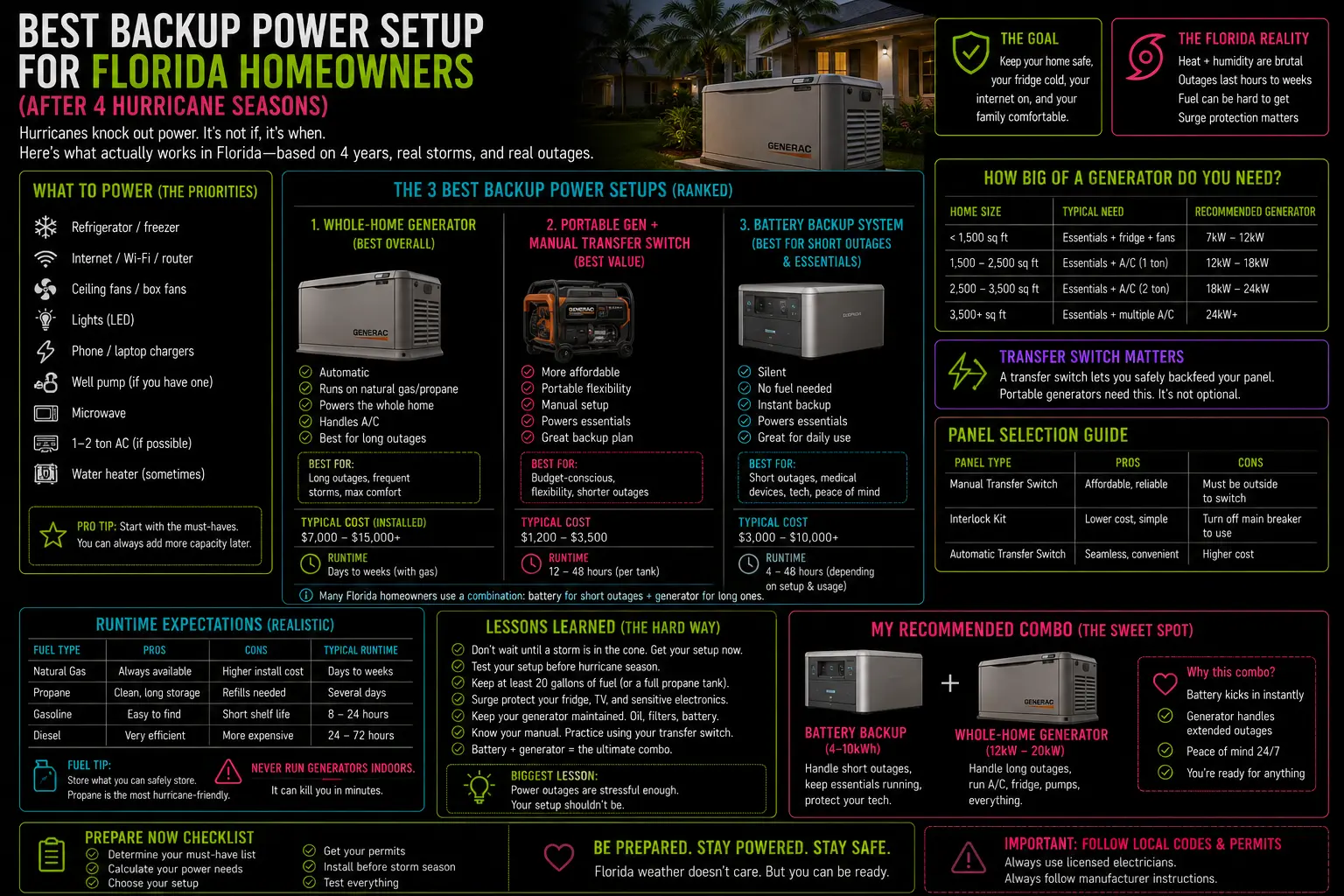
The week after Hurricane Milton hit in October 2024, Ray had eleven generator installs booked. Not eleven inquiries — eleven confirmed jobs, permits already pulled, customers who’d called him during the storm because they’d finally had enough. He told me about it over the phone while he was driving between jobs. He sounded tired in the specific way that people sound when demand has outpaced their physical capacity to keep up.
“Every storm, same thing,” he said. “They call me when the lights are out. Not before.”
The 2024 season was Florida’s most disruptive in years. According to the U.S. Energy Information Administration’s post-season report, Americans lost an average of 11 hours of electricity in 2024 — nearly twice the annual average of the previous decade. Hurricane Helene and Milton together accounted for roughly 80% of all hours without electricity that year nationwide. Florida customers were disproportionately represented.
I’ve been through 4 hurricane seasons with active backup power setups — first a standalone power station, then an expanded system with solar, most recently the full build I’ll describe below. Nine outages total over that period, ranging from 3 hours to 61 hours. Here’s what I’d tell a Florida homeowner to build, in order of priority.
The Florida Threat Model Is Different From Other States
This matters for sizing decisions.
Florida outages from tropical systems fall into roughly two categories: the short, widespread outage from a storm’s outer bands (typically 3–18 hours, often over by morning) and the extended post-landfall outage that follows a direct hit (24–96+ hours for some neighborhoods, depending on tree damage and utility crew access).
The outer-band scenario is common — Jacksonville sees it almost every season. The extended scenario is the one that kills refrigerators, spoils freezers, and makes houses genuinely uninhabitable in August heat without any cooling.
A backup power system sized only for the short scenario fails in the extended one. The extended scenario is the one worth sizing for.
What that means practically: you need enough capacity to run your critical loads for 48–72 hours with some form of daily recharge (solar, or grid return). A 1,000Wh unit covers one overnight. A 3,600Wh unit with solar panels can loop through multi-day outages on sunny post-storm days.
Priority One: The Refrigerator and Freezer
Your refrigerator is your food supply. A modern Energy Star 18–22 cubic foot refrigerator draws roughly 35–65W average, consuming 1.0–1.5 kWh over a full day. That’s 350–500Wh per overnight cycle.
A chest freezer is actually easier to power than a refrigerator — it cycles less frequently and holds temperature longer once full. A 7 cubic foot chest freezer draws 25–45W average.
Pro tip I discovered after my second outage: Fill your chest freezer with frozen water bottles before storm season. Not just for the cold mass — frozen bottles become emergency drinking water as they thaw. I keep about 20 one-liter bottles frozen from June through November. During the Helene-related outage in 2024, those bottles kept the freezer at a safe temperature for 14 hours after the power went out, before I even turned on the backup system. That buffer time is real.
Both appliances running overnight: approximately 500–700Wh combined for 8 hours. A 1,000Wh unit covers it. A 2,000Wh unit covers it twice.
Priority Two: Medical Equipment and Sleep
If anyone in your home uses a CPAP, home oxygen concentrator, or other continuous medical equipment, this is your single highest priority load — not the refrigerator.
CPAP machines are low-draw and highly manageable. A ResMed AirSense 10 or 11 with humidifier disabled draws 6–9W. With humidifier on at moderate settings: 30–56W. Plan around whether you can tolerate the humidifier off during outages and size accordingly.
A home oxygen concentrator is a different matter. Most draw 150–350W continuously. That’s not a CPAP — that’s a major load that needs to be in your backup plan from the start. If you have one in your household, call your power company’s medical baseline program. Florida utilities keep priority lists for customers with qualifying medical equipment.
⚠️ Specific safety note: I watched a neighbor run an extension cord from a generator outside, through a partially open window, to power his CPAP inside. The cord kinked against the window frame under the sash, which was pressing down on it. Over time, that kind of pressure on a cord under load can damage the insulation. Run extension cords through a proper pass-through, or leave the window slightly cracked with a cable organizer — not pinched under the sash. It’s a small thing that matters over days of continuous use.
Priority Three: One Cool Room
After food and medical equipment — one bedroom. Not the whole house. One room.
A properly sized window AC unit (5,000 BTU for a bedroom, 8,000 BTU for a larger space) running off a 3,600Wh power station gives you approximately 7–8 hours of cooling per charge. Combined with a solar panel recovering the unit during daylight hours, you can maintain one cool sleeping space through a 48-hour outage in most Florida post-storm conditions.
The key phrase is “post-storm conditions.” A day after Milton passed through, it was sunny and 87°F in Jacksonville. My 220W panel was recovering about 160W of real output — not the rated ceiling, but useful. By 3pm, the DELTA Pro had recovered from 40% to 82%.
Ray’s take: “Get the window unit installed before storm season. Don’t be the person who’s trying to install a 55-pound window AC in 90-degree heat with a storm three days away.” He’s watched it happen multiple times. The installation never goes as smoothly under time pressure, and the results of rushing it — a unit that isn’t properly secured, a bracket that wasn’t fully tightened — are worth avoiding.
Priority Four: Lighting and Communications
LED lighting is so low-draw it barely registers in the overall calculation. Four LED bulbs at 9W each, running 6 hours — that’s 216Wh. Phones, tablets, a laptop — another 100–200Wh. These don’t drive the sizing decision.
What does matter: a weather radio or battery-powered radio. During the 61-hour outage I experienced after Hurricane Matthew brushed the coast, internet was down for most of that window. Cell towers were congested. The most reliable real-time information I had was a $35 hand-crank weather radio. It’s not a backup power question — it’s a communication question — but it belongs in the Florida storm prep conversation.
The Setup I’d Tell Every Florida Homeowner to Build
Build in phases. Start before storm season — June 1 is the date to be ready.
Phase 1 (before your first season): EcoFlow DELTA Pro — $2,499 on a seasonal sale. Covers refrigerator, CPAP, device charging, and limited lighting for 24+ hours on one charge. Add one 220W solar panel ($350) and a proper 12-gauge extension cord. Total outlay: approximately $2,900.
This handles the outer-band scenario completely and gets you 70% of the way through a 48-hour event.
Phase 2 (season two or when budget allows): Add the DELTA Pro Smart Extra Battery ($1,699) — this doubles capacity to 7,200Wh. Add a second solar panel. At this point you’re fully capable of looping through a 48–72-hour outage on a combination of stored capacity and daily solar recovery.
Phase 3 (if you want one cool room): Add a 5,000–8,000 BTU window AC unit and the EcoFlow Smart Home Panel 2 for semi-automatic circuit management. At this point your system covers everything except central HVAC and well pumps.
Total Phase 3 cost: approximately $6,000–$6,500. Compare that to why I’d build a portable setup over a Generac for most Florida homes, and see which makes sense for your household.
The eleven customers who called Ray during Milton could have been protected for a fraction of what a standby installation costs — if they’d acted before the storm, not during it.
That window is usually about four to six months. Use it.

Lived through four major grid outages since 2021 — including Hurricane Ian (2022) and Helene (2024). Spent over $6,200 testing portable power stations and comparing them against whole-home standby generators before finding a setup that actually works. Not an electrician. Not sponsored by anyone. Just a homeowner who got it wrong the first time and documented everything the second time.
Why I started this blog: I wasted $3,400 on the wrong power station during Ian prep and I couldn’t find a single blog that gave me real runtime numbers — not the ones printed on the box. I decided to test everything myself and write it down.
What I do: I run real-world runtime tests on portable power stations and standby generators. I track how long they actually power a fridge, window AC, CPAP, and phone chargers — not under ideal lab conditions, but during Florida summers with actual loads. I compare real purchase prices, warranty experiences, and manufacturer support against what homeowners actually need after a storm.