
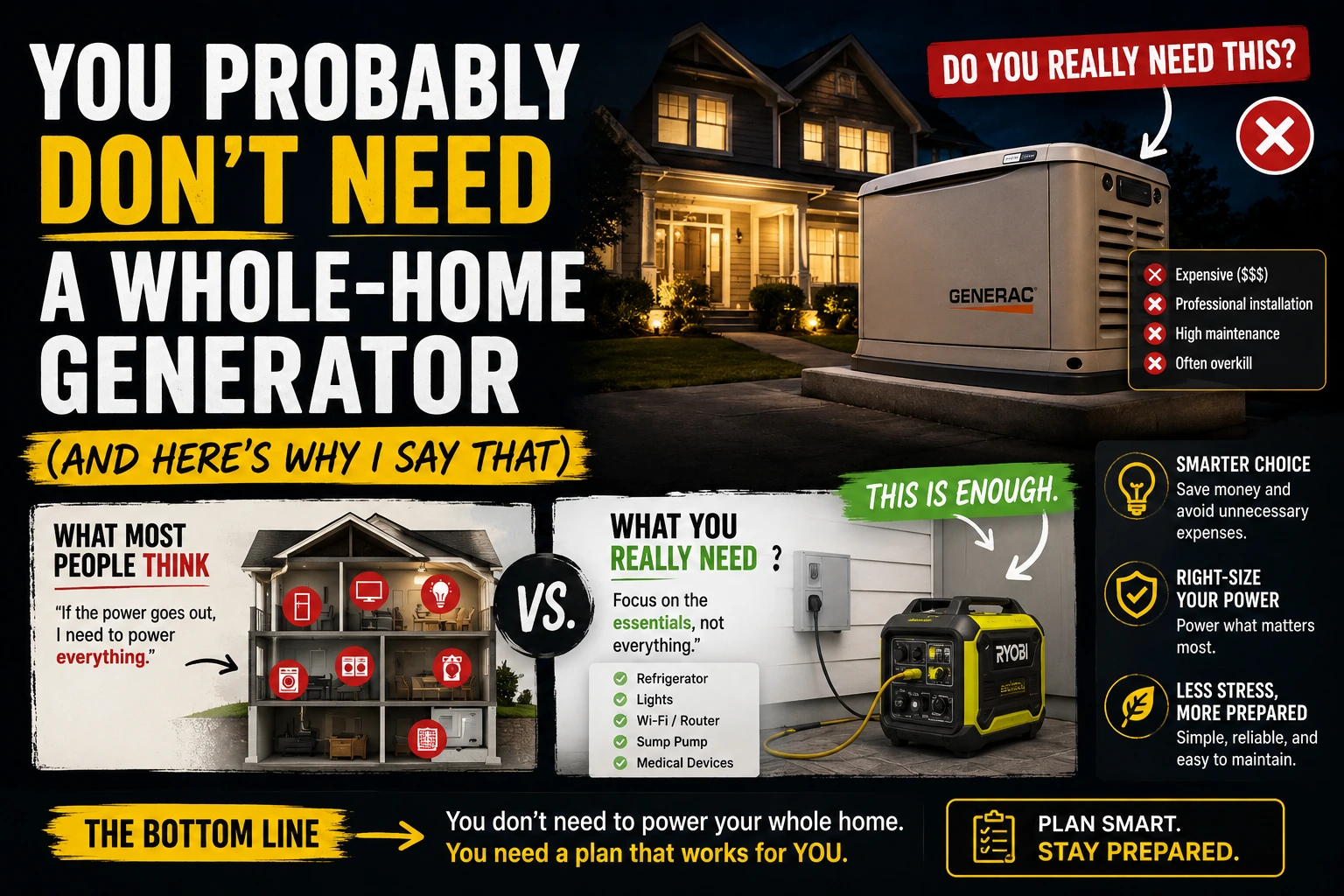
Most people buying a Generac don’t need one. There. I said it.
That’s not a knock on Generac — they make good equipment. It’s a knock on how standby generators get sold in the US, which is almost entirely on fear. A major storm hits, a few neighborhoods show up on the news, and suddenly every generator installer within 50 miles has a six-month backlog and a pitch about never losing power again.
My friend Chris went through this in Texas after the 2021 freeze. He called a contractor the week after power came back — after sitting without heat for four days in January — and signed for a Generac 22kW standby. Total installed cost: $12,400. He does not regret it, exactly, but when I asked him recently whether he’d make the same call today, he paused for a noticeably long time before answering.
What a Whole-Home Generator Actually Does (And What It Costs)
A whole-home standby generator like the Generac 22kW or a comparable Kohler unit connects to your home’s natural gas or propane line, sits outside like an HVAC unit, and kicks on automatically within seconds of a grid failure. It powers everything — HVAC, electric range, well pump, EV charger, all of it.
It is, genuinely, the most complete solution for grid outages.
It is also expensive, mechanically complex, and requires annual professional maintenance. Installed prices typically run $8,000 to $15,000 depending on your location, transfer switch setup, and whether you have a natural gas line already stubbed out near the unit. According to Angi’s cost data, the national average for a whole-home standby installation lands around $10,000–$12,000 fully installed. That’s before the $200-$400 annual service contract most installers recommend.
Then there’s the fuel logistics. During a major regional storm — the kind that actually knocks power out for days — natural gas pressure can drop significantly as thousands of homes run their generators simultaneously. Propane is more reliable in that scenario, but you need a tank large enough to sustain multi-day operation. Chris has a 250-gallon propane tank. He refills it every fall. It’s another line item.
None of this is a dealbreaker for the right homeowner. But it’s a very different picture than “pay once, never worry again.”
Who Actually Needs a Standby Generator
Let me be specific, because this is where the nuance matters.
You probably do need a whole-home standby generator if:
You have medical equipment that cannot be interrupted — a home oxygen concentrator, for example, or insulin storage that requires consistent refrigeration. Portable power stations can handle these loads, but the risk margin with medical necessity equipment is higher than most homeowners should accept on battery alone.
You live somewhere that regularly sees outages longer than 72 hours — not occasionally, but as a pattern. Coastal Carolinas during hurricane season, parts of rural Texas, some mountain states during ice events. The U.S. Energy Information Administration tracks outage duration data by state, and if your state averages more than 8 hours of interrupted service per year, the math on a standby installation improves considerably.
You run a home-based business that cannot absorb downtime. If you lose $2,000 a day when the power is out, the generator math changes fast.
Who Probably Doesn’t
Here’s what the generator salespeople won’t tell you after a storm: the median US power outage lasts under 4 hours. Most outages — even in storm-prone states — resolve within 24 hours. The dramatic multi-day events get the media coverage, but they’re not the typical case.
For homeowners whose primary concern is: keep the fridge running, keep the lights on, keep the phones charged, and run a CPAP machine — a well-sized portable power station handles all of that at a fraction of the cost.
The four portable power stations I’ve tested range from $999 to $2,800. The best of them — the EcoFlow DELTA Pro — ran my fridge, two lights, and a CPAP machine for nearly 15 hours on a single charge in my real fridge runtime test. Add a 400W solar panel setup for around $400-$600 and you’ve got a system that can loop through multi-day outages indefinitely, as long as you have sun.
Total cost: under $3,400, no installation required, no annual service contract, no fuel logistics.
Is it the same as a Generac? No. You won’t be running your central AC or your electric range. But for the majority of homeowners in the majority of outage scenarios — you don’t need to.
What I’d Tell Chris If He Called Me Today
Chris’s situation made the standby generator the right call. He lives in Austin. He has a large house with a well pump and a family with young kids. He’s been through a freeze where temperatures inside dropped below 40°F. His risk tolerance is low and his budget allows for it.
If you’re Chris, buy the Generac. It’s the right answer for that specific situation.
If you’re a homeowner in Florida or the Carolinas with standard appliances, a moderate budget, and outage history that looks like “a few days every couple of years after a named storm” — a portable power station is almost certainly the more rational purchase. You’ll spend less, get more flexibility, and not be locked into a maintenance contract for a piece of equipment you hope never to need.
The whole-home generator industry is not going to tell you that. I will.

Lived through four major grid outages since 2021 — including Hurricane Ian (2022) and Helene (2024). Spent over $6,200 testing portable power stations and comparing them against whole-home standby generators before finding a setup that actually works. Not an electrician. Not sponsored by anyone. Just a homeowner who got it wrong the first time and documented everything the second time.
Why I started this blog: I wasted $3,400 on the wrong power station during Ian prep and I couldn’t find a single blog that gave me real runtime numbers — not the ones printed on the box. I decided to test everything myself and write it down.
What I do: I run real-world runtime tests on portable power stations and standby generators. I track how long they actually power a fridge, window AC, CPAP, and phone chargers — not under ideal lab conditions, but during Florida summers with actual loads. I compare real purchase prices, warranty experiences, and manufacturer support against what homeowners actually need after a storm.