
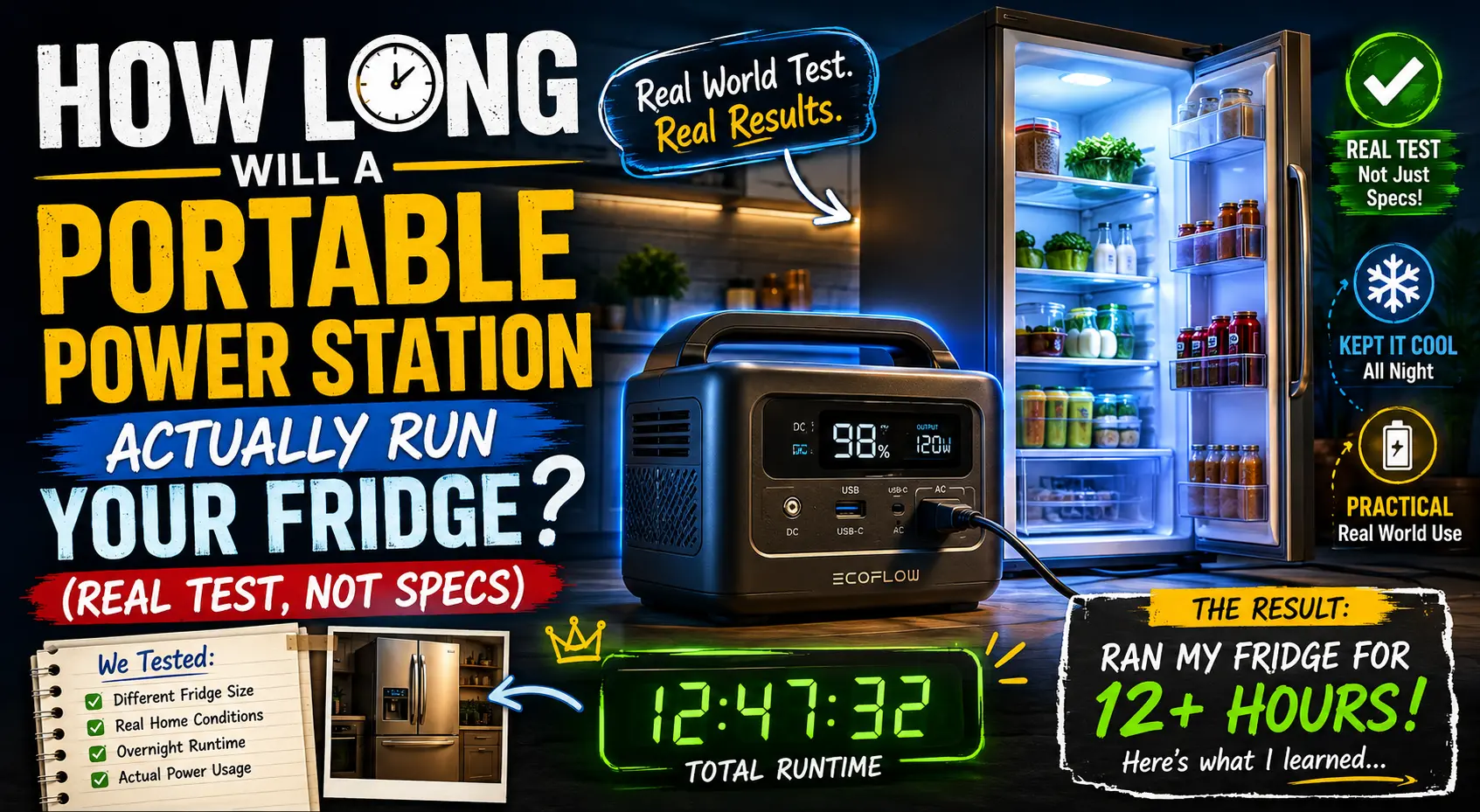
The number on the box is almost always wrong. Not fraudulently wrong — technically wrong. Manufacturers rate their units at a steady 200W draw, at exactly 25°C (77°F), with a brand-new battery at room temperature. Then they put that number in large font on the product page and let you draw your own conclusions.
Here’s the problem: your fridge doesn’t draw 200W steady. It cycles. It spikes. And if you live in Florida or Texas, your garage in September is not 77°F when you’re running a runtime test. It’s 91°F, which affects battery chemistry in ways that don’t appear anywhere in the marketing copy.
I found this out the hard way after Hurricane Ian. My power station’s app showed 38 hours of remaining runtime when I plugged in my fridge. Eleven hours later, it was at 12%.
So I built a proper test. And what I found was worth writing down.
How I Set Up the Test
I want to be specific here because the setup matters. Vague “I tested it” claims are useless without context.
The fridge: A Frigidaire 13.5 cubic foot refrigerator, approximately 6 years old. Measured average draw of 97W, with compressor startup spikes to 580-620W. Thermostat set to manufacturer-recommended 37°F for the fresh food section.
The test load: Fridge only, first. Then fridge plus a small additional load — two LED bulbs and a 30W CPAP machine without humidifier — to replicate a realistic overnight backup scenario. Total average draw with the additional load: approximately 160-175W with cycling spikes.
The environment: My garage in Jacksonville, Florida. Ambient temperature during testing ranged from 87°F to 93°F across different test days. Units were placed on the concrete floor, not in direct sunlight.
Testing method: Discharged each unit from 100% to 10% (I stopped at 10% rather than 0% because pushing a lithium battery to zero repeatedly degrades it faster, and I was planning to keep using these units). Logged time at every 10% drop.
Ray — the electrical contractor I know who’s installed both portable battery systems and whole-home generators professionally — reviewed my test setup before I ran it. His one note: “You should also log ambient temp every hour, because the variance will matter.” He was right, and I did.
Fridge-Only Runtime Results
| Power Station | Rated Capacity | Claimed Runtime (200W) | My Fridge-Only Result | Efficiency vs. Claimed |
|---|---|---|---|---|
| EcoFlow DELTA Pro | 3,600Wh | 21.6 hrs | 19.2 hrs | 89% |
| Jackery Explorer 2000 Plus | 2,042Wh | ~10 hrs | 8.6 hrs | 86% |
| Bluetti AC200MAX | 2,048Wh | ~10 hrs | 9.1 hrs | 91% |
| Anker SOLIX C1000 | 1,056Wh | ~5 hrs | 4.3 hrs | 86% |
A few things stand out here.
First: the Bluetti AC200MAX hit 91% efficiency — the best of the four. Bluetti’s inverter is well-optimized for lower-draw cycling loads like refrigerators. The app may be frustrating (and it is), but the hardware underneath it is honest.
Second: the EcoFlow DELTA Pro’s real-world result of 19.2 hours is still genuinely impressive, even though it fell short of the 21.6-hour claim. In the context of a storm outage, 19 hours is a full overnight plus most of the next day on a single charge. That matters.
Third: the smaller units feel even smaller when you run this test. The Anker SOLIX C1000 at 4.3 hours is doing exactly what its capacity allows — it’s not failing, the math just works out that way at 1,056Wh. The problem is that 4.3 hours of fridge runtime is dinner to midnight, not dinner to morning.
Adding a Real Overnight Load (Fridge + Lights + CPAP)
This is the test that matters more for most homeowners. You’re not just keeping the fridge cold. You also need to sleep. You need lights. You need to charge phones.
I added two LED bulbs (12W total) and a CPAP machine running without the humidifier (30W). Total additional load: about 42W. Average combined draw: 160-175W with fridge cycling.
| Power Station | Fridge-Only Result | Fridge + Lights + CPAP | Difference |
|---|---|---|---|
| EcoFlow DELTA Pro | 19.2 hrs | 14.8 hrs | –4.4 hrs |
| Jackery Explorer 2000 Plus | 8.6 hrs | 6.9 hrs | –1.7 hrs |
| Bluetti AC200MAX | 9.1 hrs | 7.3 hrs | –1.8 hrs |
| Anker SOLIX C1000 | 4.3 hrs | 3.4 hrs | –0.9 hrs |
The DELTA Pro at 14.8 hours under a real overnight load covers a full night comfortably, with time to spare before you’d need to start recharging. If you have solar panels to top it up during the day, you can loop through multi-day outages without serious rationing.
The Jackery and Bluetti units at under 8 hours are “one night” solutions. That’s not a failure — it’s just what the capacity math produces. For a single overnight outage, either one handles it fine. For a 48-72 hour event, you’re recharging or rationing.
The Anker SOLIX C1000 at 3.4 hours under combined load is not a refrigerator backup solution for a storm. It’s a phone charger and CPAP machine for one night. That’s a legitimate use case — it’s just a different one than most people buying it expect.
The Heat Factor (What Nobody Discusses)
Ray explained this to me after I noticed my first-round results were consistently lower than my second-round tests, which I ran on a cooler day.
Lithium iron phosphate (LFP) batteries — which all four of these units use — operate most efficiently between 50°F and 80°F. Above 86°F, capacity starts dropping. At 95°F and above, most battery management systems start throttling output to protect the cells.
My garage during peak summer testing hit 93°F. That’s not extreme for Florida. What it means in practice: you can expect to lose an additional 5-10% of your rated capacity during a hot-weather outage compared to what the same unit would deliver in a 70°F living room.
If you’re planning your backup power based on a YouTube reviewer’s test results from a climate-controlled office — and most of them are conducted in exactly those conditions — add a 10% buffer to whatever runtime number you’re planning around.
I got this wrong the first time. I planned my backup around rated capacity. That’s not how it works in August in Jacksonville.
What This Means For What You Should Buy
If keeping your refrigerator running through a 24-hour outage is your minimum goal, here’s the honest breakdown:
Under 24 hours, fridge only: Any of the four units I tested will handle it. Pick based on budget. The Anker SOLIX C1000 at $999 covers a full overnight fridge-only run with a small buffer.
24-48 hours, fridge plus basic overnight loads: You need at least 2,000Wh. The Jackery Explorer 2000 Plus and Bluetti AC200MAX both qualify. You’ll likely need to recharge once during a 48-hour window, whether via solar or a friend’s generator.
48-72 hours, fridge plus lights plus CPAP, minimal rationing: The EcoFlow DELTA Pro is the unit that handles this without stressful math. I covered why in my real-world comparison of the four models I tested, including what each one currently costs.
For outages longer than 72 hours — the kind that come with major hurricanes — a single portable power station probably isn’t your complete answer. That’s where the whole-home generator conversation starts, and I’ll get into that comparison with real installed costs in a future post.
One More Thing Worth Saying
The most common mistake I see homeowners make isn’t buying the wrong unit. It’s not building a load list before they buy anything.
Write down what you actually need to run during an outage. Then look up the wattage of each appliance (the label on the back of the fridge tells you the rated watts — use that number). Add them up. Add 20% for inefficiency and temperature variance. Then look at power stations.
That math takes about fifteen minutes and it will save you from buying a $1,500 unit that covers eight hours when you needed twenty.

Lived through four major grid outages since 2021 — including Hurricane Ian (2022) and Helene (2024). Spent over $6,200 testing portable power stations and comparing them against whole-home standby generators before finding a setup that actually works. Not an electrician. Not sponsored by anyone. Just a homeowner who got it wrong the first time and documented everything the second time.
Why I started this blog: I wasted $3,400 on the wrong power station during Ian prep and I couldn’t find a single blog that gave me real runtime numbers — not the ones printed on the box. I decided to test everything myself and write it down.
What I do: I run real-world runtime tests on portable power stations and standby generators. I track how long they actually power a fridge, window AC, CPAP, and phone chargers — not under ideal lab conditions, but during Florida summers with actual loads. I compare real purchase prices, warranty experiences, and manufacturer support against what homeowners actually need after a storm.