
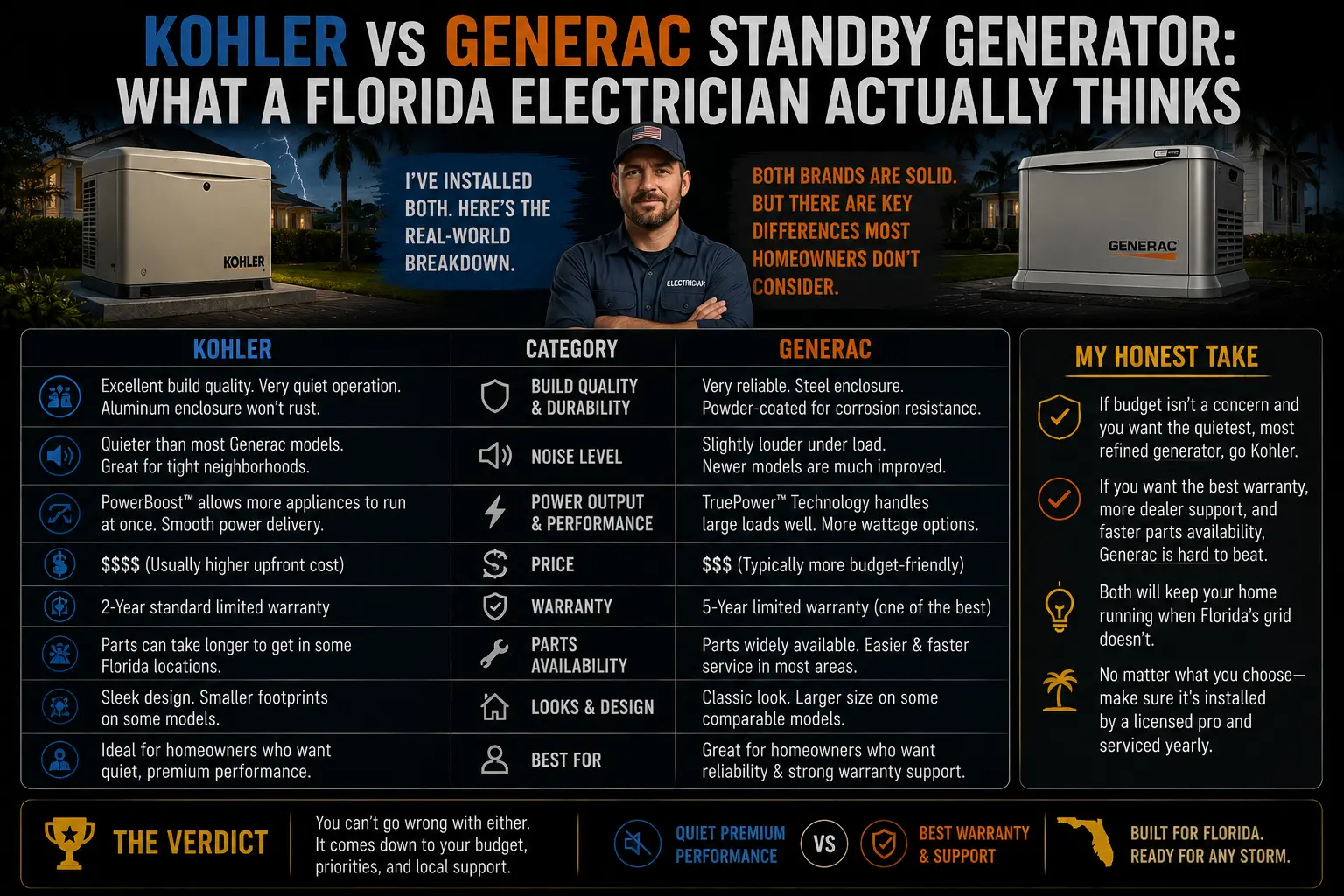
23. That’s how many standby generators Ray has installed in the past 18 months in the Jacksonville area alone. Generac units, Kohler units, a handful of Briggs & Stratton machines he doesn’t recommend anymore. He’s pulled permits on all of them, run gas lines to most of them, and gotten service calls back on some of them.
When I want to know how standby generators perform in the real world — not on spec sheets, not in press releases — I call Ray. He doesn’t have a brand preference in the sales sense. He charges the same labor rate regardless of what you’re putting in. What he has is pattern recognition from 18 months of installs and the follow-up calls that come after.
I’ve been writing about backup power for over a year. Most of that time has been spent on portable power stations — the EcoFlow DELTA Pro, the Anker SOLIX F3800, the Jackery line, and how those options compare to standby generators for the average Florida homeowner. But a meaningful portion of the people who read this site have already decided they want a whole-home standby. They’re not reconsidering the generator question. They just want to know: Kohler or Generac?
Ray has an answer. It’s more nuanced than most people expect.
Two Brands, One Category, Different Philosophies
Before the specifics — it helps to understand where each brand sits in the market.
Generac owns roughly 70% of the residential standby generator market in the United States. They built that market share by being early, being everywhere, and being moderately priced relative to competitors. Their dealer network is vast. If you’re in any mid-sized American metro area, there are multiple Generac-authorized installers within a short drive. Parts are easy to source. Service techs are familiar with the units. That ubiquity is a real advantage.
Kohler is a different kind of company in this category. Kohler has been making engines since 1920 — they have decades of small engine history before they ever got into the generator business. Their residential standby units are premium-positioned: more expensive, more deliberately engineered, and sold through a smaller, more selective dealer network. They’re not trying to match Generac’s volume. They’re trying to match or exceed their reliability at a higher price point.
The question is whether that higher price buys you meaningfully better performance. Ray’s answer: it depends on what you mean by “better.”
The Engine Argument — Where Contractors Actually Disagree
Both brands use air-cooled single-cylinder or V-twin engines in their residential standby lineup. The Generac 22kW uses Generac’s own OHVI (Overhead Valve Industrial) engine — a proprietary design built specifically for generator applications. The Kohler 20kW uses the Kohler Command Pro engine, which descends from a commercial small engine lineage that’s been powering construction equipment and outdoor power products for decades.
The Generac engine argument: purpose-built for generator duty cycles, designed around this specific application, and the engineering team optimizes it specifically for the extended-run, variable-load environment of home standby use.
The Kohler engine argument: proven in commercial applications far more demanding than residential standby use, with decades of iteration behind it.
Ray’s take, which I’m quoting nearly verbatim: “The Kohler engine is just more familiar to me. I know what to expect from it. The Generac engine is fine — I haven’t had bad experiences — but the Kohler Command Pro has a track record that goes back further than Generac’s generator business does.”
That’s a contractor’s opinion, not an engineering test. Worth weighing accordingly.
What’s actually documented: Consumer Reports data on generator reliability shows both brands cluster together in owner-reported reliability surveys, with neither holding a statistically significant edge over multi-year periods. The gap in the field, if it exists, isn’t large enough to show up clearly in survey data.
Transfer Switch: Overlooked, Matters More Than People Think
The transfer switch is the component that automatically disconnects your house from the grid and reconnects you to generator power when an outage occurs. It’s also the component most homeowners know least about.
Generac uses an integrated automatic transfer switch built around their units — the RTSC series for their air-cooled residential line. The integration is clean: one manufacturer, one point of contact for warranty service, one company to call when something doesn’t work. That simplicity has real value.
Kohler’s RXT series automatic transfer switches have been in commercial and residential use for a long time. They’re robust. They’re also a more established design with more field history specifically in the transfer switch category.
Ray’s experience: “Generac transfer switches are fine. I’ve had more nuisance trips on Kohler — the unit detects a brief dip and kicks over when it probably didn’t need to. But I’ve also had fewer actual failures. The Generac integration is genuinely convenient for troubleshooting because you’re dealing with one system.”
Nuisance trips — the generator starting unnecessarily because the transfer switch interpreted a brief voltage fluctuation as an outage — are a minor annoyance rather than a reliability failure. But in neighborhoods with frequent minor grid fluctuations, they add wear-and-tear hours to the engine. Worth knowing if your local grid is unstable.
Remote Monitoring: Both Functional, Neither Outstanding
Generac’s monitoring app is called Mobile Link. Kohler’s equivalent is OnCue. Both give you remote visibility into your generator’s status — last run time, current output, error codes, battery health. Both are competent. Neither is as intuitive as the EcoFlow or Anker app ecosystems — though that’s not a fair comparison, since the portable station apps are built around consumer UX and the standby apps are built around a less frequent use case.
Ray’s office uses Mobile Link for the Generac installs because it integrates with Generac’s dealer portal and makes it easier to pull diagnostic data on customer units remotely. He notes the interface is “fine, not great.” Kohler’s OnCue is similar in scope and similar in its lukewarm usability.
If remote monitoring is a major priority, don’t choose between these brands on app quality. The functional capabilities are equivalent and the interfaces are both unremarkable.
Noise — Kohler’s Underrated Advantage
This one actually matters for neighborhood living.
The Generac 22kW air-cooled unit operates at approximately 67 decibels at 23 feet — about the volume of a normal conversation. Not loud in absolute terms, but generator noise is lower-pitched and more carrying than conversation. In a quiet suburban neighborhood, it’s noticeable.
Kohler’s 20kW unit measures roughly 63–64 decibels at the same distance. The difference between 63 and 67 decibels is perceptible — it’s not just 4 numbers. At 67dB you hear it clearly. At 63dB it fades into background.
For homeowners with close neighbors, HOA sound restrictions, or generators positioned near bedroom windows, that 4-decibel difference is worth knowing. Ray mentions it to clients who ask about placement. Most don’t ask.
Dealer Networks: Generac Wins, and It Matters
Here’s where the Generac advantage becomes concrete.
When your standby generator needs service — annual maintenance, a warranty claim, or an emergency repair — you need someone who can come to you, knows the product, and has parts. Generac’s dealer network is dramatically larger than Kohler’s residential network. In Jacksonville specifically, Ray can name six Generac-authorized service providers. Kohler’s residential standby dealer network is thinner and concentrated in certain markets.
This isn’t a dealbreaker if you’re in a market with strong Kohler representation. But if you’re in a smaller city or a rural area and your Kohler unit has a problem, you may be waiting longer for parts and service than a Generac owner would in the same situation.
“I always ask the customer where they’re buying it from and who’s servicing it,” Ray says. “If the Kohler dealer is 80 miles away, I’m telling them to look at Generac. Parts availability and service response time aren’t features, but they feel like features when your generator is down during a storm.”
Pricing: Real Numbers, Not Brochure Numbers
Based on current Jacksonville market pricing across multiple contractors:
Generac 22kW air-cooled, fully installed: Typical range: $9,400–$13,200. Middle quote: $10,847 (based on my own contractor research from early 2024 — I walked through the full cost breakdown on this unit in a separate post). Variables: distance of gas line run, permit complexity, transfer switch type, local labor rates.
Kohler 20kW air-cooled, fully installed: Typical range: $11,200–$15,400. Middle quote in Jacksonville: approximately $12,600–$13,100.
The installed gap is roughly $1,800–$2,500 for a genuinely comparable setup. Kohler unit prices are higher, and Kohler dealers tend to carry higher labor rates partly because of lower install volume and more selective dealership standards.
Whether that gap is justified comes back to the engine and build quality question — which, as noted above, the reliability surveys don’t clearly resolve in Kohler’s favor.
Annual Maintenance: Neither Brand Gets a Pass
Both units require annual professional service: oil change, oil filter, air filter, spark plug replacement, battery test, and a full system exercise run under load. Typical cost in Florida: $150–$250 per year depending on the contractor.
Both units require the homeowner to remember to schedule this or set up an auto-maintenance program through their dealer. Neither brand automates the reminder in a useful way. Skipping annual maintenance is the most common cause of standby generator failures at exactly the moment they’re needed — and it happens with both brands at roughly equal frequency, according to Ray.
“Generac or Kohler — I don’t care,” he says. “If you don’t do the annual service, you’re rolling dice. I’ve seen three-year-old Generacs fail in outages because they hadn’t been touched. I’ve seen eight-year-old Kohlers run perfectly because the owner kept up on maintenance. The brand is less important than the maintenance.”
What Ray Would Actually Install
At his own house. No brand preference, no sales incentive, straight question.
“Kohler. But I’d make sure the dealer was close and their service response time was solid. If the Kohler situation locally wasn’t good, I’d go Generac without hesitation.”
His reasoning: he prefers the Kohler engine’s pedigree and the slightly quieter operation. He trusts the Generac transfer switch integration. For a homeowner who’s in a market without strong Kohler dealer support, he calls it even and recommends Generac on the strength of the service network.
For the homeowner trying to decide: both are legitimate choices at the top of the residential standby category. The Kohler costs more and is quieter with a strong engine reputation. The Generac costs less, has a larger service network, and performs at essentially the same reliability level by every published measure. If the Kohler dealer in your area is reputable and close, it earns its premium. If you’re in Kohler dealer no-man’s-land, Generac is the straightforward answer.
Either way — get three installer quotes, check their permit history with your county, and schedule that annual service before you need the generator.
Side by Side
| Generac 22kW | Kohler 20kW | |
|---|---|---|
| Engine | Generac OHVI (proprietary) | Kohler Command Pro (commercial lineage) |
| AC Output | 22kW | 20kW |
| Noise level | ~67 dB at 23 ft | ~63–64 dB at 23 ft |
| Transfer switch | Generac RTSC (integrated) | Kohler RXT series |
| Remote monitoring | Mobile Link app | OnCue app |
| Dealer network | Very large (nationwide) | Selective/smaller |
| Warranty | 5 years | 5 years |
| Typical installed cost | $9,400–$13,200 | $11,200–$15,400 |
| Annual service required | Yes (~$150–$250) | Yes (~$150–$250) |
| Ray’s pick | Second choice | First choice* |
*With strong local dealer support. Without it: Generac.

Lived through four major grid outages since 2021 — including Hurricane Ian (2022) and Helene (2024). Spent over $6,200 testing portable power stations and comparing them against whole-home standby generators before finding a setup that actually works. Not an electrician. Not sponsored by anyone. Just a homeowner who got it wrong the first time and documented everything the second time.
Why I started this blog: I wasted $3,400 on the wrong power station during Ian prep and I couldn’t find a single blog that gave me real runtime numbers — not the ones printed on the box. I decided to test everything myself and write it down.
What I do: I run real-world runtime tests on portable power stations and standby generators. I track how long they actually power a fridge, window AC, CPAP, and phone chargers — not under ideal lab conditions, but during Florida summers with actual loads. I compare real purchase prices, warranty experiences, and manufacturer support against what homeowners actually need after a storm.