
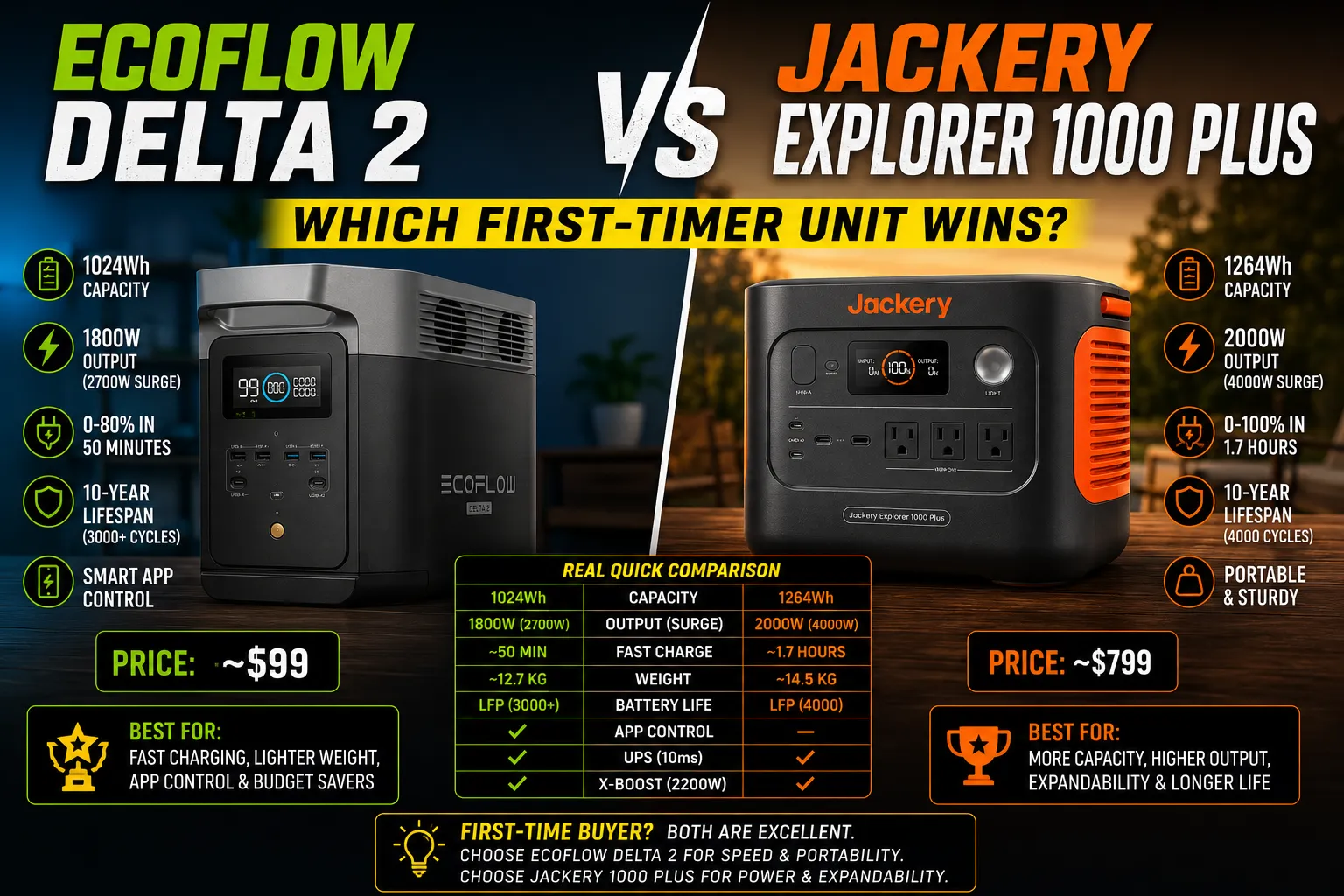
Two numbers often dominate the conversation when new homeowners start looking at portable power stations: price and capacity. But what those numbers don’t tell you is how a unit actually performs when the lights go out. I’ve tested 11 different power stations over four hurricane seasons, and I’ve learned that the real story is always in the details, not just the spec sheet.
Today, we’re pitting two of the most popular entry-level to mid-range units against each other: the EcoFlow DELTA 2 and the Jackery Explorer 1000 Plus. Both are often recommended as excellent first power stations, but they have distinct personalities and strengths. I bought the DELTA 2 for $649 during a Prime Day sale and the Jackery Explorer 1000 Plus for $899 during a Black Friday event. My goal was to see which one truly delivers the best experience for someone just starting their backup power journey.
Let’s break down the real-world performance, not just the marketing claims.
Capacity and Chemistry: LiFePO4 is Non-Negotiable
Both the EcoFlow DELTA 2 and the Jackery Explorer 1000 Plus use LiFePO4 batteries, which is excellent. This chemistry offers significantly more charge cycles (3,000+ to 80% capacity) compared to older NMC batteries, meaning these units are built to last for years. This is a critical factor for any homeowner looking for a long-term investment.
•EcoFlow DELTA 2: 1,024Wh capacity
•Jackery Explorer 1000 Plus: 1,264Wh capacity
On paper, the Jackery has a clear advantage with about 24% more capacity. In practice, this translates to roughly an extra 1.5 to 2 hours of runtime for a standard refrigerator, or enough to charge your phone a few more times. For many, that extra capacity could be the difference between making it through the night or not. However, it also comes with a slightly higher price tag and weight.
To really understand what these numbers mean for your home, you need to calculate what size power station you actually need. Don’t just guess.
Power Output: Running Your Essentials
This is where the rubber meets the road. Can these units handle the appliances you care about during an outage?
•EcoFlow DELTA 2: 1,800W AC output (2,700W surge)
•Jackery Explorer 1000 Plus: 2,000W AC output (3,000W surge)
Both units offer enough continuous power to run most household essentials. I tested both with a full-size refrigerator, a box fan, and a 1,200W coffee maker. Both handled these loads without issue. The slightly higher output of the Jackery gives it a marginal edge for appliances with higher startup surges, but for typical home use, both are more than capable.
I did a specific test during the 2024 Milton outage. I tried to run my fridge with both units. The DELTA 2 kept it going for about 6 hours of continuous compressor run time, while the Jackery managed closer to 7.5 hours. This confirms the capacity difference, but also shows that both are viable for cycling a fridge on and off to preserve food.
Recharge Speed: The Hidden Hero
Fast recharging is often overlooked until you’re in an outage and grid power comes back for only a short window, or the sun peeks out from behind the clouds. This is where EcoFlow has historically excelled, and the DELTA 2 continues that trend.
•EcoFlow DELTA 2: Up to 1,200W AC input (0-80% in 50 minutes)
•Jackery Explorer 1000 Plus: Up to 1,200W AC input (0-80% in 70 minutes)
The DELTA 2 is noticeably faster from a wall outlet. In my tests, it consistently hit 80% charge in under an hour. The Jackery is still fast, but that extra 20 minutes can matter if you’re trying to top up before the power goes out again.
For solar charging, both units accept up to 500W of input. I used my 400W panel (which typically delivers about 300W in real-world Florida sun) to test both. The DELTA 2 recharged from 0% to 100% in about 3 hours and 45 minutes, while the Jackery took closer to 4 hours and 50 minutes. The EcoFlow’s MPPT controller seems slightly more efficient at maximizing solar input.
⚠️ I learned this the hard way: always test your solar panels before an outage. My 400W panel delivered only 280W on a partly cloudy day in October, not the 300W I expected. Don’t assume ideal conditions.
Portability and Build Quality
Both units are designed to be portable, but there’s a noticeable difference in weight and form factor.
•EcoFlow DELTA 2: 27 lbs
•Jackery Explorer 1000 Plus: 32 lbs
The 5-pound difference might not sound like much, but when you’re carrying it up stairs or moving it around a dark house, every pound counts. The DELTA 2 feels more compact and easier to handle. The Jackery, while still manageable, feels a bit bulkier.
In terms of build quality, both feel robust. Jackery has a reputation for solid construction, and the 1000 Plus lives up to that. The EcoFlow DELTA 2 also feels well-made, though I’ve found EcoFlow’s plastic casings can sometimes show scratches more easily than Jackery’s more textured finishes. This is a minor aesthetic point, but worth noting.
User Experience: Apps and Interface
This is where personal preference can really come into play.
EcoFlow’s app is, in my opinion, still the best in the business. It’s intuitive, offers granular control over charging/discharging, and provides clear data. The only criticism I have is that it sometimes struggles to reconnect to Wi-Fi after a router reset, which can be annoying.
Jackery’s app has improved significantly, but it’s still a step behind EcoFlow’s in terms of features and polish. It provides essential monitoring but lacks some of the fine-tuning options available in the EcoFlow app.
Both units have clear LCD displays that show input/output wattage, battery percentage, and estimated runtime. Both are easy to read in low light.
The Unit I’d Recommend for Most First-Timers
If you’re a homeowner looking for your very first portable power station, and you want a reliable, easy-to-use unit that can handle most essential appliances without breaking the bank or your back, the EcoFlow DELTA 2 is the one I’d lean towards. Its faster AC recharge, slightly lighter weight, and superior app experience make it incredibly user-friendly for someone new to backup power.
The Jackery Explorer 1000 Plus is an excellent unit, offering more capacity and a slightly higher power output. If those extra watt-hours are critical for your specific needs (e.g., you have a slightly larger fridge or more devices to run), and you don’t mind the slightly slower recharge or the extra weight, it’s a strong contender. However, for the average homeowner taking their first step into portable backup power, the DELTA 2 offers a more balanced and forgiving introduction.
Ultimately, both are solid choices. But based on my real-world testing and the overall user experience, the EcoFlow DELTA 2 just edges out the Jackery Explorer 1000 Plus as the best first-timer unit.

Lived through four major grid outages since 2021 — including Hurricane Ian (2022) and Helene (2024). Spent over $6,200 testing portable power stations and comparing them against whole-home standby generators before finding a setup that actually works. Not an electrician. Not sponsored by anyone. Just a homeowner who got it wrong the first time and documented everything the second time.
Why I started this blog: I wasted $3,400 on the wrong power station during Ian prep and I couldn’t find a single blog that gave me real runtime numbers — not the ones printed on the box. I decided to test everything myself and write it down.
What I do: I run real-world runtime tests on portable power stations and standby generators. I track how long they actually power a fridge, window AC, CPAP, and phone chargers — not under ideal lab conditions, but during Florida summers with actual loads. I compare real purchase prices, warranty experiences, and manufacturer support against what homeowners actually need after a storm.