
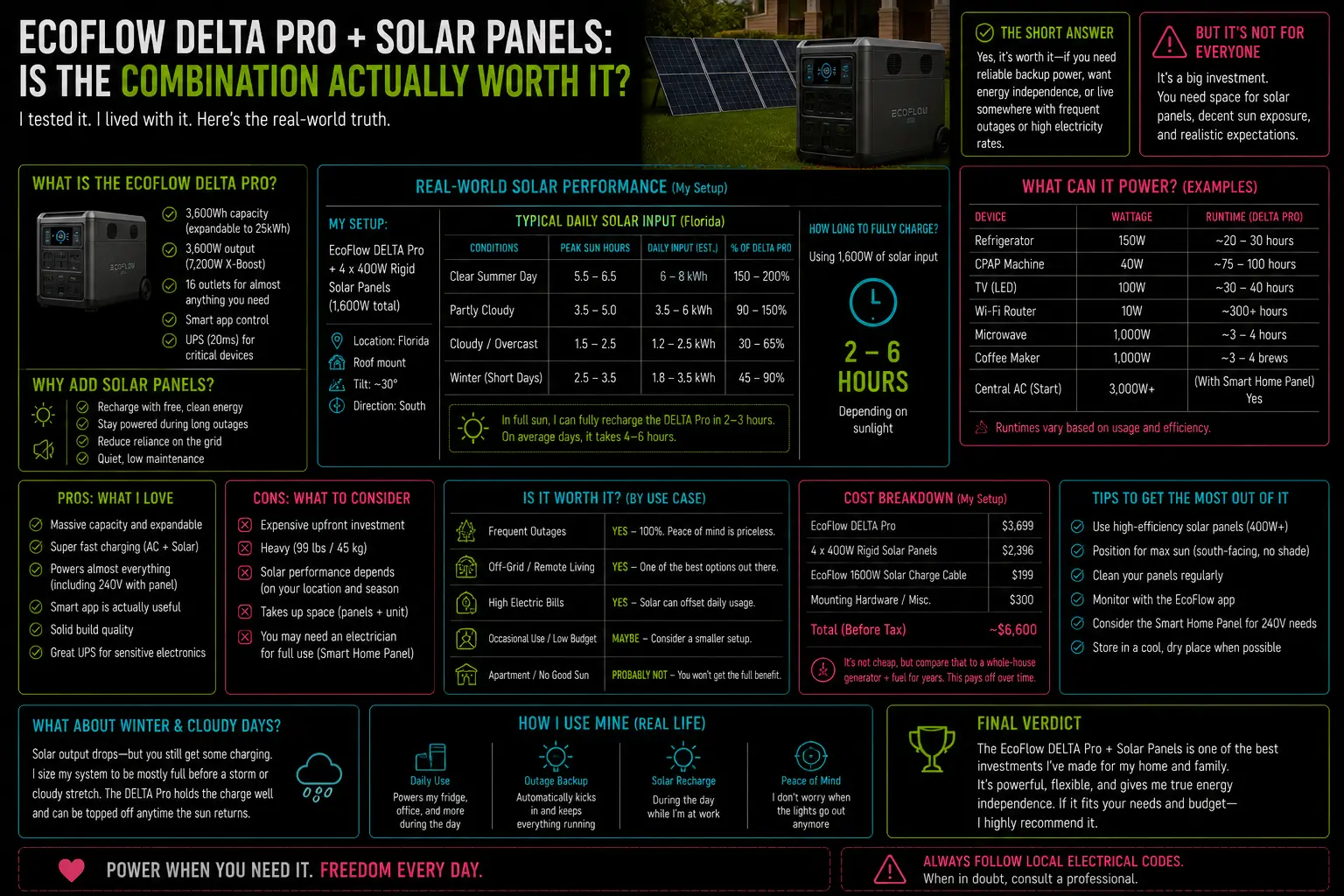
Yes. But not for the reason most people expect, and not at every price point.
The solar panel question comes up constantly — usually from someone who just bought a DELTA Pro and is wondering if the $350–$400 for a 220W panel is worth adding. Chris asked me this almost word for word. He’d bought the DELTA Pro for Austin storm prep after the 2021 freeze, and solar felt like the logical next step. His hesitation: Texas is cloudy during winter events, which is exactly when he needs the backup power.
He’s right about that. And it’s the key nuance in this answer.
What Solar Actually Recovers — Real Numbers, Not Rated Output
The EcoFlow DELTA Pro accepts up to 1,600W of solar input. A single 220W panel doesn’t get anywhere near that ceiling — it’s one-seventh of the max input. But one panel is a meaningful start.
Real-world recovery numbers from my Jacksonville setup in the two most recent storm seasons:
Clear Florida summer day, 220W panel, 5-hour peak window:
- Actual input: 155–185W average (panels rarely hit nameplate output — temperature derating, angle, atmospheric haze)
- Wh recovered: approximately 800–900Wh
Overcast post-storm day (20–40% cloud cover), same panel:
- Actual input: 40–70W average
- Wh recovered: approximately 200–350Wh
Heavy cloud cover / storm day:
- Actual input: 10–25W
- Wh recovered: approximately 50–120Wh — essentially negligible for planning purposes
The honest conclusion: solar is a reliable daily recharge tool during normal weather and a weak contributor during the storm itself. For Florida summer outages — which usually occur in largely clear weather after the storm passes — one 220W panel recovers roughly 25% of a DELTA Pro’s full capacity per day. Two panels gets you to 50%. That’s the difference between one-night coverage and multi-day looping capability.
⚠️ Heat note, specific to Florida: In August, the surface of a dark-framed solar panel in direct sun hits 140–160°F. I know this because I grabbed one bare-handed while adjusting the angle after setup and immediately wished I hadn’t. Handle panels with gloves during setup in summer. The frame edges get sharp and the surface temperature is genuinely surprising. I have a small scar on my right palm that reminds me of this every time I look at it. Gloves. Every time.
For Texas: The Calculation Changes
Chris’s concern — solar is less useful during winter freeze events — is valid.
During a cold, overcast Texas February, solar recovery is minimal. A panel under snow produces nothing until cleared. A panel on a cloudy 20°F day produces a fraction of its rated output. If the event you’re preparing for is a repeat of Uri — multi-day, overcast, extreme cold — solar panels don’t contribute meaningfully to your backup strategy.
In that case, the money is better spent on a second battery (the DELTA Pro Smart Extra Battery at $1,699) than a solar panel. The second battery doubles your stored capacity without depending on weather conditions you can’t control.
Chris ended up doing both eventually: battery first for winter resilience, panel added later for summer storm season. That’s the right order for a Texas homeowner.
For Florida homeowners, the order flips — panel first because summer storm recovery windows are usually sunny, battery second if extended coverage is needed.
My Honest Answer After Two Seasons
The EcoFlow DELTA Pro + 220W solar panel combination earns its cost if:
- You’re in a region with predictable post-storm sun (Florida, Southeast generally, California)
- You want multi-day coverage without depending entirely on grid return
- You have a place to angle the panel toward the south with minimal shading
It’s less compelling if:
- Your primary risk is a winter freeze event (Texas, Midwest, Mountain West)
- You have limited outdoor space or significant roof/tree shading
- Your outages typically resolve within 24–36 hours (one full charge is usually sufficient)
The panel itself — EcoFlow’s 220W rigid panel — is well-built, weathers outdoor exposure without degrading badly, and integrates cleanly with the DELTA Pro’s MC4 input. The foldable versions are more convenient to store but slightly less efficient. I use the rigid panel because I have a spot for it. If storage is tight, the foldable version is worth the minor efficiency trade.
Start with the battery. Add the panel when the budget allows. In that order.

Lived through four major grid outages since 2021 — including Hurricane Ian (2022) and Helene (2024). Spent over $6,200 testing portable power stations and comparing them against whole-home standby generators before finding a setup that actually works. Not an electrician. Not sponsored by anyone. Just a homeowner who got it wrong the first time and documented everything the second time.
Why I started this blog: I wasted $3,400 on the wrong power station during Ian prep and I couldn’t find a single blog that gave me real runtime numbers — not the ones printed on the box. I decided to test everything myself and write it down.
What I do: I run real-world runtime tests on portable power stations and standby generators. I track how long they actually power a fridge, window AC, CPAP, and phone chargers — not under ideal lab conditions, but during Florida summers with actual loads. I compare real purchase prices, warranty experiences, and manufacturer support against what homeowners actually need after a storm.