
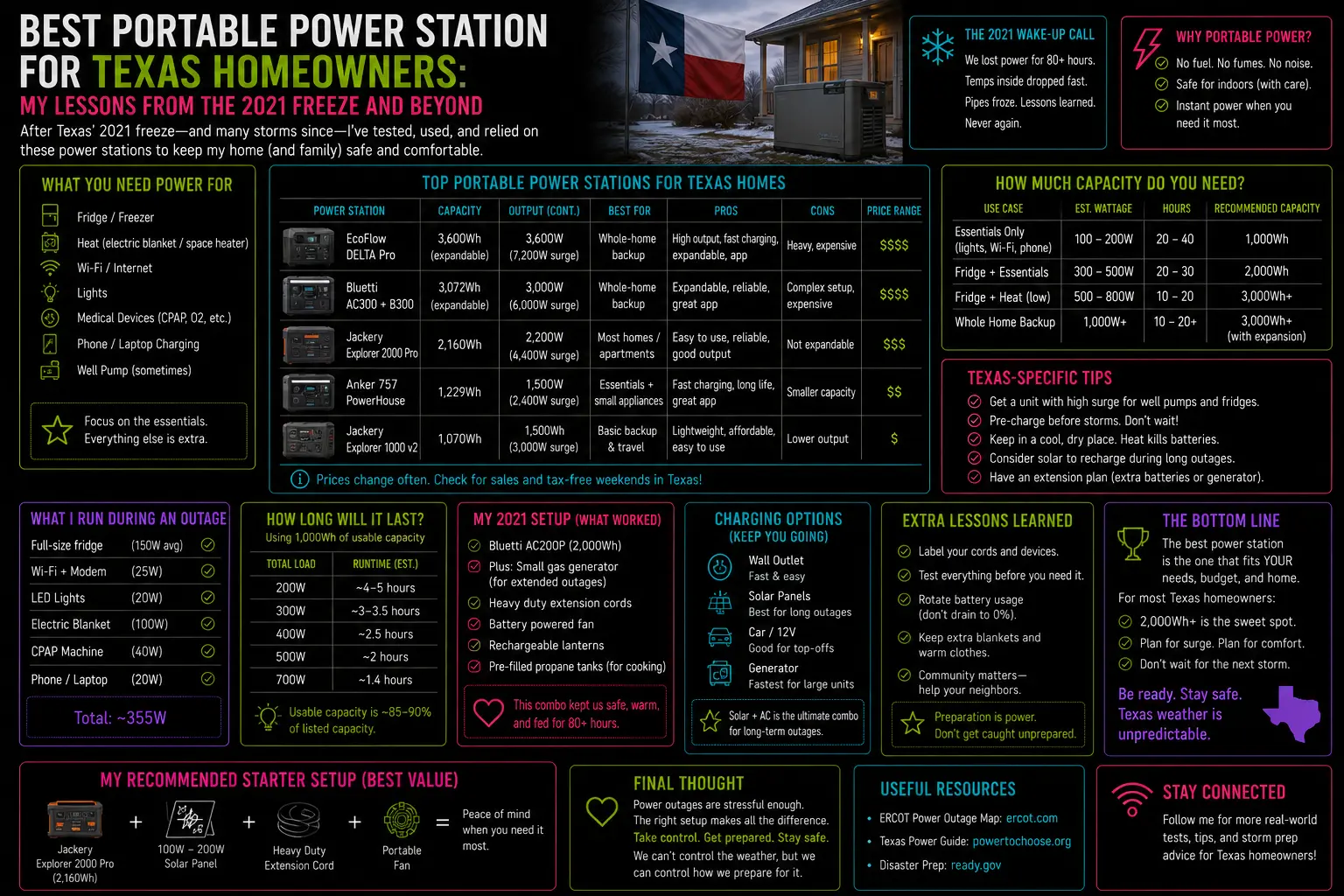
4.5 million. That’s how many Texas homes and businesses lost power during Winter Storm Uri in February 2021. According to the Texas Comptroller’s impact analysis, 69% of Texans lost power at some point during the February 14–20 event. Some for hours. Many for days. A significant number for the entire seven-day span.
At least 246 people died as a result of the storm. A disproportionate share of those deaths were from carbon monoxide poisoning — people running gas generators, gas grills, and propane heaters inside their homes or attached garages in an attempt to stay warm. Not from the cold directly. From trying to solve the cold with equipment that produces lethal gas in enclosed spaces.
That fact shapes everything about this post. Because when I write about backup power for Texas homeowners, the threat model is different from Florida. Florida homeowners are dealing with summer heat and tropical storms. Texas homeowners are dealing with a grid that has shown it can fail in winter, when the consequences of losing heat — and of improvised heating solutions — are categorically more dangerous.
I want to be specific about what works, what doesn’t, and what has already killed people.
The 2021 Freeze: What Actually Happened
The 2021 Texas power crisis was a cascading grid failure driven by simultaneous generation failures across natural gas, wind, and nuclear sources — all affected by the extreme cold in ways that Texas infrastructure wasn’t winterized to handle. The Electric Reliability Council of Texas (ERCOT) came within minutes of a complete grid collapse that, by some estimates, could have left Texas without power for months.
The median outage duration for customers who lost power was approximately 42–49 hours. That number obscures the spread — some people were out for less than a day, others for the full week.
What killed people wasn’t usually the grid failure itself. It was:
- Carbon monoxide from indoor generator and grill use
- Hypothermia in homes that lost heat without adequate backup
- Pipe bursts causing flooding and water damage that complicated recovery
Any backup power strategy for Texas has to account for all three failure modes — not just the power question.
Carbon Monoxide: The Rule That Has No Exceptions
Before any product discussion: this is non-negotiable.
Gas generators, propane generators, gasoline-powered inverter generators, charcoal grills, propane heaters not designed for indoor use — none of these belong inside your home, garage, or any enclosed or semi-enclosed space. A garage with the door cracked is not sufficient ventilation. A running generator 10 feet from an open window can still produce lethal CO concentrations inside within 30 minutes depending on wind direction.
Carbon monoxide is colorless and odorless. You don’t smell it. You don’t see it. The first symptoms — headache, dizziness, nausea — feel like flu symptoms, which makes people slow to connect the source. By the time someone realizes what’s happening, they may lack the coordination to move themselves to safety.
According to the CDC, CO poisoning kills approximately 400 Americans per year in non-fire incidents. In the weeks following Storm Uri, Texas saw a spike in CO hospitalizations that overwhelmed some ERs alongside the already-stressed healthcare system.
This is why portable battery-based power stations are a categorically different safety profile than gas generators for indoor use. An EcoFlow DELTA Pro, a Jackery Explorer, an Anker SOLIX — these produce zero combustion emissions. They can run safely inside your bedroom, living room, or wherever you need power. No ventilation required.
⚠️ Personal note: A friend in Austin — Chris — told me about his neighbor during Uri. The neighbor ran a gas generator in the garage with the door partially open. He was found by his wife the next morning, non-responsive. He survived, but was hospitalized for three days. Chris bought a battery-based portable power station two weeks after that conversation and has not looked back. There is no version of “just this once” that’s worth the risk.
This isn’t a marginal concern. It’s the central safety point for any Texas winter power backup conversation.
The Cold-Weather Performance Issue Nobody Mentions
Battery-based power stations have one significant cold-weather limitation that doesn’t show up in Florida hurricane discussions: lithium batteries lose capacity in cold temperatures.
The chemistry behind this is straightforward — at low temperatures, the chemical reactions inside the battery slow down, reducing both available capacity and charge acceptance. The practical effect: a unit rated at 3,600Wh at 77°F may deliver only 75–85% of that capacity at 32°F, and discharge curves shift so the unit reports more remaining charge than it actually has.
The 2021 freeze brought temperatures to 0°F and below in parts of Texas. At those temperatures, an unprotected power station sitting in a garage or on a porch loses significant capacity — and may not charge at all from solar until the unit warms up.
What this means for Texas-specific setup:
- Store the power station indoors. Not in the garage. In your living space, where temperatures stay above 40°F even when the heat fails temporarily.
- If using solar panels outdoors (for recharge), bring the unit inside to charge — run a cable through a window pass-through rather than leaving the unit outside.
- Check your specific unit’s operating temperature range before buying. Most quality units (EcoFlow, Anker, Jackery) are rated for discharge down to -4°F to 14°F, but charge temperature minimums are often higher — typically 32°F to 41°F minimum for charging.
⚠️ Specific caution: Do not place a cold power station (one that’s been sitting in a 20°F space) directly on charging and expect normal behavior. Let it warm up to room temperature first — typically 30–60 minutes inside before plugging in. A cold lithium battery forced into rapid charge can develop internal stress. I’ve done this wrong once — brought a unit in from a cold car trunk, plugged it straight in, and watched it charge at roughly 40% of its normal rate for the first hour before normalizing. Not dangerous, but a good illustration of the operating envelope.
What Size Do You Actually Need for a Texas Winter Event?
The critical difference from Florida: heating loads. A Florida backup power system is sized around a refrigerator and some lights, with AC as a possible add-on. A Texas winter backup system needs to address heating.
Electric space heaters — the small portable kind — are real candidates for battery power. A 1,500W space heater (standard size) running continuously drains a 3,600Wh DELTA Pro in approximately 2.4 hours. That’s not a sleep-through-the-night solution on its own.
The math is better if you use a smaller, lower-wattage heater efficiently:
- A 750W space heater (half-power setting on most models): roughly 4.8 hours from a DELTA Pro
- A 500W infrared panel heater: roughly 7.2 hours from a DELTA Pro
- A 200W heating pad or electric blanket (low setting): 18 hours from a DELTA Pro
The most energy-efficient cold-weather survival strategy on battery power: Focus heat on the person, not the room. An electric blanket at 50–100W keeps one person warm through the night for less than 500Wh. That’s four to six times more efficient per person-hour-warm than a 1,500W space heater trying to heat a room.
During Uri, households who stayed warm most efficiently were often the ones who gathered everyone into one room, put the smallest space heater on a timer, and layered blankets. The battery power went a lot further under those conditions.
Run the actual sizing calculation for your household with these numbers. Heating load is the biggest difference from a summer-oriented backup plan.
Which Units for Texas Specifically
EcoFlow DELTA Pro (3,600Wh) — the most capable single-unit option. 3,600W output handles a space heater at half-power (750W) for 4+ hours, all device charging, refrigerator, and lighting simultaneously. The expansion battery doubles capacity to 7,200Wh — at electric blanket draw, that’s 14+ hours of consistent warmth without solar. During a Texas freeze with limited solar access (overcast, snow-covered panels), the larger battery is meaningfully better.
EcoFlow DELTA 2 Max (2,048Wh) — a strong mid-range option if the DELTA Pro budget is out of reach. At 2,048Wh with a 750W heater, you get about 2.5 hours of space heating plus full overnight coverage of refrigerator, CPAP, and devices. Not a multi-night heating solution without recharge, but functional for a 24–36 hour event.
Jackery Explorer 2000 Plus (2,042Wh) — comparable capacity to the DELTA 2 Max. The cold-weather operating specs are slightly different (check your specific model). The Jackery handles low temperatures reasonably well when stored indoors. I’ve had no performance issues with it down to 45°F ambient.
Units I’d skip for Texas winter specifically: The Anker SOLIX C1000 (1,056Wh) is excellent for a Florida setup but undersized for meaningful winter heating. You can run electric blankets off it effectively, but space heater use will drain it too quickly to be reliable for multi-night events.
Pipe Bursts: The Third Risk
Uri’s lasting damage came heavily from frozen pipes. When pipes burst, water enters walls and floors — and if any electrical equipment is on the floor in an affected area, you have a secondary hazard to manage.
Keep your power station elevated during a freeze event. Not on the floor in a kitchen or bathroom that might see water from a pipe burst or ice dam leak. A table, a shelf, somewhere off the floor.
⚠️ This is not hypothetical: I’ve heard from two Texas homeowners who lost backup equipment to water damage — in both cases, burst pipes released water into spaces where the power station was sitting on the floor. Neither unit was a fire hazard, but both were destroyed. Position matters during freeze events.
The Propane Question
Many Texas homeowners added portable propane heaters after 2021. These are legitimate indoor-safe options if used correctly — specifically units rated for indoor use, like the Mr. Heater Buddy series, which have oxygen depletion sensors that shut the unit off if CO builds up.
Even with an indoor-rated propane heater: ventilate. Crack a window slightly. Never run any combustion device in a completely sealed space. The oxygen depletion sensor is a safety net, not a permission slip.
Store propane outdoors. Propane tanks should never be stored inside — not in the garage, not in the basement. Outside only.
A portable propane heater paired with a battery-based power station for devices, lighting, refrigerator, and CPAP is a reasonable Texas winter strategy. The propane handles spot heating where you need it. The battery handles everything that can run electrically without combustion.
What to Have Before the Next Event
The ERCOT grid has been weatherized in some ways since 2021, but not completely. Texas still experiences winter events. The infrastructure remains under pressure. Assuming 2021 was a once-in-a-generation event is a risk calculation that a significant number of grid engineers don’t agree with.
What I’d tell a Texas homeowner to have ready before winter:
- EcoFlow DELTA Pro or DELTA 2 Max — stored indoors year-round, not in the garage. Charged to 80% and maintained.
- Electric blankets — one per person in the household, low-wattage and efficient.
- A Mr. Heater Buddy or equivalent indoor-rated propane heater — with propane stored outside, with a window cracked during use.
- A carbon monoxide detector — battery-powered, with fresh batteries checked in October. Not negotiable. This has saved lives.
- Frozen water bottles in the chest freezer — thermal mass for food preservation and emergency water.
- A hand-crank weather radio — Texas cell towers were overwhelmed during Uri. The weather radio was more reliable.
For which power stations I’ve tested across the range and the standby generator comparison if you’ve decided portable isn’t enough — both are worth reading before you commit to any setup.
The 2021 freeze was preventable in its severity. The next event won’t be. The window to prepare is always the time between the last one and the next one — which is exactly now.

Lived through four major grid outages since 2021 — including Hurricane Ian (2022) and Helene (2024). Spent over $6,200 testing portable power stations and comparing them against whole-home standby generators before finding a setup that actually works. Not an electrician. Not sponsored by anyone. Just a homeowner who got it wrong the first time and documented everything the second time.
Why I started this blog: I wasted $3,400 on the wrong power station during Ian prep and I couldn’t find a single blog that gave me real runtime numbers — not the ones printed on the box. I decided to test everything myself and write it down.
What I do: I run real-world runtime tests on portable power stations and standby generators. I track how long they actually power a fridge, window AC, CPAP, and phone chargers — not under ideal lab conditions, but during Florida summers with actual loads. I compare real purchase prices, warranty experiences, and manufacturer support against what homeowners actually need after a storm.