
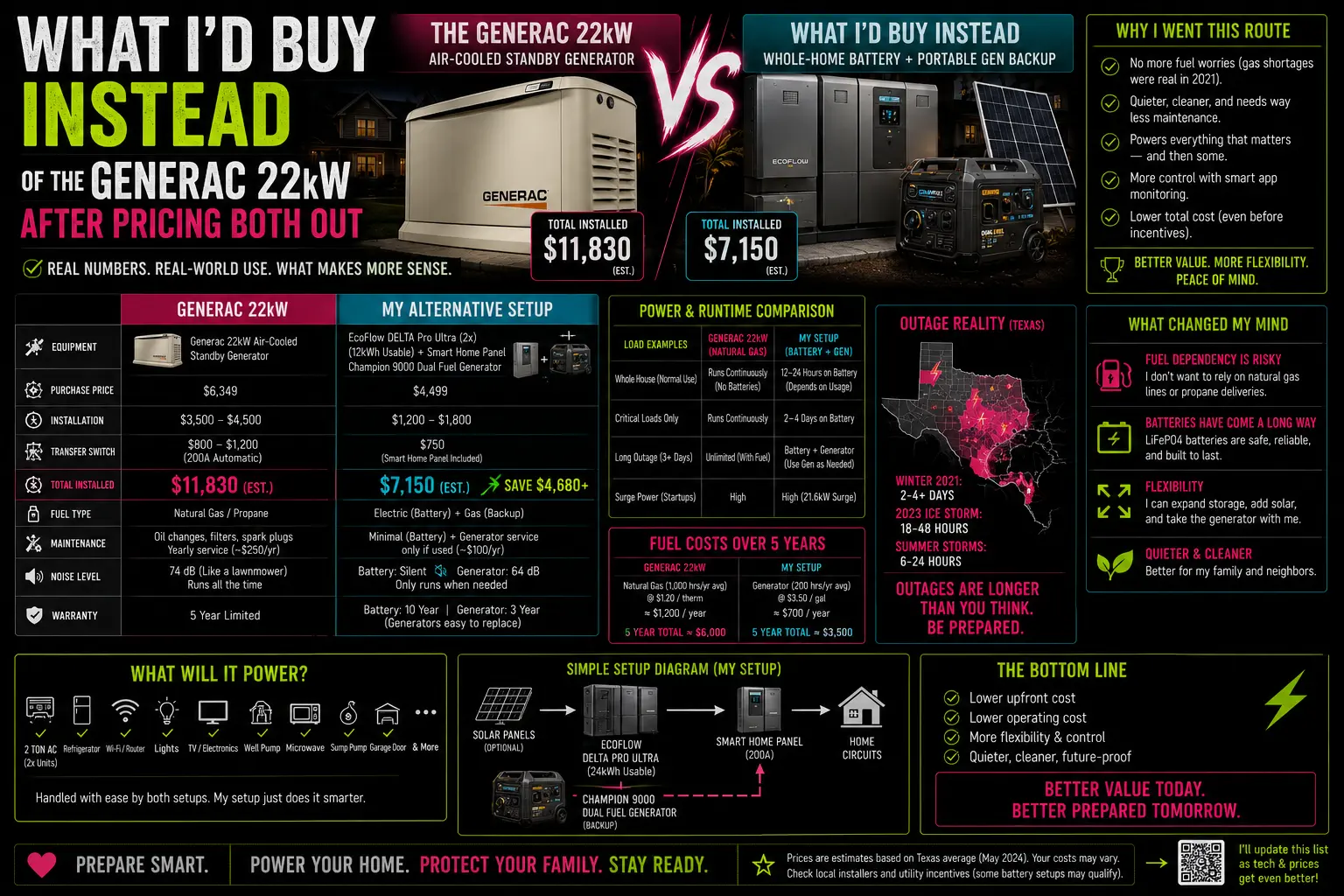
Hey, quick note — this one should’ve gone up before my Generac vs EcoFlow and Kohler vs Generac posts, but it got lost in the scheduling shuffle, so here it is now.
$10,847. That’s what a Generac 22kW air-cooled standby generator would have cost me, installed, at the middle quote of three I got from Jacksonville contractors in early 2024. That included the transfer switch, running gas line twelve feet to the install location, permits, inspection, and labor. Not the highest quote I received ($13,200) and not the lowest ($9,400, from a contractor I had questions about). The middle.
I got those quotes for one reason: I wanted to know exactly what I’d be saying no to when I chose not to buy one. It’s easy to say a portable power station is the smarter buy when you’re vaguely aware that generators are “expensive.” It’s a different kind of clarity when you have three pieces of paper on your kitchen table with actual numbers on them.
Here’s what I found when I put that $10,847 into a portable power setup instead — and what I’d tell Donna, who called me last month after her HOA started offering bulk-rate deals on Generac installations to residents.
The Generac’s Honest Case
Before the alternative — let’s be fair to what that $10,847 actually buys.
A Generac 22kW standby is a legitimate whole-home solution. It powers everything: central HVAC, electric range, well pump, every outlet in the house, simultaneously and automatically. When the grid drops, it starts within 10–30 seconds — you don’t touch anything. It runs on natural gas, which means no fuel storage, no refill logistics, no running out during a multi-day event as long as your gas service holds.
For the right homeowner, it’s the right answer. I covered the core differences between a Generac and a portable power station in an earlier post, and why most homeowners don’t actually need a whole-home standby in another. The case for the Generac is real. I just don’t think it applies to most single-family homeowners in Florida and the Carolinas whose primary concern is storm-season grid reliability.
With that said — here’s what that money builds instead.
Building the Alternative: Phase by Phase
I didn’t design this as one purchase. The power of the portable approach is that you can build it in stages, use it and learn from it, and expand from a position of experience rather than anxiety.
Phase 1 — Core Backup (~$3,200)
EcoFlow DELTA Pro: $2,499 on sale (Black Friday or major seasonal promotion — I’ve never seen it stay at full retail for more than a few weeks at a stretch)
2× EcoFlow 220W rigid solar panels: $700–$800 depending on current pricing
Basic mounting hardware and cabling: ~$120
Running total: ~$3,300–$3,400
This covers: fridge for 14–15 hours per charge, CPAP all night, LED lighting in three rooms, all device charging. In Florida summer with two panels delivering real-world input of 320–370W on clear days, you can loop through a 48-hour outage — one full charge overnight, solar recovery the next day, repeat.
That’s the setup I actually have. I’ve run three outages through it with no real stress. Donna bought almost exactly this configuration after watching me use it through the June 2024 outage and realizing the DELTA 2 Max she’d bought wasn’t quite enough for her needs.
Phase 2 — Expanded Overnight Coverage (~$1,700 more)
EcoFlow DELTA Pro Smart Extra Battery: $1,699
This doubles the base capacity from 3,600Wh to 7,200Wh. Under the same critical overnight load — fridge, CPAP, lights, charging — that’s 28–30 hours of coverage without touching a solar panel. A full day and night. At this point you’re genuinely through a 48-hour storm event on one charge with real margin left over.
Running total through Phase 2: ~$5,000–$5,100
Still $5,700 below the Generac quote.
Phase 3 — Window AC and Heavy-Load Capability (~$1,500 more)
Third solar panel (220W): $350–$400
EcoFlow Smart Home Panel 2: $1,149
The third panel pushes real-world solar input to roughly 520–560W on clear days, which means faster daytime recovery and more room to run a window AC unit during daylight hours without depleting the overnight reserve.
The Smart Home Panel 2 isn’t required — you can plug appliances directly into the DELTA Pro. But it allows the system to automatically manage which home circuits receive power when the grid is down, removing the need to manually switch plugs during a stressful outage situation. It’s the closest thing to the Generac’s “automatic” behavior in the portable world.
Running total through Phase 3: ~$6,500–$6,700
Still $4,100 below the Generac. Still no annual maintenance contract. Still zero fuel logistics.
What the Remaining ~$4,000 Does
Here’s where the comparison gets interesting.
After building out Phase 3 — a 7,200Wh battery system with 660W of solar input and semi-automatic home circuit management — there’s roughly $4,000 remaining from that original Generac quote. That money can do real things.
A standalone 8,000 BTU window AC unit for the primary bedroom: $250–$350. Dedicated, efficient, sized appropriately for one room rather than trying to cool an entire house through central air during a storm. This is how most people actually use AC during an outage — one room, close the door, stay comfortable.
A 7 cubic foot chest freezer: $200–$300. Run it alongside the existing fridge. On a fully charged 7,200Wh system, both can run overnight. Fill the chest freezer with water bottles frozen solid before storm season — they serve as thermal mass that extends food safety even when the freezer isn’t running.
A second EcoFlow unit (DELTA 2 or DELTA 2 Max) for a family member or a backup charging station: $700–$900. Donna ended up doing exactly this — she kept her DELTA 2 Max and bought a smaller unit for her parents in Clearwater. Two households covered from one buying decision.
The remaining $2,000+: Savings. Or the start of an actual whole-home solar installation if that’s where your energy journey is heading.
Where the Generac Still Wins
Worth saying, because the honest version of this comparison requires it.
If you have a well pump, the Generac is the better answer. Well pumps draw significant startup current and run continuously — not a good fit for portable battery systems at this price tier.
If you need your central HVAC running during a multi-day outage — not a window unit, the actual central system — the Generac handles that cleanly and the portable setup doesn’t.
If automatic whole-home restoration with no manual steps is non-negotiable, the Generac is the only realistic answer.
For everyone else doing the math honestly — which is most Florida and Carolina homeowners buying for storm season — the portable system wins on cost, flexibility, maintenance burden, and scalability.
The Exact Setup I’d Build
For a homeowner who got that Generac quote and wants a concrete alternative:
| Item | Approximate Cost |
|---|---|
| EcoFlow DELTA Pro | $2,499 |
| 3× 220W solar panels | $1,050 |
| DELTA Pro Smart Extra Battery | $1,699 |
| EcoFlow Smart Home Panel 2 | $1,149 |
| Mounting hardware + cables | $150 |
| 8,000 BTU window AC | $300 |
| Total | ~$6,850 |
Savings vs. the middle Generac quote: approximately $4,000. No installation contractor needed. No annual service contract. No propane tank. No moving parts outside of the cooling fan.
That’s what I’d build. That’s what I’d spend the rest on.

Lived through four major grid outages since 2021 — including Hurricane Ian (2022) and Helene (2024). Spent over $6,200 testing portable power stations and comparing them against whole-home standby generators before finding a setup that actually works. Not an electrician. Not sponsored by anyone. Just a homeowner who got it wrong the first time and documented everything the second time.
Why I started this blog: I wasted $3,400 on the wrong power station during Ian prep and I couldn’t find a single blog that gave me real runtime numbers — not the ones printed on the box. I decided to test everything myself and write it down.
What I do: I run real-world runtime tests on portable power stations and standby generators. I track how long they actually power a fridge, window AC, CPAP, and phone chargers — not under ideal lab conditions, but during Florida summers with actual loads. I compare real purchase prices, warranty experiences, and manufacturer support against what homeowners actually need after a storm.