
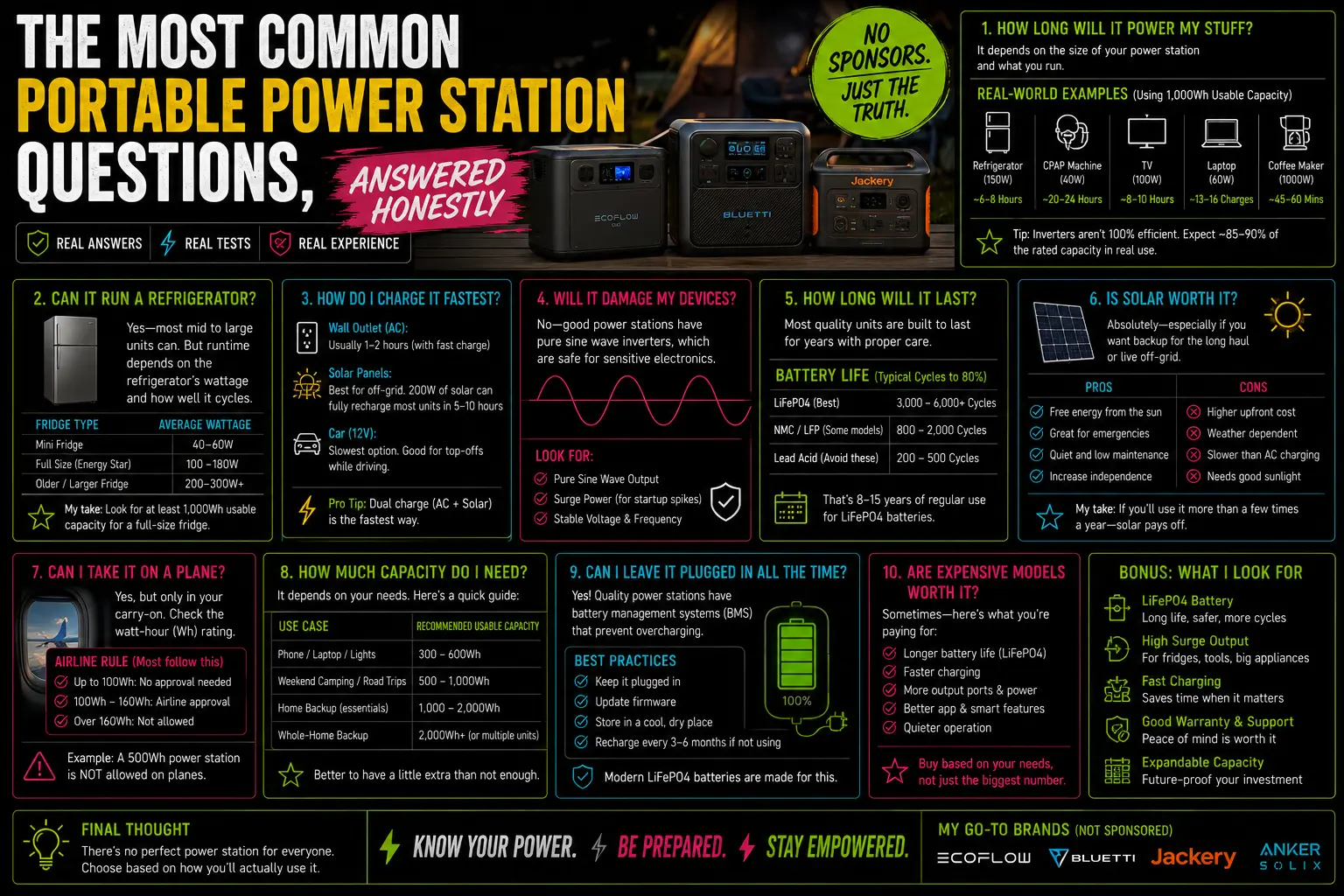
Can a portable power station actually run my refrigerator? For how long? What happens if I leave it plugged in all the time? Do I need to do anything to maintain it?
I get variations of these questions constantly — from readers, from neighbors, from people who found this site three hours into a power outage and are trying to figure out if the unit their brother-in-law gave them is actually useful. The answers exist, but they’re buried under spec sheets and forum arguments. Here they are, straight.
Will a portable power station run my refrigerator?
Yes — almost certainly, as long as your refrigerator is a modern unit with a standard compressor. A typical 18–22 cubic foot Energy Star refrigerator draws 35–65W on average, with startup surges up to 400–600W when the compressor kicks on. Most mid-range power stations (1,000Wh and above from quality brands) handle that surge and sustain the continuous draw without issue.
The math: a 1,000Wh unit running a refrigerator that consumes 50W average covers roughly 14–16 hours of refrigerator-only runtime before hitting 10% remaining charge. That’s through the night and into the next afternoon.
A wine fridge, a very old refrigerator, or a large commercial-style unit may draw differently — look up your specific model’s annual kWh usage on the Energy Star database and divide by 8,760 to get average hourly watts.
How long will it actually last?
Longer than people fear, shorter than the box implies.
The number on the box (watt-hours) is theoretical capacity at 100% efficiency. Real-world delivery through the inverter is typically 85–90% of that number due to conversion losses. A “1,000Wh” unit delivers roughly 850–900Wh to your actual devices.
Runtime depends entirely on what you’re running. A CPAP at 35W runs for roughly 24 hours on a 1,000Wh unit. A window AC at 500W runs for about 1.7 hours on the same unit. Everything else falls somewhere in between. There’s no single answer — the exact calculation for your household takes about fifteen minutes and tells you exactly what you’re working with.
Is it safe to leave it plugged in and charging all the time?
Yes, for most quality units — with one qualification. Modern power stations from EcoFlow, Anker, Jackery, and Bluetti use battery management systems that stop accepting charge when the battery is full and manage the charge cycle to reduce long-term degradation. Leaving them plugged in continuously is generally fine.
The qualification: if you’re storing the unit for months without use — say, putting it away after hurricane season — don’t leave it at 100% or 0%. Most manufacturers recommend storage at 50–80% charge for long-term battery health. I store mine at around 70% through the winter months, check it every 4–6 weeks, and top it up if it’s dropped below 50%.
⚠️ One thing that bit me: I left a unit plugged in with ECO mode disabled for about six weeks without realizing it had stopped charging at 80% due to a firmware update that changed the charge limit setting. The unit was at 80% when I needed it — not 100%. Not dangerous, just inconvenient. Check your firmware settings after any updates. Battery care settings sometimes change.
Can I use it while it’s charging from solar?
Yes. This is called “pass-through charging” and all the major brands support it. You can have the unit connected to solar panels while simultaneously drawing power to run appliances. The unit manages the energy flow — if solar input exceeds your load, the excess charges the battery; if your load exceeds solar input, the battery supplements it.
In practice during a clear Florida day, I run my refrigerator and a couple of lights off the DELTA Pro while it’s connected to 220W of panels. The net result is slower depletion, not net charging — my load typically exceeds the panel’s real output by 30–40W on average. But it extends the battery life significantly compared to running with no solar at all.
Do I need to do any maintenance?
Less than a gas generator — but not zero.
Keep the battery out of temperature extremes when possible. Heat above 104°F (40°C) over extended periods degrades lithium batteries faster than anything else. Don’t store it in a south-facing Florida garage that hits 120°F in summer. A climate-controlled interior or a garage with ventilation is better.
Firmware updates: check every 6 months. Both EcoFlow and Anker push meaningful improvements through OTA updates — better charge efficiency, improved battery management, bug fixes. These aren’t cosmetic. I’ve had real improvements in measured runtime after firmware updates on EcoFlow units.
Clean the vents. The cooling fan pulls air through vent openings and collects dust over time. A can of compressed air every six months keeps airflow healthy. Not complicated. Takes two minutes. Skipping it indefinitely contributes to thermal stress.
How long do these units last before the battery wears out?
LiFePO4 chemistry (which EcoFlow, Anker, Bluetti, and Jackery all use in their mid-to-upper range) is rated at 3,000–6,000 charge cycles to 80% capacity. At one full cycle per week, that’s 57–115 years.
No homeowner running one of these for storm prep will cycle it more than 30–50 times per year in a typical region. At that pace, the battery is a non-issue for the life of the product. The electronics, the inverter, the charge controller — those components have shorter meaningful lifespans in practice. Build quality at the brand level matters more than cycle ratings at typical use frequencies.
What’s the difference between a power station and a generator?
A generator burns fuel — gas, propane, or natural gas — and produces electricity through combustion. It produces exhaust. It cannot be run inside. It requires fuel storage and logistics. It makes noise (typically 60–70 decibels). It can run indefinitely as long as it has fuel.
A portable power station stores electricity in a battery and delivers it silently, without emissions, indoors or outdoors. It has no fuel logistics and no maintenance beyond what I described above. It runs until the battery is depleted, then needs recharging from grid power, solar, or both.
For most homeowners, the question of which is better comes down to: how long is your typical outage, and do you need to run loads that only a generator can handle (central AC, large well pumps)? For outages under 72 hours with moderate critical loads, why buying the biggest one you can afford is usually the wrong move applies directly — match the tool to the actual job. Per EIA data on outage duration, most residential outages in the US resolve within 24 hours. Most portable power stations handle that scenario cleanly.
Will it damage sensitive electronics?
No — assuming you buy a unit with a pure sine wave inverter, which every reputable brand in the mid-range and above uses. Pure sine wave output is electrically equivalent to what your wall outlet delivers. CPAP machines, laptop power supplies, home theater equipment, and other electronics with sensitive internals all run safely on pure sine wave inverters.
Avoid “modified sine wave” inverters for sensitive electronics. These produce a stepped approximation of AC power that can cause problems with some devices — buzzing in audio equipment, overheating in some motor loads, malfunctions in medical equipment. Most modified sine wave units are found in the cheapest power stations. The major brands I cover here don’t use them.

Lived through four major grid outages since 2021 — including Hurricane Ian (2022) and Helene (2024). Spent over $6,200 testing portable power stations and comparing them against whole-home standby generators before finding a setup that actually works. Not an electrician. Not sponsored by anyone. Just a homeowner who got it wrong the first time and documented everything the second time.
Why I started this blog: I wasted $3,400 on the wrong power station during Ian prep and I couldn’t find a single blog that gave me real runtime numbers — not the ones printed on the box. I decided to test everything myself and write it down.
What I do: I run real-world runtime tests on portable power stations and standby generators. I track how long they actually power a fridge, window AC, CPAP, and phone chargers — not under ideal lab conditions, but during Florida summers with actual loads. I compare real purchase prices, warranty experiences, and manufacturer support against what homeowners actually need after a storm.