
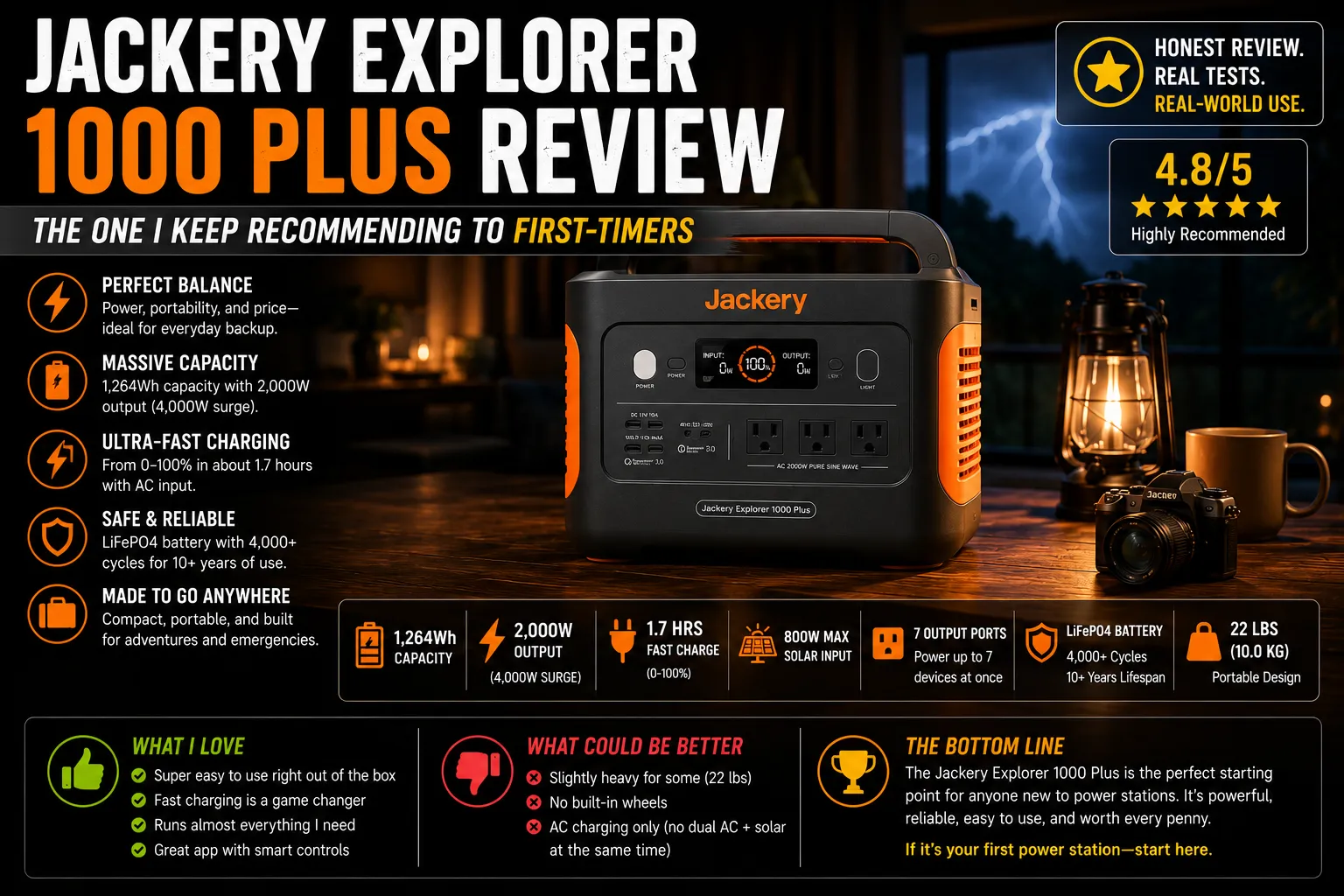
Why do I keep recommending the Jackery Explorer 1000 Plus before I’d even tested it thoroughly myself? Honest answer: three different neighbors asked me what to buy as their first power station in a six-month period, and I kept landing on the same unit. The price was right, the brand had a track record I trusted, and the specs matched what most first-time homeowners actually need. I was recommending it on instinct built from the bigger Jackery units I’d already tested.
Then I put it through a full test week and found out my instincts were mostly right — with a few things I hadn’t accounted for.
The Specs That Actually Matter
The 1000 Plus has 1,002Wh of LiFePO4 battery capacity — just barely over the 1,000Wh threshold that covers a refrigerator through the night in most scenarios. Jackery rates it at 2,000W AC output continuous, with a 4,000W surge for compressor startups.
| Spec | Jackery Explorer 1000 Plus |
|---|---|
| Battery capacity | 1,002Wh |
| Battery chemistry | LiFePO4 |
| AC output | 2,000W (4,000W surge) |
| Max solar input | 400W |
| AC charging speed | Up to 1,000W |
| Weight | ~31 lbs |
| Expandable? | Yes — up to 5,000Wh with add-on batteries |
| Cycle life | 4,000 cycles to 80% |
The 4,000-cycle rating stands out. Most comparable units land at 3,000–3,500 cycles. At typical homeowner backup use frequencies (maybe 20–40 cycles per year), this is well past any practical concern — but it signals quality LiFePO4 cell selection, and that’s not nothing.
The 31-Pound Advantage
Nobody talks about weight as a feature, but it is. The 1000 Plus at 31 lbs is one of the lightest units in its capacity class. The EcoFlow DELTA 2 (1,024Wh) comes in at 27 lbs — close. But competing 1,000Wh-class units from some other brands push 40+ lbs for the same capacity.
At 31 lbs, one person can carry this from a closet to the kitchen counter without help, without a dolly, without thinking about it. That matters during an outage when you’re moving things in the dark at 2am. I picked it up single-handed out of storage three times during my test week and never once thought about its weight. That’s the correct relationship to have with a portable power station.
Real Runtime Test — My Numbers
Test setup: July, indoor garage, ambient 89°F. Load: one refrigerator (52W average measured), one CPAP without humidifier (28W average), two phones charging (12W combined). Total ~92W average.
| Time | Charge Level |
|---|---|
| Start (7:00 PM) | 100% |
| 11:00 PM | 64% |
| 3:00 AM | 38% |
| 7:00 AM | 14% |
12 hours of runtime at ~92W average load, ending at 14% — meaning roughly 848Wh of usable capacity delivered out of 1,002Wh theoretical. That’s an 84.6% efficiency rate through the inverter, which is solid.
Adding a humidifier to the CPAP would have pushed total load to ~110W, reducing runtime to roughly 10 hours before hitting 10%. For a single overnight outage, the 1000 Plus covers moderate critical loads comfortably with a little buffer.
⚠️ What I tested that went wrong: I tried running a 700W box fan on top of the refrigerator and CPAP load — total around 800W average. At that load, the unit ran for just over an hour before I had to make choices. A high-draw fan turns a 12-hour overnight unit into a 2-hour unit. Always measure your actual fan wattage — “box fan” can range from 60W to 300W depending on the model. I used a Kill A Watt meter and found mine pulled 285W on high. Use the load calculator with your actual measured numbers, not guesses.
Solar Charging: 400W Maximum
One 220W panel gets you roughly 165W of real-world input — meaning a full 0–100% recharge takes about 6–7 hours of good sun. One 400W panel, if you have one, hits the unit’s maximum input ceiling and delivers approximately 300W in ideal conditions, cutting recharge time to about 3.5–4 hours.
The 400W ceiling is the one meaningful limitation versus the EcoFlow DELTA 2 Max (1,000W ceiling). If you’re building a solar-plus-battery setup where you want to run more than one panel, the 1000 Plus will eventually be a bottleneck. For most homeowners using one panel as a recharge supplement, it’s a non-issue.
The Jackery App: Functional, Not Exciting
Jackery’s app works. You get battery level, input/output wattage, estimated runtime, and charging status. It connects via Bluetooth for short-range monitoring and WiFi for remote access.
What it doesn’t have is EcoFlow’s granular control panel — no per-outlet management, no detailed charge cycle history, no smart charging schedule. For most homeowners checking charge level during an outage, this isn’t a gap. For power users who want to optimize charging schedules or monitor long-term battery health trends, it falls short.
I’ve never had the Jackery app lose connection during active use. I’ve had EcoFlow’s app briefly disconnect twice. Both apps are usable. EcoFlow’s has more features; Jackery’s is more stable in my experience.
Build Quality: Jackery’s Calling Card
Jackery has been at this since 2012 — longer than most of the brands now competing in this space. Their build quality at the unit-to-price ratio is consistently impressive. The 1000 Plus has solid port covers, a chassis that doesn’t flex when you pick it up, and a fan that runs quieter than several competing units I’ve tested.
The display is bright and legible in direct sunlight, which matters when you’re checking it in a hot garage during a daytime outage. EcoFlow’s DELTA 2 display is slightly larger but comparably readable. Neither is a problem.
For a comparison across similar capacity levels, the full breakdown versus the DELTA 2 is in the 2000 Plus review context — the build quality thread runs consistent across Jackery’s product line.
What It Doesn’t Do Well
The 1000 Plus has no pass-through charging optimization in the same sense that EcoFlow’s X-Stream does. It charges from AC at up to 1,000W, which means a full recharge from wall power takes about an hour. That’s fine — but if you want to top it off quickly between outage phases using a generator, competitors with 1,500–2,000W AC input have an edge.
There’s also no self-discharge protection out of the box — the unit will slowly discharge if left stored for months. Jackery recommends storage at 50–80% with a top-up every 3 months. Most quality brands have this same requirement; Jackery just doesn’t automate it the way some EcoFlow units do with a scheduled maintenance charge.
Price and Value
The 1000 Plus typically runs $599–$749 on sale (Prime Day, Black Friday, or EcoFlow-style rolling promotions). At $699, it delivers 1,002Wh of LiFePO4 capacity, 4,000 cycles, 31 lbs, and a 2,000W inverter from a brand with 12+ years in the space. That’s a reasonable deal.
At $800+ (near-MSRP), the value equation gets closer to the DELTA 2 territory, and the DELTA 2 would be the stronger pick. Buy the 1000 Plus at its sale price, not its list price.
What Type of Homeowner This Is Right For
First-time buyers who have a clear overnight load list under 900Wh and don’t plan to add solar panels in the near term: this is the unit. The build quality is excellent, the brand is established, the weight is manageable alone, and the price at sale is among the best in this capacity class.
If there’s any chance you’ll want to expand capacity later or add solar charging with more than one panel, pay the step-up for the DELTA 2 Max or the Jackery 2000 Plus instead. But for the homeowner who wants one solid, reliable unit that covers a moderate overnight load — this is a correct choice, and I’ve seen three neighbors use it through real outages without a single problem.

Lived through four major grid outages since 2021 — including Hurricane Ian (2022) and Helene (2024). Spent over $6,200 testing portable power stations and comparing them against whole-home standby generators before finding a setup that actually works. Not an electrician. Not sponsored by anyone. Just a homeowner who got it wrong the first time and documented everything the second time.
Why I started this blog: I wasted $3,400 on the wrong power station during Ian prep and I couldn’t find a single blog that gave me real runtime numbers — not the ones printed on the box. I decided to test everything myself and write it down.
What I do: I run real-world runtime tests on portable power stations and standby generators. I track how long they actually power a fridge, window AC, CPAP, and phone chargers — not under ideal lab conditions, but during Florida summers with actual loads. I compare real purchase prices, warranty experiences, and manufacturer support against what homeowners actually need after a storm.