
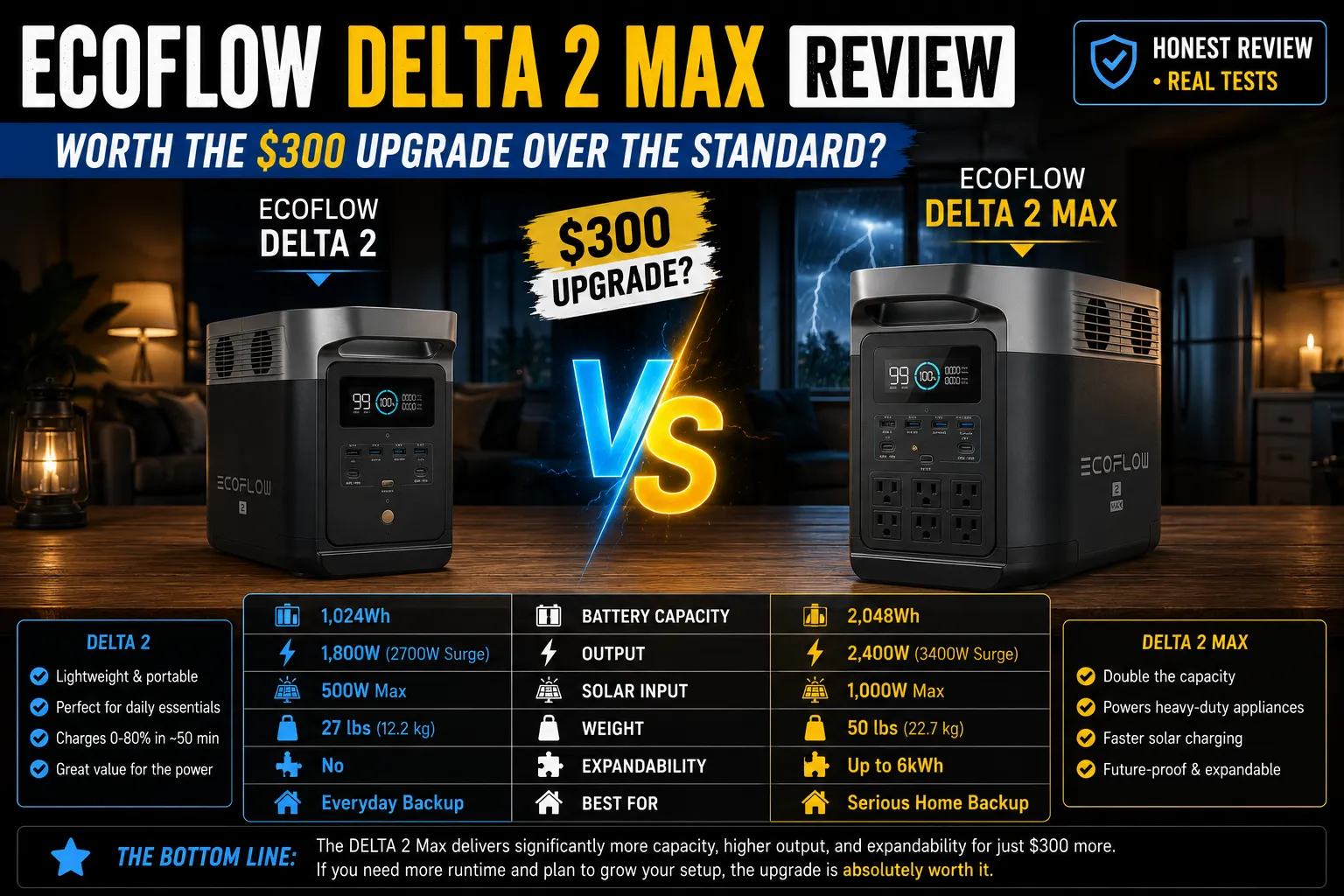
$300. That’s the consistent price gap between the EcoFlow DELTA 2 and the DELTA 2 Max — roughly $599–$799 for the standard unit versus $999–$1,199 for the Max, both on sale. Whether that gap is worth crossing depends entirely on what you’re trying to do, and the answer is less obvious than EcoFlow’s product page makes it sound.
I ran both units through the same load tests over the same three-day period last summer to get a direct comparison. Here’s what the extra $300 buys you — and what it doesn’t.
The Specs Difference, Simplified
The DELTA 2 Max and the standard DELTA 2 look nearly identical and run off the same EcoFlow app. The differences are internally meaningful:
| Spec | DELTA 2 | DELTA 2 Max |
|---|---|---|
| Battery capacity | 1,024Wh | 2,048Wh |
| AC output | 1,800W (2,700W surge) | 2,400W (5,000W surge) |
| Max solar input | 500W | 1,000W |
| Max AC charging speed | 1,200W | 2,400W (X-Stream) |
| Weight | ~27 lbs | ~48 lbs |
| Expandable? | No | Yes — up to 6,144Wh |
Two specs stand out as genuinely consequential: the capacity (double) and the max solar input (also double). The AC output and surge rating improvements matter for some load types but not for the refrigerator-plus-CPAP overnight scenario most homeowners are planning for.
What the Double Capacity Actually Means in Practice
Running a standard refrigerator at 50W average draw, a CPAP at 35W with humidity, two phone chargers at 10W combined, and two LED lamps at 15W total — that’s a combined load of roughly 110W.
- DELTA 2 at 1,024Wh: approximately 7.5–8 hours of runtime at that load before reaching 10% remaining.
- DELTA 2 Max at 2,048Wh: approximately 15–16 hours at the same load before reaching 10%.
That’s the difference between getting through one night and getting through one night plus most of the next day. For a 24-hour outage, the DELTA 2 runs low; the DELTA 2 Max has comfortable headroom. For a 12-hour overnight outage — which represents the majority of residential events — both units handle it without breaking a sweat, with the standard DELTA 2 ending the night at roughly 40–45% remaining.
The honest answer: for most homeowners whose outages are under 24 hours with moderate loads, the standard DELTA 2 is sufficient. The Max makes a real difference the moment you start running higher loads (window AC, electric blanket, space heater) or face multi-day outages.
The Solar Input Advantage
This is where I think the Max case gets genuinely stronger.
The standard DELTA 2 accepts up to 500W of solar input. If you have one 220W panel, you’re capped at a real-world delivery of roughly 165W — meaning a full recharge from 0% takes about 6–8 hours of direct sun. That’s workable.
The DELTA 2 Max accepts up to 1,000W of solar input. Two 220W panels gives you roughly 330W of real-world delivery, cutting the recharge window to around 6–7 hours for its 2,048Wh battery. Compared to the DELTA 2’s 6–8 hours for 1,024Wh, the solar efficiency per storage unit is roughly equivalent — but the Max’s higher ceiling means you can add a third panel and actually use it, whereas the DELTA 2 is maxed at one or two panels depending on wattage.
For homeowners planning a solar-plus-battery setup where the goal is looping through multi-day outages without grid power, the Max’s expandable solar ceiling is meaningful. For homeowners who aren’t adding panels, it’s irrelevant.
The Expandability Argument
The DELTA 2 Max can be expanded to 6,144Wh by adding two DELTA 2 Extra Batteries (each 2,048Wh, approximately $499 each on sale). The standard DELTA 2 has no expansion option.
This changes the calculus significantly. At $999 for the Max plus $499 for one expansion battery, you’re at 4,096Wh for $1,498 — approaching DELTA Pro territory at a lower upfront commitment. You can buy in stages.
The standard DELTA 2 at $799 is a complete unit. Once you’ve bought it, you’ve bought it — no upgrade path within the same ecosystem.
If there’s any chance your needs will grow, the Max’s expansion path is worth paying for now.
The Weight Question
The Max at ~48 lbs is noticeably heavier than the DELTA 2 at ~27 lbs. Both have integrated carry handles. Neither has wheels.
For most homeowners, this is a non-issue — the unit lives in one spot in the garage or pantry. If you’re planning to move it frequently or carry it to a second floor, the 21-pound difference is worth thinking about. If it’s a fixed installation, ignore this spec entirely.
⚠️ One thing I actually got wrong: I initially moved the Max to my second floor using one hand on the handle and one on the bottom corner. The corner edge is sharp enough to cut through skin if the unit shifts. It shifted. Use two hands on the handle, one on the side grip, and take the stairs slowly. This sounds obvious in retrospect. It wasn’t obvious at 2am during an outage.
Recharge Speed: Where the Max Genuinely Wins
The DELTA 2 Max supports EcoFlow’s X-Stream AC charging at up to 2,400W — meaning it can charge from 0–100% from a wall outlet in about 50 minutes. That’s fast in any company.
The standard DELTA 2 charges at up to 1,200W, hitting 100% in about 50 minutes as well for its smaller battery. In practice, both units recharge from a standard 120V outlet at roughly 1 hour to 100% — the capacity difference and input difference roughly cancel out.
Where the Max’s faster input matters: if you want to top off the Max quickly from a generator before the generator runs out of fuel, the 2,400W input takes advantage of that window more efficiently.
My Measured Results
Three-day test, July, Jacksonville garage (ambient 87–91°F inside garage):
Load: Refrigerator (avg 52W measured), two fans (avg 60W combined), phone charging (avg 15W), one floor lamp LED (8W) — total ~135W average.
| Day | Unit | Start % | End % | Hours Run | Approx Wh Used |
|---|---|---|---|---|---|
| Day 1 | DELTA 2 | 100% | 17% | 12 hours | ~845Wh |
| Day 1 | DELTA 2 Max | 100% | 57% | 12 hours | ~880Wh |
| Day 2 (no solar) | DELTA 2 Max | 57% | 13% | 12 hours | ~900Wh |
The DELTA 2 at 17% after 12 hours was functionally depleted — I’d have needed to charge it before the second night. The DELTA 2 Max ran two full 12-hour nights before getting critical.
This matches the sizing calculator output if you plug in those numbers — the calculator predicted roughly 8 hours for the standard unit at 135W load, and I got 12 hours (because “average load” often undershoots real-world power cycles, where the fridge compressor isn’t running constantly).
Who Should Actually Buy the Max
Buy the DELTA 2 (standard) if: your outages are typically under 24 hours, your critical load is moderate (fridge + CPAP + phones, nothing more), you’re not planning to add solar panels, and price is a real constraint.
Buy the DELTA 2 Max if: your outages sometimes stretch 24–48 hours, you want to run a window AC unit for even a few hours, you’re planning to add a solar panel in the next year or two, or you want expansion capability for the future.
Based on what I found in the DELTA 2 review, the standard unit is excellent for most homeowners in its target use case. The Max is for people who’ve thought carefully about their load profile and know they need more headroom. It’s a good unit — the $300 premium is fair for what you get. It’s just not universally necessary.

Lived through four major grid outages since 2021 — including Hurricane Ian (2022) and Helene (2024). Spent over $6,200 testing portable power stations and comparing them against whole-home standby generators before finding a setup that actually works. Not an electrician. Not sponsored by anyone. Just a homeowner who got it wrong the first time and documented everything the second time.
Why I started this blog: I wasted $3,400 on the wrong power station during Ian prep and I couldn’t find a single blog that gave me real runtime numbers — not the ones printed on the box. I decided to test everything myself and write it down.
What I do: I run real-world runtime tests on portable power stations and standby generators. I track how long they actually power a fridge, window AC, CPAP, and phone chargers — not under ideal lab conditions, but during Florida summers with actual loads. I compare real purchase prices, warranty experiences, and manufacturer support against what homeowners actually need after a storm.