
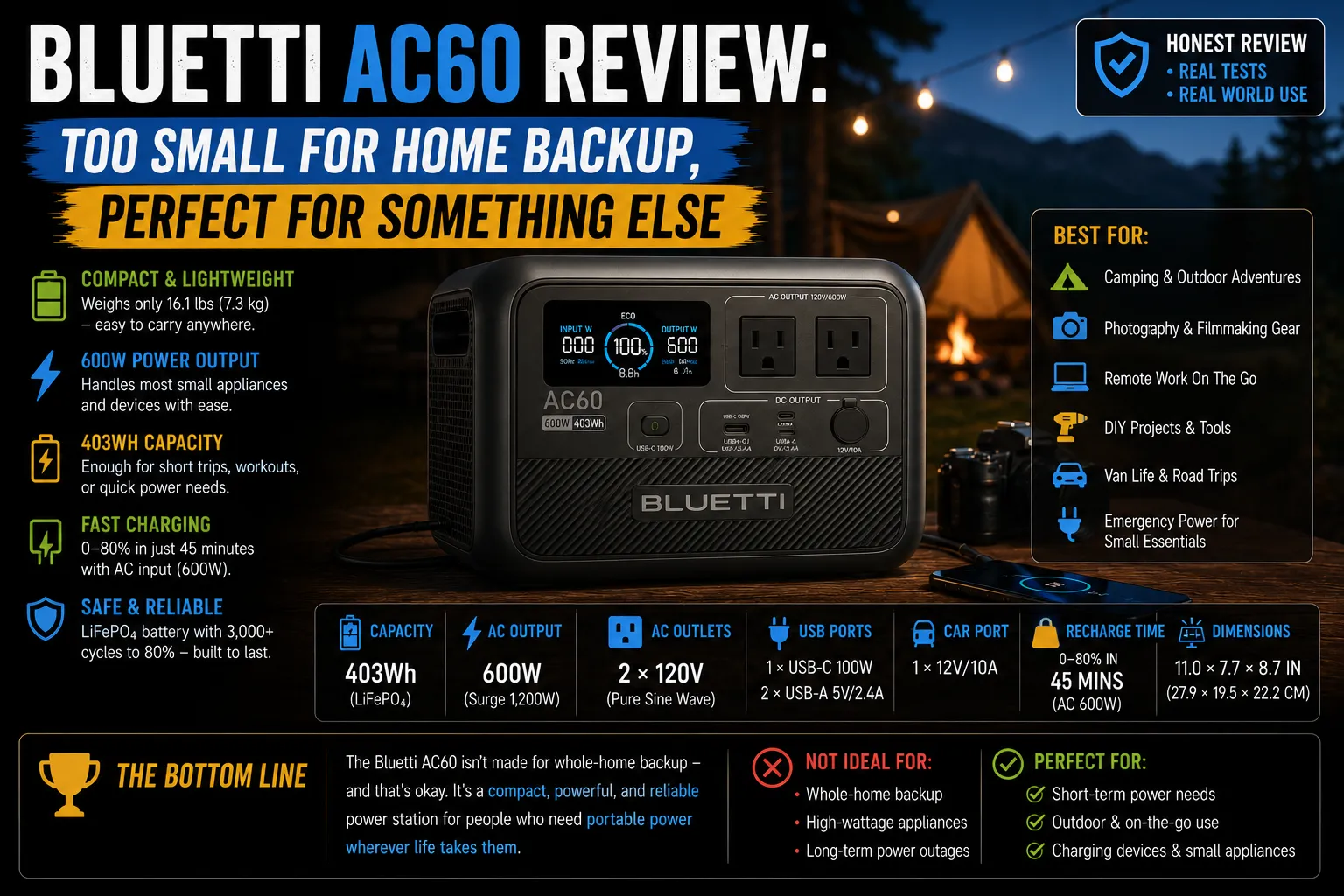
Can 403Wh actually do anything useful during a power outage?
Short answer: yes, depending on what you define as useful. Long answer is what this review is for.
The Bluetti AC60 is a compact unit — 16 pounds, 403Wh, 600W AC output. It’s smaller than most competitors I write about here, and deliberately so. Bluetti positioned it as a portable outdoor and light-use unit, not as home backup infrastructure. The mistake I see homeowners make is buying it because the price is right ($299–$399 on sale) without doing the math on what 403Wh actually covers in a real outage scenario.
So let’s do the math first, then talk about what this unit genuinely does well.
What 403Wh Gets You — Specifically
At 403Wh theoretical capacity, with an estimated 85% inverter efficiency, you have roughly 342Wh of usable energy delivered to your devices.
| Load | Runtime |
|---|---|
| Phone charging (10W) | ~34 hours |
| Laptop (45W) | ~7.6 hours |
| CPAP without humidifier (30W) | ~11 hours |
| Box fan on low (40W) | ~8.5 hours |
| Refrigerator (50W avg) | ~6.8 hours |
| CPAP + phone + one lamp (50W total) | ~6.8 hours |
| Refrigerator + CPAP (80W total) | ~4.3 hours |
A refrigerator alone runs for about 6.8 hours. That covers the evening into the middle of the night — not through a full overnight outage. Add a CPAP and you’re down to 4.3 hours before hitting 10% remaining. That’s not a full night’s coverage for moderate critical loads.
⚠️ This is where the purchase mistake happens: the AC60’s price ($299–$399) looks attractive compared to 1,000Wh units at $599–$799. But if your critical overnight load includes both a refrigerator and a CPAP, the AC60 leaves you in the dark — literally — before sunrise. Underbuying is a real cost that the spec sheet doesn’t warn you about. Why matching unit size to actual need matters is the fuller argument, but the 4.3-hour number above is the specific proof point for this unit.
The Build
At 16 pounds, the AC60 is genuinely portable in a way that 30–60 pound units are not. One hand on the integrated handle. It fits in an overhead compartment, in the back seat of a car, on a kitchen counter without dominating it.
The build quality is solid — Bluetti’s chassis construction is consistent at this price tier, and the AC60 doesn’t feel cheap despite its compact footprint. Port layout is practical: two AC outlets, USB-A, USB-C (100W PD), and a DC barrel port. Enough for most light-use scenarios.
The display shows battery percentage, input/output wattage, and estimated runtime. It’s accurate and easy to read.
Charging Speed
The AC60 accepts up to 600W from AC, meaning a full charge from wall power takes about 40–45 minutes. That’s fast. From solar, it accepts up to 200W — one 220W panel delivers real-world input of ~165W, meaning full recharge in about 2.5–3 hours of good sun. For a small unit, that’s an efficient solar recovery rate.
What the AC60 Is Actually For
This is where the review turns from critical to honest: the AC60 is a good product in the right application.
For keeping phones charged, a laptop running, a CPAP covered for one night, or lights on through a short evening outage — it works cleanly. For an apartment dweller whose only critical outage need is a laptop and connectivity, $349 gets them covered. For a homeowner who already has a larger primary backup unit and wants something compact for the bedroom or a secondary room, the AC60 is a reasonable supplement.
What it isn’t: a standalone home backup unit for homeowners trying to cover a refrigerator and CPAP through a typical storm outage. The load calculator will tell you the same thing — plug in your loads and the 403Wh number becomes self-evidently insufficient for most full-overnight scenarios.
Buy it for what it is. Don’t buy it hoping it’ll do what a 1,000Wh unit does

Lived through four major grid outages since 2021 — including Hurricane Ian (2022) and Helene (2024). Spent over $6,200 testing portable power stations and comparing them against whole-home standby generators before finding a setup that actually works. Not an electrician. Not sponsored by anyone. Just a homeowner who got it wrong the first time and documented everything the second time.
Why I started this blog: I wasted $3,400 on the wrong power station during Ian prep and I couldn’t find a single blog that gave me real runtime numbers — not the ones printed on the box. I decided to test everything myself and write it down.
What I do: I run real-world runtime tests on portable power stations and standby generators. I track how long they actually power a fridge, window AC, CPAP, and phone chargers — not under ideal lab conditions, but during Florida summers with actual loads. I compare real purchase prices, warranty experiences, and manufacturer support against what homeowners actually need after a storm.