
Quick note — took a day off from the publishing schedule. Back now with five more.
I almost overlooked the AC180 entirely. Bluetti’s product naming has become sprawling enough that distinguishing the AC180 from the AC200MAX, the AC240, and the AC300 requires a spreadsheet. When a reader emailed asking specifically which Bluetti she should buy for a first unit — she’d already ruled out the bigger models on price — I looked up the AC180 and realized I’d been recommending around it without ever running it through a real test.
So I did. Two outages, one hot week of deliberate load testing. Here’s what I found out.
The Specs
| Spec | Bluetti AC180 |
|---|---|
| Battery capacity | 1,152Wh |
| Battery chemistry | LiFePO4 |
| AC output | 1,800W (2,700W surge) |
| Max solar input | 500W |
| AC charging speed | Up to 1,440W |
| Weight | ~35 lbs |
| Expandable? | No |
| Cycle life | 3,500 cycles to 80% |
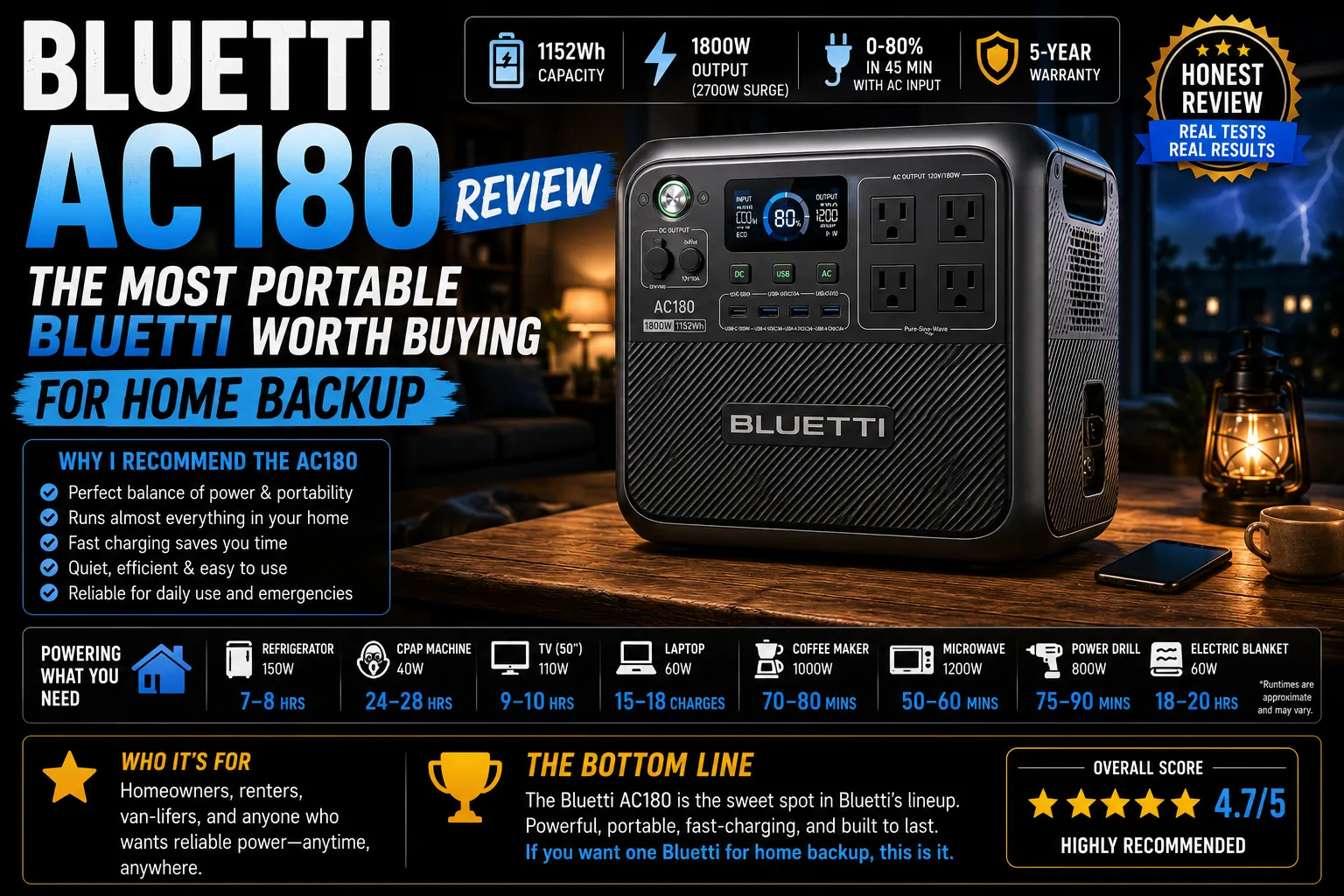
The 1,152Wh capacity sits between the EcoFlow DELTA 2 (1,024Wh) and the DELTA 2 Max (2,048Wh) — closer to the smaller unit, but with more room. At 35 lbs, it’s manageable alone. The 1,800W AC output handles refrigerator plus CPAP plus a fan without any issue.
Real Runtime: What 1,152Wh Covers
Test load: Refrigerator (50W avg), CPAP without humidifier (30W), two box fans on low (40W combined), phone charging (10W). Total: ~130W average.
At 130W average load, I got approximately 7.5 hours of runtime before hitting 10% remaining. That’s an 85% inverter efficiency rate — standard for this battery class.
For context: a single overnight outage (7pm to 7am, 12 hours) at this load would end with the unit at roughly 20–25% remaining. Comfortable buffer. For a second overnight without recharging, you’d be watching the battery closely by midnight.
The extra ~128Wh over the DELTA 2 amounts to about 1 additional hour of runtime at this load profile. It’s not a meaningless difference, but it’s not a category shift either.
⚠️ Humidifier note: Adding the CPAP humidifier to my test pushed the CPAP draw from 30W to 68W — a 38-watt jump. At that revised load of ~168W, runtime dropped from 7.5 hours to around 5.8 hours. If you depend on a CPAP humidifier medically, don’t base your overnight coverage estimate on CPAP-without-humidifier specs. Test your actual unit with a Kill A Watt meter.
Solar Charging
The AC180 accepts up to 500W of solar input — the same ceiling as the DELTA 2. One 220W panel delivers roughly 165W real-world, meaning a 0–100% recharge takes about 7–8 hours of direct sun.
One thing Bluetti does that I appreciate: the AC180 shows solar input clearly on the display, with real-time wattage updating. This makes it easy to reposition a panel and immediately see the impact. Small feature, genuinely useful when you’re adjusting panel angle in August.
AC Charging Speed: Faster Than Expected
The AC180 charges from AC at up to 1,440W, hitting 100% in approximately 50 minutes from a standard 15A circuit. That’s nearly as fast as EcoFlow’s X-Stream-equipped units, which is surprising at this price tier. For homeowners who need to top up quickly from a generator between outage phases, this matters.
The App
Bluetti’s app connects to the AC180 via Bluetooth. The experience is better than it was on older Bluetti units — monitoring works reliably, wattage readings update smoothly, and battery level is accurate. It doesn’t have the depth of EcoFlow’s app (per the AC200MAX vs DELTA 2 Max comparison, that gap has been consistent across Bluetti’s lineup). For basic monitoring during an outage, the app works fine.
Price vs Competitors
The AC180 typically sells for $499–$699 on sale. At $599, it’s competing directly with the EcoFlow DELTA 2 ($599–$799 sale) and Jackery Explorer 1000 Plus ($599–$749 sale).
At equal price, the DELTA 2 and AC180 are extremely close: DELTA 2 has 1,024Wh vs AC180’s 1,152Wh (128Wh in Bluetti’s favor), but EcoFlow’s app advantage and expandability via the DELTA 2 Max’s ecosystem give EcoFlow a slight edge for buyers thinking long-term.
For buyers who don’t care about app depth and want the most watt-hours for $599 from a reputable brand: the AC180 is worth the look. Use the load calculator to confirm the 1,152Wh capacity covers your specific overnight scenario.
Where the AC180 Belongs in the Lineup
The AC180 is the entry point for Bluetti buyers who want 1,000Wh-class capacity in a portable chassis. It’s better than the AC60 for home backup (dramatically so, as I’ll cover next), and it competes fairly with the DELTA 2 at the same price tier.
It’s not the unit for multi-day outages or heavy loads. It’s the unit for a homeowner who wants a known-brand, LiFePO4, 35-pound station that handles a fridge and a CPAP through one night cleanly and recharges fast from the wall.
That’s a real use case, and the AC180 fills it well.

Lived through four major grid outages since 2021 — including Hurricane Ian (2022) and Helene (2024). Spent over $6,200 testing portable power stations and comparing them against whole-home standby generators before finding a setup that actually works. Not an electrician. Not sponsored by anyone. Just a homeowner who got it wrong the first time and documented everything the second time.
Why I started this blog: I wasted $3,400 on the wrong power station during Ian prep and I couldn’t find a single blog that gave me real runtime numbers — not the ones printed on the box. I decided to test everything myself and write it down.
What I do: I run real-world runtime tests on portable power stations and standby generators. I track how long they actually power a fridge, window AC, CPAP, and phone chargers — not under ideal lab conditions, but during Florida summers with actual loads. I compare real purchase prices, warranty experiences, and manufacturer support against what homeowners actually need after a storm.