
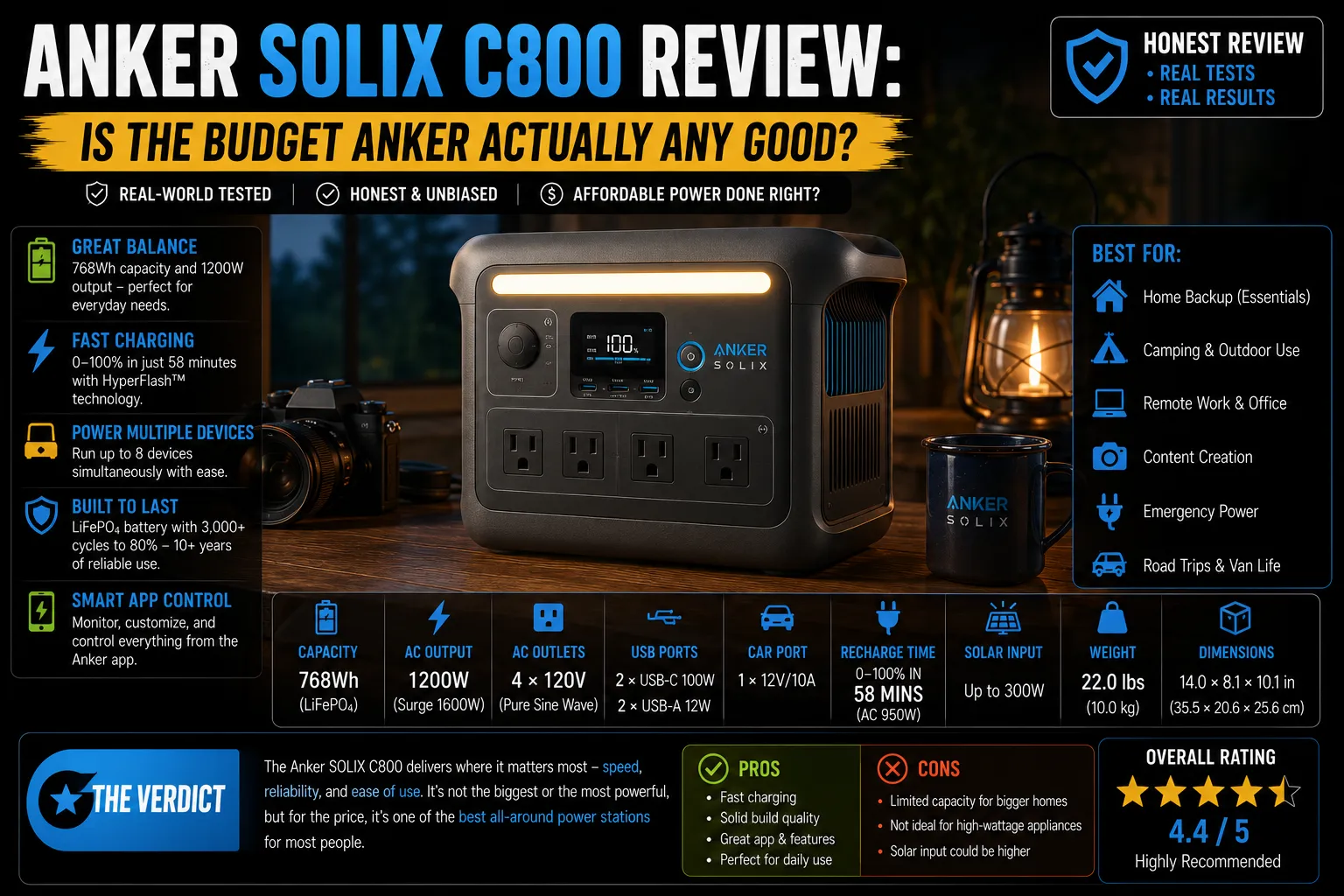
17.4 pounds. For a unit with 768Wh of LiFePO4 capacity, that’s one of the best power-to-weight ratios in the entry-level tier. The Anker SOLIX C800 is the smallest unit in the SOLIX lineup, and when I first picked it up I thought they’d made a mistake on the weight spec. It felt light enough to be half that capacity.
They didn’t make a mistake. The C800 is a genuinely compact unit, and the weight is real. Whether the 768Wh capacity is useful for home backup is the question the rest of this review answers.
Specs
| Spec | Anker SOLIX C800 |
|---|---|
| Battery capacity | 768Wh |
| Battery chemistry | LiFePO4 |
| AC output | 800W (2,400W surge) |
| Max solar input | 200W |
| AC charging speed | Up to 1,500W |
| Weight | ~17.4 lbs |
| Expandable? | No |
| Cycle life | 3,000 cycles to 80% |
The 800W continuous AC output is the lowest ceiling in the SOLIX lineup — and the spec that determines what this unit can and cannot run. A window AC unit (typically 500–800W) sits right at or just below the C800’s continuous rating; a surge on startup can push into the 2,400W surge territory, which the C800 handles. A refrigerator at 50W average with a 400–600W startup surge is well within spec.
What the C800 cannot do: run a refrigerator and a window AC simultaneously without exceeding the continuous output. These two loads together push past 800W combined. Know your load ceiling before choosing this unit.
Runtime Test
Test load: Refrigerator (50W avg measured), one LED lamp (8W), phone charging (10W). Total: ~68W average.
At 68W average load, the C800 ran for approximately 9.4 hours before hitting 10% remaining. That’s roughly 652Wh of usable capacity out of 768Wh theoretical — an 85% efficiency rate.
For the more conservative “survival mode” load, 9+ hours is enough to cover most overnight outages. The problem emerges when you add more devices.
Same test, adding a CPAP without humidifier (30W): Total load ~98W. Runtime: approximately 6.5 hours. Covers the night if the outage starts late but leaves no buffer for a full 12-hour event.
With CPAP humidifier added (pushing CPAP to 68W): Total load ~136W. Runtime: approximately 4.7 hours. Not sufficient for overnight coverage.
The C800’s 768Wh is a real limitation for homeowners who need refrigerator plus CPAP plus humidifier through a full night. The load calculator will show you the exact numbers for your specific devices — run it before buying at this capacity tier.
AC Charging Speed: Where the C800 Surprises
The C800 accepts up to 1,500W of AC input — the same as the larger C1000 — and charges from 0 to 100% in approximately 30 minutes from a wall outlet. That is genuinely fast for a unit of this size. The Bluetti AC60 (403Wh) charges in about 40 minutes; the Anker C800 (768Wh) nearly matches that speed with almost double the capacity.
For homeowners using a small generator to recharge their backup unit during an extended outage, 30 minutes of generator run time returns a full 768Wh — an efficient use of fuel.
⚠️ On that charging speed: the C800 gets warm during fast AC charging. Not hot — warm. The vent fan runs audibly during the charge cycle. Don’t place it in an enclosed cabinet or closet while charging at full speed. Leave at least 6 inches of clearance around all vent faces. I tested it in an enclosed space once to see what would happen — it throttled charging speed and displayed a temperature warning. Not dangerous, but not ideal. Ventilation is not optional during high-speed charging.
Solar Charging: 200W Maximum
One 200W panel maxes this unit’s solar input ceiling. In real conditions, that delivers roughly 150W, meaning a full solar recharge takes about 5–6 hours of good direct sun. Practical for a clear-day supplement — you can fully recover overnight draw by early afternoon.
The 200W ceiling is a limitation if you own or want two panels — the second panel’s output would be wasted. Buy one quality panel for this unit, not two.
Build Quality: Anker Standard
The C800 feels premium for its price. The chassis is solid, the carry handle is flush and integrated cleanly, and the display is backlit and easy to read in direct sunlight. Anker’s manufacturing quality from its broader electronics business translates well here — this doesn’t feel like a product from a company learning how to make hardware.
Port layout: two AC outlets, two USB-A, two USB-C (including one 140W PD port), and a 12V car outlet. Complete for the unit’s use case.
The C800 vs the C1000
The C1000 (1,056Wh, $399–$549 sale) is $50–$100 more than the C800 ($299–$399 sale) and delivers an extra 288Wh of capacity — roughly 3 additional hours of runtime at the C800’s tested load. The C1000 also has a higher continuous AC output (1,000W vs 800W) that removes the ceiling concern for most standard loads.
From the C1000 vs DELTA 2 comparison, the C1000 earned a strong recommendation in its tier. The C800 is for buyers with a firm budget below $400 or a load profile genuinely light enough that 768Wh is sufficient. If you’re unsure which you need, you probably need the C1000.
The Verdict on the C800’s Value
The C800 is a well-built, fast-charging, lightweight unit with a real capacity limitation that disqualifies it for most standard home-backup overnight scenarios involving a refrigerator and medical equipment.
Where it makes sense: light load overnight use (phones, a laptop, one lamp), day use during an outage, or as a secondary unit supplementing a larger primary backup. At 17.4 pounds, it’s the most effortlessly portable unit I’ve tested in the LiFePO4 class.
Where it doesn’t make sense: as the only backup power for a household that needs refrigerator and CPAP coverage through an 8-hour overnight outage. The math doesn’t work, and discovering that during an actual storm is the worst time to find out.

Lived through four major grid outages since 2021 — including Hurricane Ian (2022) and Helene (2024). Spent over $6,200 testing portable power stations and comparing them against whole-home standby generators before finding a setup that actually works. Not an electrician. Not sponsored by anyone. Just a homeowner who got it wrong the first time and documented everything the second time.
Why I started this blog: I wasted $3,400 on the wrong power station during Ian prep and I couldn’t find a single blog that gave me real runtime numbers — not the ones printed on the box. I decided to test everything myself and write it down.
What I do: I run real-world runtime tests on portable power stations and standby generators. I track how long they actually power a fridge, window AC, CPAP, and phone chargers — not under ideal lab conditions, but during Florida summers with actual loads. I compare real purchase prices, warranty experiences, and manufacturer support against what homeowners actually need after a storm.