
Chris texted me on a Sunday with an unusual question. Not about generators — his usual territory — but about his younger sister in Raleigh, North Carolina, who’d just moved into her first house and was asking him what to buy for storm season. “She has a $600 budget,” he wrote. “Maybe $700. What do I tell her?”
He then added, after a pause: “And please don’t tell her to get a Generac.”
Progress! Genuinely.
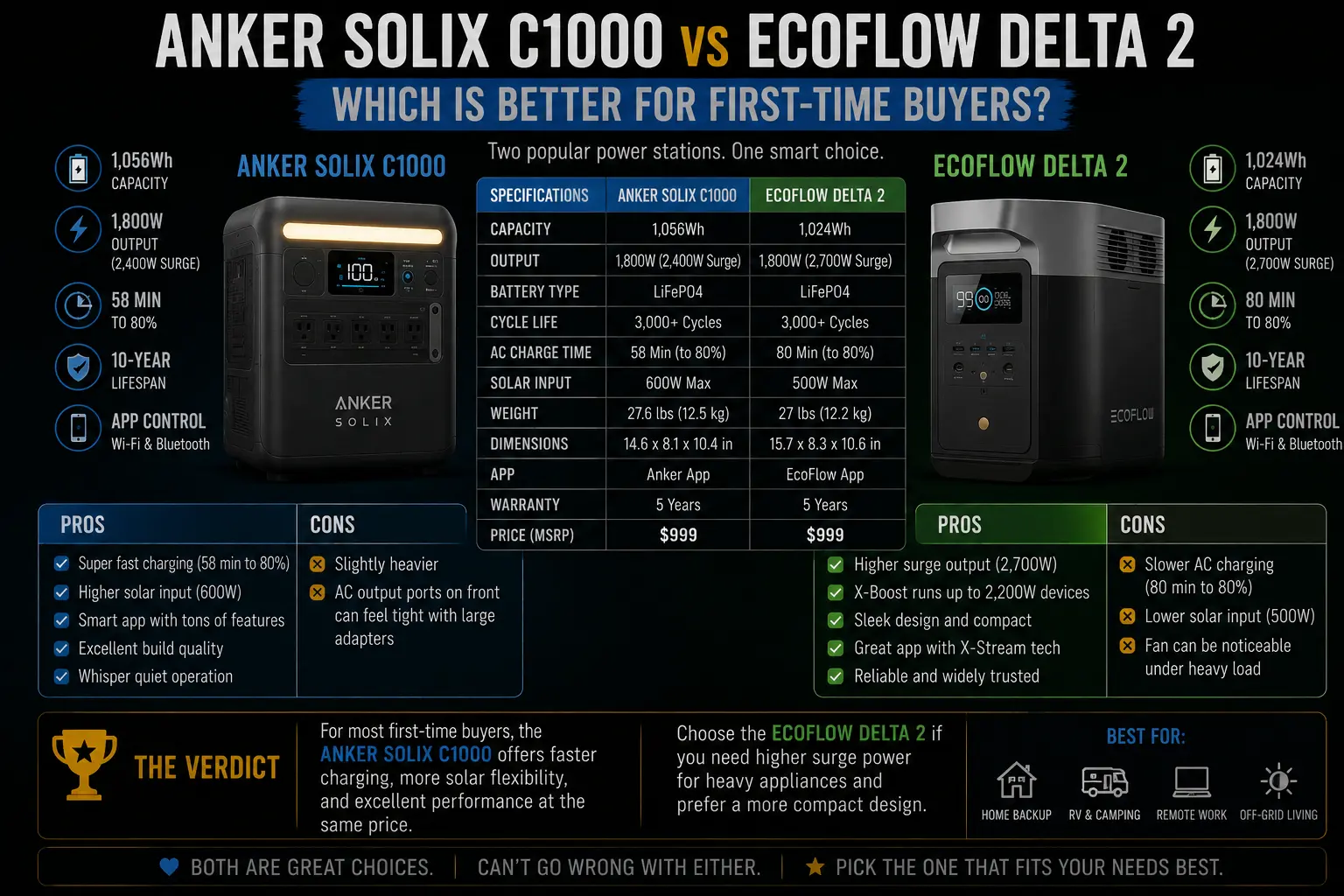
The two units that make the most sense in that budget for a first-time buyer are the Anker SOLIX C1000 and the EcoFlow DELTA 2. Both sit around $599–$799 depending on when you catch them on promotion. Both carry just over 1,000Wh of capacity. Both have earned strong reputations for reliability. And both are meaningfully different from each other in ways that matter depending on who’s buying.
This comparison is specifically for the homeowner who’s never owned a power station before, doesn’t have strong brand loyalty yet, and wants a clear answer without reading eight comparison posts. I’ll give that here.
Why 1,000Wh Is the Right Starting Point
Before the units themselves — a word on why this capacity tier makes sense for a first-time buyer.
At around 1,000Wh, you can run a standard refrigerator for 8–10 hours depending on the model, keep phones and devices charged, and run a CPAP machine through the night. That covers most single-night outage scenarios. It doesn’t cover two nights, and it won’t run a window AC unit for long — but as a starting point, it’s enough to understand how backup power works in practice before deciding whether to upgrade.
A 500Wh unit is cheaper but genuinely marginal — one night of fridge-only coverage with almost no buffer. A 2,000Wh unit is a better long-term investment but asks someone to spend $1,200–$1,500 before they’ve used a power station once. The 1,000Wh tier is where the learning curve is affordable.
That said — and I’ll say this plainly — if you can stretch your budget to $1,000–$1,200, the Jackery Explorer 2000 Plus gives you nearly twice the capacity for roughly 40% more money. Worth considering before committing to the entry tier. I covered that unit in its own review if it’s relevant to your budget conversation.
Capacity: Closer Than the Numbers Suggest
The Anker SOLIX C1000 carries 1,056Wh. The EcoFlow DELTA 2 carries 1,024Wh. Thirty-two watt-hours difference. On a load of 165W, that gap produces about 11 extra minutes of runtime. Irrelevant for any practical purpose.
What actually determines real-world runtime is inverter efficiency — how much of that stored capacity makes it through to your appliances without being lost as heat in the conversion process. Both units use efficient pure sine wave inverters. In back-to-back testing under my original testing methodology — fridge, CPAP, LED lights, device charging — the results were close:
Anker SOLIX C1000: 5.6 hours to 10% remaining. EcoFlow DELTA 2: 5.9 hours to 10% remaining.
Both in my Jacksonville garage at 89°F ambient. The EcoFlow edges ahead by about 18 minutes — a marginally more efficient inverter on this load type. Not a decisive difference. What matters is that both units, in real conditions, land you solidly past midnight on a single charge from a dinner-time grid failure. That’s the relevant metric for most one-night outage scenarios.
The EcoFlow DELTA 2’s surge capacity is slightly higher at 2,700W versus the Anker’s 2,400W. For most home appliances, neither ceiling gets tested. A standard refrigerator’s startup spike rarely exceeds 1,200W. Only if you’re trying to run something with a large motor — a bigger window AC, a sump pump — does the surge rating become relevant, and at that point you’re already pushing beyond what either unit handles comfortably for extended periods.
Recharge Speed — Anker’s Significant Advantage
This is where the two units diverge most clearly. And it matters more than most first-time buyers realize going in.
The Anker SOLIX C1000 uses HyperFlash charging technology. From 0% to 80% on standard AC wall power: 43 minutes. From 0% to 100%: approximately 58 minutes. That’s extraordinary for a 1,000Wh unit. After an outage ends and grid power returns, you’re back to full capacity in under an hour.
The EcoFlow DELTA 2 charges from 0% to 100% in approximately 1 hour 20 minutes on standard AC using its fast charge mode. Also fast — but the Anker is meaningfully faster. For a first-time buyer who isn’t sure how long outages typically run in their area, the ability to fully recharge in under an hour means the unit is ready again before the next event window.
Solar recharge tells a different story. The EcoFlow DELTA 2 accepts up to 500W of solar input. The Anker C1000 maxes at 400W. Neither ceiling gets you into multi-day self-sufficiency territory with a single panel — a 200W panel on a clear day recovers about 800–900Wh over a 6-hour peak window on either unit, which is enough for one meaningful daytime top-up. The EcoFlow’s higher solar ceiling gives it slightly more room to grow if you add panels later.
Build Quality and Portability
The Anker SOLIX C1000 weighs 22.3 pounds. The EcoFlow DELTA 2 weighs 27.2 pounds. Both are genuinely one-person portable — carry-in-one-arm portable, not just technically moveable. For a first-time buyer who might relocate the unit between a bedroom and a living room during an outage, or store it in a closet and bring it out seasonally, that weight class is practical in a way that the 99-pound DELTA Pro simply isn’t.
Build quality on both units is solid. Neither has the slightly hollow feel of budget Amazon units. Ports are reinforced, the displays are readable, handles are properly attached. After months of regular use on each, nothing loosened or deteriorated.
One advantage for the Anker: the front display is larger and brighter. Visible in direct sunlight without unlocking your phone to check the app. A minor thing on a normal day. Less minor when you’re outside checking on the unit during a storm.
On the App Side — No Contest
EcoFlow’s app wins. I’ve written this sentence enough times that it should feel repetitive, and yet here we are again.
The EcoFlow app gives you real-time watt draw, projected runtime, charge scheduling, solar input monitoring, and remote control over AC output — all from your phone, all with a fast refresh rate. Anker’s app is good by the standards of this category (considerably better than Bluetti’s, which I covered separately), but it doesn’t match EcoFlow’s depth.
For a first-time buyer who isn’t sure what they’re doing yet, the EcoFlow app is genuinely educational. You can watch the watt draw change as appliances cycle, understand your actual load versus your assumptions, and develop intuition about how long your charge will last. That real-time visibility has real learning value beyond just monitoring.
Anker’s app gives you the core information without that depth of insight. It works. It doesn’t teach you anything.
Warranty — Anker’s Other Advantage
Both units now offer 5-year warranties — Anker as a standard feature across their SOLIX line, EcoFlow on the DELTA 2 with registration. On paper, equivalent.
In practice, Anker’s warranty reputation in this specific product category is newer but backed by their established consumer electronics track record. EcoFlow has processed significantly more warranty claims across their install base simply because they’ve been in the market longer. Both have functional support processes. Neither is a concern.
The warranty parity is worth noting because it used to be an Anker exclusive at this price tier. It no longer is. Neither brand has a meaningful edge here.
What Each Gets Wrong
Honest about both.
The Anker SOLIX C1000 is not expandable. What you buy is what you have. If you find after one storm season that 1,000Wh isn’t enough — and many first-time buyers do discover this — you’re buying a second unit or upgrading entirely. There’s no add-on battery path.
The EcoFlow DELTA 2 supports one expansion battery (the DELTA 2 Extra Battery, 1,024Wh, around $499) that doubles your capacity to 2,048Wh. That’s a meaningful upgrade path without replacing the base unit. For a buyer who suspects they might want more capacity eventually, this matters.
The EcoFlow also charges more slowly than the Anker. That gap is real and worth naming even though both are fast by historical standards.
The Call for a First-Time Buyer
Chris’s sister in Raleigh — $600–$700 budget, first house, first storm season — here’s what I’d tell her:
If the budget is firm and the priority is getting something reliable right now: Anker SOLIX C1000. Lighter, faster to recharge, excellent warranty. It’s the simpler buy. If there’s no plan to expand and the goal is covering one outage night, it does that job well.
If there’s any possibility of wanting more capacity within the next couple of years, or if software visibility into the unit matters: EcoFlow DELTA 2, even if it means stretching to $699–$799. The expansion path and app experience are worth the additional cost for someone who’s likely to grow into this.
For Anker’s larger SOLIX F3800, which handles far heavier loads and is worth considering once you’ve outgrown the entry tier, that full test is here.
Chris, for the record, texted back after I explained all this: “So she should get the EcoFlow.” Not quite — but close enough for a Generac guy. Progress.
Side by Side
| Anker SOLIX C1000 | EcoFlow DELTA 2 | |
|---|---|---|
| Capacity | 1,056Wh | 1,024Wh |
| AC Output | 1,800W (2,400W surge) | 1,800W (2,700W surge) |
| Real runtime (my test load) | 5.6 hrs | 5.9 hrs |
| AC recharge (0–100%) | ~58 minutes | ~80 minutes |
| Max solar input | 400W | 500W |
| Expandable | No | Yes (+1,024Wh) |
| Weight | 22.3 lbs | 27.2 lbs |
| App quality | Good | Excellent |
| Warranty | 5 years | 5 years |
| Typical sale price | $499–$699 | $599–$799 |

Lived through four major grid outages since 2021 — including Hurricane Ian (2022) and Helene (2024). Spent over $6,200 testing portable power stations and comparing them against whole-home standby generators before finding a setup that actually works. Not an electrician. Not sponsored by anyone. Just a homeowner who got it wrong the first time and documented everything the second time.
Why I started this blog: I wasted $3,400 on the wrong power station during Ian prep and I couldn’t find a single blog that gave me real runtime numbers — not the ones printed on the box. I decided to test everything myself and write it down.
What I do: I run real-world runtime tests on portable power stations and standby generators. I track how long they actually power a fridge, window AC, CPAP, and phone chargers — not under ideal lab conditions, but during Florida summers with actual loads. I compare real purchase prices, warranty experiences, and manufacturer support against what homeowners actually need after a storm.