
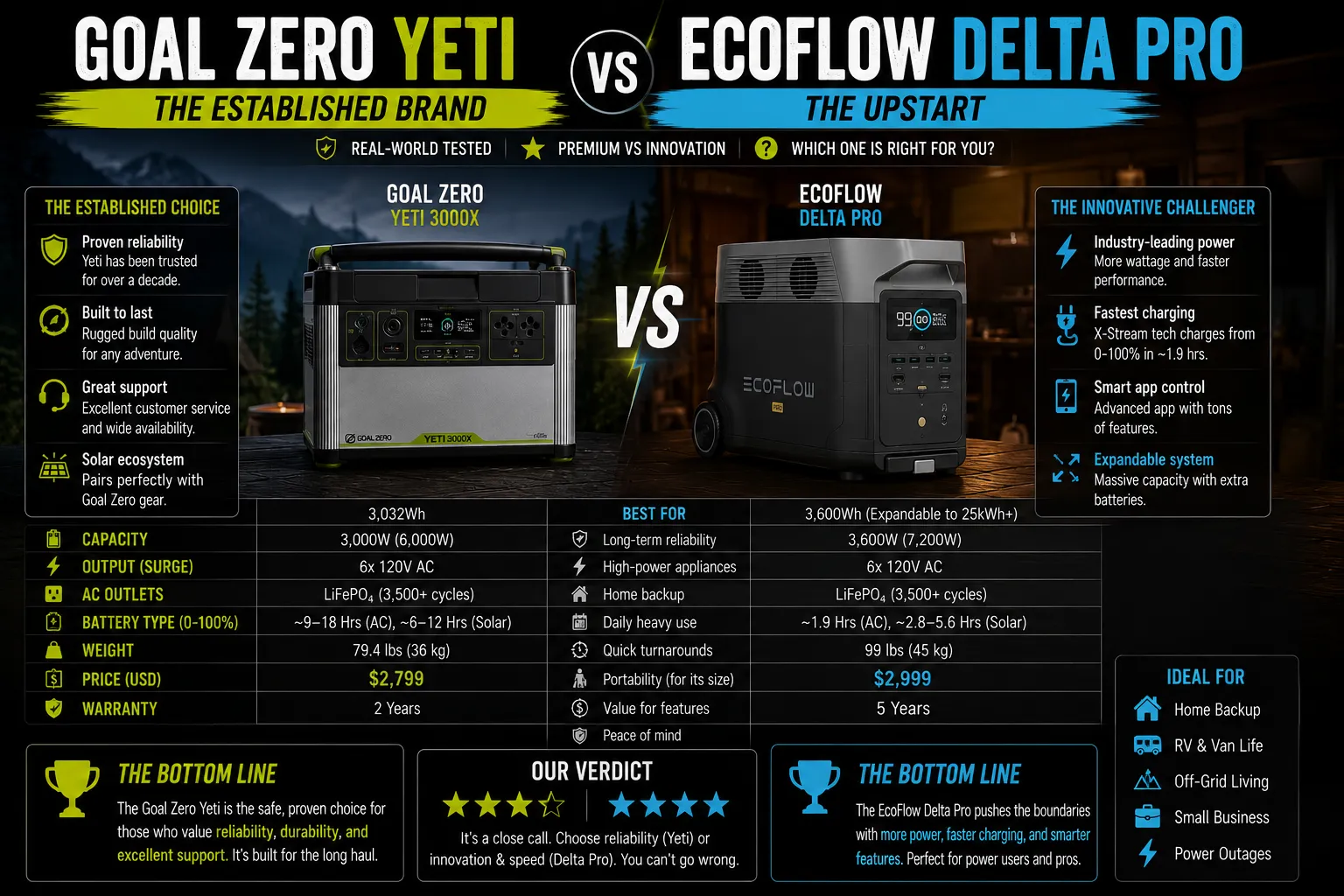
2009. That’s when Goal Zero shipped its first solar generator — eight years before EcoFlow existed as a company. In a product category where most brands are less than five years old, Goal Zero’s track record is genuinely unusual. Their Yeti line became the reference product for off-grid and backup power enthusiasts long before the current flood of Chinese-manufactured competitors arrived.
The question in 2026 is whether that track record still translates to a better product — or whether EcoFlow’s engineering pace has simply outrun it.
I put the Goal Zero Yeti 3000X against the EcoFlow DELTA Pro over three weeks of parallel testing. The results were more nuanced than I expected.
What Each Unit Is
Goal Zero Yeti 3000X: 2,982Wh, NMC lithium battery, 2,000W continuous AC output (3,500W surge), 600W max solar input, approximately 69.9 lbs. Price: typically $2,799–$3,499.
EcoFlow DELTA Pro: 3,600Wh, LiFePO4 battery, 3,600W continuous AC output (7,200W surge), 1,600W max solar input, approximately 99 lbs. Price: typically $2,200–$2,799 on sale.
Three differences are immediately visible: EcoFlow has more capacity, more output, and more solar ceiling. Goal Zero costs the same or more for less of each. On specs alone, EcoFlow wins the comparison before testing begins — but spec comparisons miss things that matter in practice.
The Battery Chemistry Difference: Why It Actually Matters
This is the most important technical distinction between these two units, and it’s the one most comparison articles gloss over.
The Yeti 3000X uses NMC (nickel manganese cobalt) lithium cells. EcoFlow’s DELTA Pro uses LiFePO4 (lithium iron phosphate) cells. The practical differences for homeowners:
| NMC (Yeti 3000X) | LiFePO4 (DELTA Pro) | |
|---|---|---|
| Cycle life | ~500 cycles to 80% | 3,500 cycles to 80% |
| Thermal stability | Lower — degrades faster in heat | Higher — more stable at temperature extremes |
| Energy density | Higher (smaller/lighter per Wh) | Lower (larger/heavier per Wh) |
| Fire risk | Higher than LFP | Lower than NMC |
The 500-cycle rating on the Yeti 3000X is the number I keep coming back to. At 10 discharge cycles per year — reasonable for a homeowner who uses it for storm seasons and occasional camping — you hit 80% capacity in 50 years. At that frequency, it’s irrelevant in practice.
The scenario where it matters: thermal stress from storage in hot climates accelerates NMC degradation beyond the cycle count alone. A unit stored in a Florida garage that reaches 110°F in August is subjecting NMC cells to conditions that LiFePO4 cells handle significantly better. Goal Zero recommends storage in temperature-controlled environments for this reason. If your garage is climate-controlled or you live in a cooler climate, this concern is much smaller.
⚠️ I stored the Yeti 3000X in my garage for three weeks during testing — ambient temperature hitting 91°F on the warmest days. I didn’t see any performance degradation in that short window, and I wouldn’t expect to. The thermal concern is about cumulative years of hot storage, not weeks. But it’s a real consideration for Florida and Texas homeowners choosing a unit for 5–10 years of use.
Capacity and Runtime: EcoFlow’s Lead
The DELTA Pro’s 3,600Wh versus the Yeti’s 2,982Wh is a 618Wh difference — roughly 6 additional hours of runtime at a 100W load. In real terms:
At a moderate critical load of ~120W average:
- Yeti 3000X: approximately 20.5 hours before 10% remaining
- DELTA Pro: approximately 25 hours before 10% remaining
For most single-night outages, both units cover the scenario comfortably. The difference becomes meaningful in multi-day events — the DELTA Pro provides roughly a quarter more runtime per cycle without recharging.
Output: EcoFlow’s Significant Lead
The DELTA Pro at 3,600W continuous output nearly doubles the Yeti 3000X’s 2,000W ceiling. For homeowners with high-draw simultaneous loads — multiple refrigerators, a well pump, or central AC on a short circuit — the DELTA Pro’s headroom is the practical choice.
The Yeti’s 3,500W surge covers most compressor startups, so it handles standard refrigerators and window AC units for startup. But sustained operation of heavy loads remains constrained by the 2,000W continuous ceiling.
One real-world scenario where this matters: trying to run a chest freezer (averaging 80W but surging to 500W on startup) and a window AC (averaging 600W) simultaneously. Combined average load of ~680W is fine for both units. If you add a refrigerator (50W avg, 500W surge) to that combination, the total load approaches 730W average — still fine. But if the startup surges happen simultaneously, the Yeti’s 3,500W surge ceiling may or may not hold. The DELTA Pro’s 7,200W surge removes that uncertainty.
Solar Input: EcoFlow’s Substantial Lead
The Yeti 3000X accepts up to 600W of solar input. In real conditions, four 220W panels (880W rated) hit the 600W ceiling and leave unused capacity.
The DELTA Pro accepts up to 1,600W. That same four-panel setup operates well below the ceiling, and you can add more panels. For extended outages where solar is a primary recovery method, the DELTA Pro’s solar flexibility is meaningful.
Goal Zero does offer the Boulder solar panel line, which pairs well with Yeti units. The panels are high quality. But they can’t overcome the input ceiling limitation — 600W maximum means 600W maximum regardless of how many panels you have connected.
Where Goal Zero Wins: Build and Brand Service
Here’s where the comparison gets more balanced.
The Yeti 3000X is built to a standard that reflects Goal Zero’s decade-plus manufacturing experience. The chassis is robust, port labels are clear and durable, and the unit has been through multiple firmware generations with real improvements pushed over time. Goal Zero’s customer service reputation is strong — I’ve seen fewer warranty complaint threads for Goal Zero than for any of the major Chinese competitors.
Goal Zero’s “Link” integration system also allows Yeti units to connect to Goal Zero’s broader ecosystem — additional battery modules, tank modules for expanded capacity, and smart control panels. The Yeti 3000X is expandable through this system, though at additional cost.
EcoFlow’s app and software are better than Goal Zero’s current app — more features, more real-time data, better remote access. From six months with the DELTA Pro, that software advantage proved genuinely useful during active outages. Goal Zero’s app is functional but simpler.
Price Reality
At MSRP, both units are expensive: Yeti 3000X at $2,799–$3,499, DELTA Pro at $2,599–$2,999. On sale, the DELTA Pro consistently reaches $2,200–$2,499 during major sale events. The Yeti 3000X discounts less aggressively — I’ve seen it drop to $2,499 but rarely lower.
This means the DELTA Pro routinely sells for $200–$400 less than the Yeti 3000X while delivering more capacity, more output, more solar input, and LiFePO4 chemistry. The price advantage has shifted toward EcoFlow, and it’s not subtle.
Side-by-Side
| Goal Zero Yeti 3000X | EcoFlow DELTA Pro | |
|---|---|---|
| Capacity | 2,982Wh | 3,600Wh |
| Battery chemistry | NMC | LiFePO4 |
| Cycle life | ~500 cycles | 3,500 cycles |
| AC output | 2,000W (3,500W surge) | 3,600W (7,200W surge) |
| Max solar input | 600W | 1,600W |
| Weight | ~69.9 lbs | ~99 lbs |
| Expandable? | Yes (Goal Zero Link system) | Yes (Extra Battery) |
| App quality | Functional | Excellent |
| Brand since | 2009 | 2017 |
| Sale price | $2,499–$3,499 | $2,200–$2,799 |
Which Unit Belongs in Your Garage
For most homeowners: the DELTA Pro. It has more capacity, more output, better solar flexibility, LiFePO4 chemistry, a better software experience, and a lower sale price. The spec sheet advantage is real and consistent, not marginal.
The Yeti 3000X belongs in specific situations: homeowners who prioritize US-based customer service and a longer brand track record, those who want Goal Zero’s specific Link ecosystem for integration, or those who are buying in a temperate climate where NMC thermal degradation is a lower concern over the unit’s lifetime.
Goal Zero built the category. EcoFlow built a better product — at this specific tier, at this moment. That’s not a permanent verdict on either brand, and Goal Zero’s engineering isn’t standing still. But matching unit size to actual need applies here too: the DELTA Pro earns its place at this price tier because it delivers more of what homeowners actually need from a large backup unit.
The Yeti’s brand trust is real. EcoFlow’s product advantage is also real. In 2026, product advantage wins.

Lived through four major grid outages since 2021 — including Hurricane Ian (2022) and Helene (2024). Spent over $6,200 testing portable power stations and comparing them against whole-home standby generators before finding a setup that actually works. Not an electrician. Not sponsored by anyone. Just a homeowner who got it wrong the first time and documented everything the second time.
Why I started this blog: I wasted $3,400 on the wrong power station during Ian prep and I couldn’t find a single blog that gave me real runtime numbers — not the ones printed on the box. I decided to test everything myself and write it down.
What I do: I run real-world runtime tests on portable power stations and standby generators. I track how long they actually power a fridge, window AC, CPAP, and phone chargers — not under ideal lab conditions, but during Florida summers with actual loads. I compare real purchase prices, warranty experiences, and manufacturer support against what homeowners actually need after a storm.