
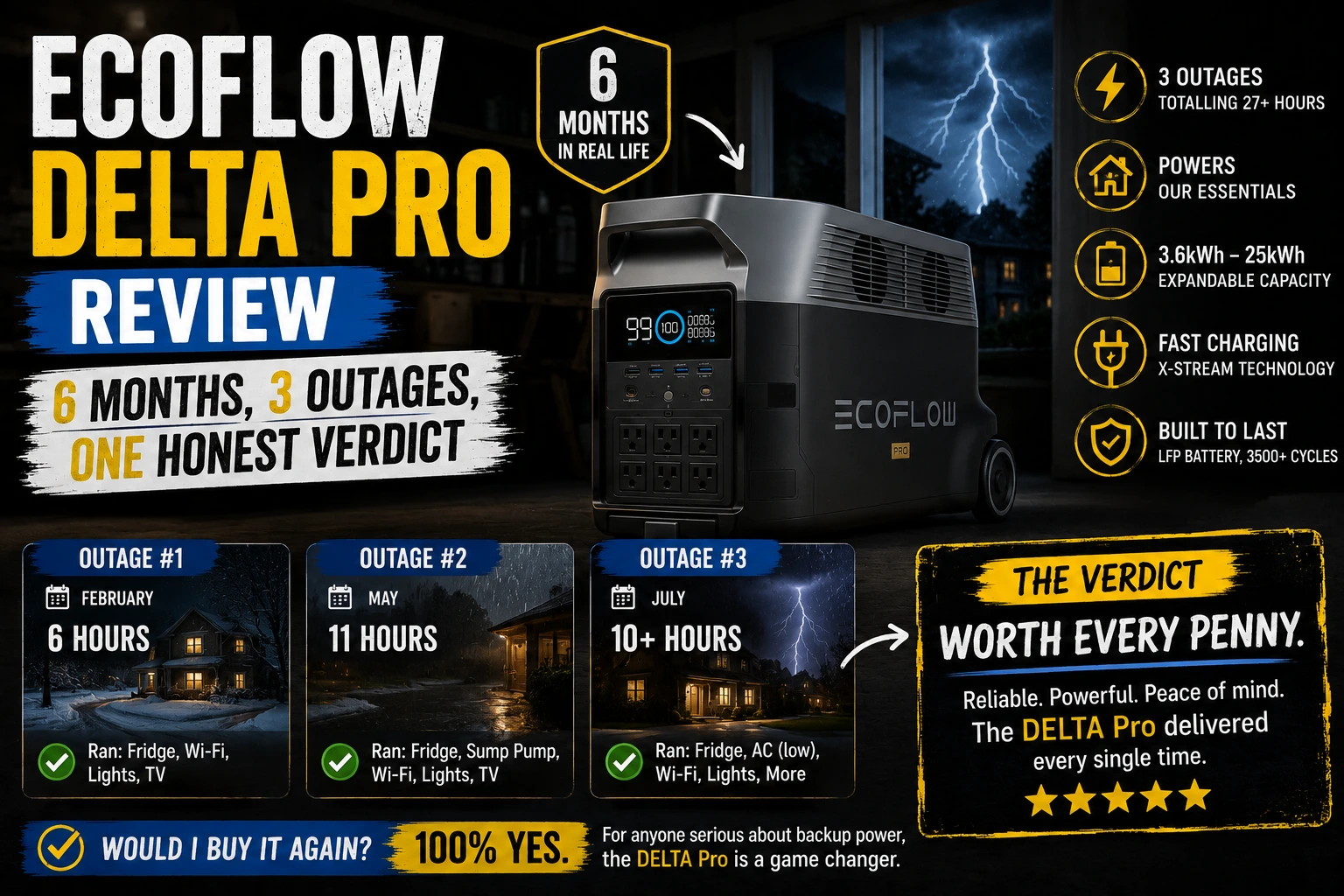
$2,499. That’s what I paid for the EcoFlow DELTA Pro during a Black Friday sale in November 2023. At the time, that felt like a significant amount of money to spend on something I hoped never to need urgently. Six months later, I’d used it through three separate outages and had a pretty complete picture of what this thing actually does — and where it falls short.
This isn’t a spec-sheet review. EcoFlow’s product page tells you the numbers. What I want to give you is the stuff that only shows up after months of real use: what the battery management does under load, how the app behaves during a stressful outage night, and the one thing I genuinely got wrong about this unit before I owned it.
The Three Outages — What Actually Happened
Outage #1 — February 2024 (11 hours)
This was a straightforward storm outage — strong winds, not a named storm, grid went down at 2:14 a.m. and came back just after 1 p.m. the next day. I had the DELTA Pro at 87% charge when the grid dropped.
Load: refrigerator, two LED lights, one CPAP machine without humidifier, phone charging.
The DELTA Pro handled this without drama. It was at 61% when power restored — which matched almost exactly with the projected draw from my earlier 14.8-hour test under real overnight load. No surprises. The app showed me real-time watt draw all night and I checked it twice before going back to sleep. That visibility is worth something. Staring at a percentage number that makes sense is genuinely calming during an outage in a way that “it should be fine” isn’t.
Outage #2 — June 2024 (31 hours)
This one was harder. A combination of heat-related grid stress and storm damage in my distribution area took power out for 31 hours across a stretch where daytime highs were hitting 94°F. I had two 200W solar panels set up — and this is where I started learning about the gap between theoretical solar input and real-world solar input.
On day one of the outage, I recovered about 840Wh through the panels between 10 a.m. and 4 p.m. EcoFlow claims up to 1,600W of solar input; I was running two 200W panels at an imperfect angle on a partially cloudy day. Real input was closer to 140W average across that six-hour window. That’s not a failure — that’s physics and panel angle — but it’s important to understand before you design your setup.
Net result: I started the outage at 91%, used down to 34% overnight, recovered to 57% via solar the next day, and the grid came back before the second night. Fine. But it was closer to the edge than I’d planned for. I’ve since bought a third 200W panel.
Outage #3 — September 2024 (19 hours, Helene-related)
Tropical Storm Helene clipped Jacksonville with enough wind and rain to take out my street’s power for 19 hours. By this point I had three solar panels and the DELTA Pro fully charged going in.
I added a window AC unit to the load for the overnight stretch — a 6,000 BTU unit pulling approximately 550W on its high setting. That’s a meaningful additional draw! The DELTA Pro handled the startup surge without tripping (the surge protection on the X-Boost inverter absorbed the compressor startup spike cleanly), and I ran the AC for about four hours before switching it off to preserve capacity for the next day.
Total draw over 19 hours with fridge, AC (4 hours), CPAP, lights, and charging: the unit went from 100% to 29%. That felt right given the load. I was honestly impressed that it absorbed the AC startup spikes without complaint — that’s not guaranteed with every inverter at this price point.
What Held Up Well
The X-Stream fast charging is real. Every time I recharged from a low state after an outage, the DELTA Pro went from 20% to 100% in under two hours on a standard 120V outlet with the X-Stream adapter. That recovery speed changes the math on multi-day preparedness. I’m not babysitting a slow charge for six hours — I plug in, walk away, and it’s full before dinner.
The app is genuinely the best in this category. I’ve used Bluetti’s app and Jackery’s app for comparison purposes. EcoFlow’s app wins — it’s not close. Real-time watt draw, charge scheduling, battery health status, solar input monitoring, remote control over charge rate — all of it works reliably. During the June outage, I was monitoring the unit from my phone while running errands, which let me make smarter decisions about when to run the AC and when to conserve.
The build quality feels serious. After six months of being moved in and out of my garage, plugged and unplugged dozens of times, and used in temperatures from 55°F to 93°F, there’s no play in any of the connectors, no rattles, no cosmetic wear that concerns me. It’s a heavy unit — 99 pounds — but the wheels and handle work well enough that one person can manage it without drama.
What Surprised Me (Not All of It Good)
The fan noise under heavy load is noticeable. When the DELTA Pro is pulling a high watt draw — the AC unit or the window charging a laptop at full speed — the internal cooling fan kicks up to a level that’s audible in a quiet room. Not loud enough to be a problem, but louder than I expected from a “silent” backup solution. At idle or low draw, it’s genuinely quiet. At 2,000W+ load, it sounds like a desktop computer working hard.
The display dims quickly and isn’t great in bright sunlight. A minor complaint, but real: the front display auto-dims after a short time and in direct Florida sun it’s essentially unreadable. The app compensates for this almost entirely, but if you want to glance at the unit status without unlocking your phone, it’s frustrating.
I got the solar input math wrong before I bought it. I assumed two 200W panels would deliver close to 400W on a sunny day. They deliver 300-350W on a genuinely clear day with good panel angle — and a lot less on partial cloud cover or poor angle. I should have planned for a third panel from the start. This isn’t EcoFlow’s fault; it’s my failure to properly account for real-world solar efficiency losses. But it’s worth saying clearly, because a lot of homeowners are going to make the same mistake.
How It Compares to What I Tested Before
When I ran the head-to-head comparison of how it compared against Jackery, Bluetti, and Anker, the DELTA Pro came out on top on every metric that matters for home backup: capacity, recharge speed, app quality, and load handling. Six months of real use hasn’t changed that verdict at all — it’s reinforced it.
The one scenario where the competition closes the gap is pure cost. If $2,500 is a hard ceiling, the Bluetti AC200MAX at $1,499 gives you reasonable overnight coverage at lower cost. The DELTA Pro’s advantage is the capacity headroom — that extra 1,500Wh means you’re not rationing anxiously. You’re sleeping.
Donna’s Take
My neighbor Donna bought an EcoFlow DELTA 2 Max — the smaller sibling at 2,048Wh — in early 2023 after her Ian experience. She’s been through two outages with it and texts me every time she does. Last time she wrote: “still impressed. fridge ran all night and I wasn’t even nervous.”
That’s the real metric, honestly. The power station you’re not nervous about.
The Verdict After Six Months
The EcoFlow DELTA Pro is the best portable power station I’ve tested for home backup — and six months of real use confirms what the bench tests suggested. The fast recharge, app quality, and capacity headroom are genuine advantages over the competition, not just spec-sheet claims.
The price is real. So is the performance. If your outage risk profile calls for serious capacity and you’re not willing to spend $10,000 on a standby generator, this is the unit I’d buy without hesitation — and I’d buy three solar panels from the start, not two.

Lived through four major grid outages since 2021 — including Hurricane Ian (2022) and Helene (2024). Spent over $6,200 testing portable power stations and comparing them against whole-home standby generators before finding a setup that actually works. Not an electrician. Not sponsored by anyone. Just a homeowner who got it wrong the first time and documented everything the second time.
Why I started this blog: I wasted $3,400 on the wrong power station during Ian prep and I couldn’t find a single blog that gave me real runtime numbers — not the ones printed on the box. I decided to test everything myself and write it down.
What I do: I run real-world runtime tests on portable power stations and standby generators. I track how long they actually power a fridge, window AC, CPAP, and phone chargers — not under ideal lab conditions, but during Florida summers with actual loads. I compare real purchase prices, warranty experiences, and manufacturer support against what homeowners actually need after a storm.