
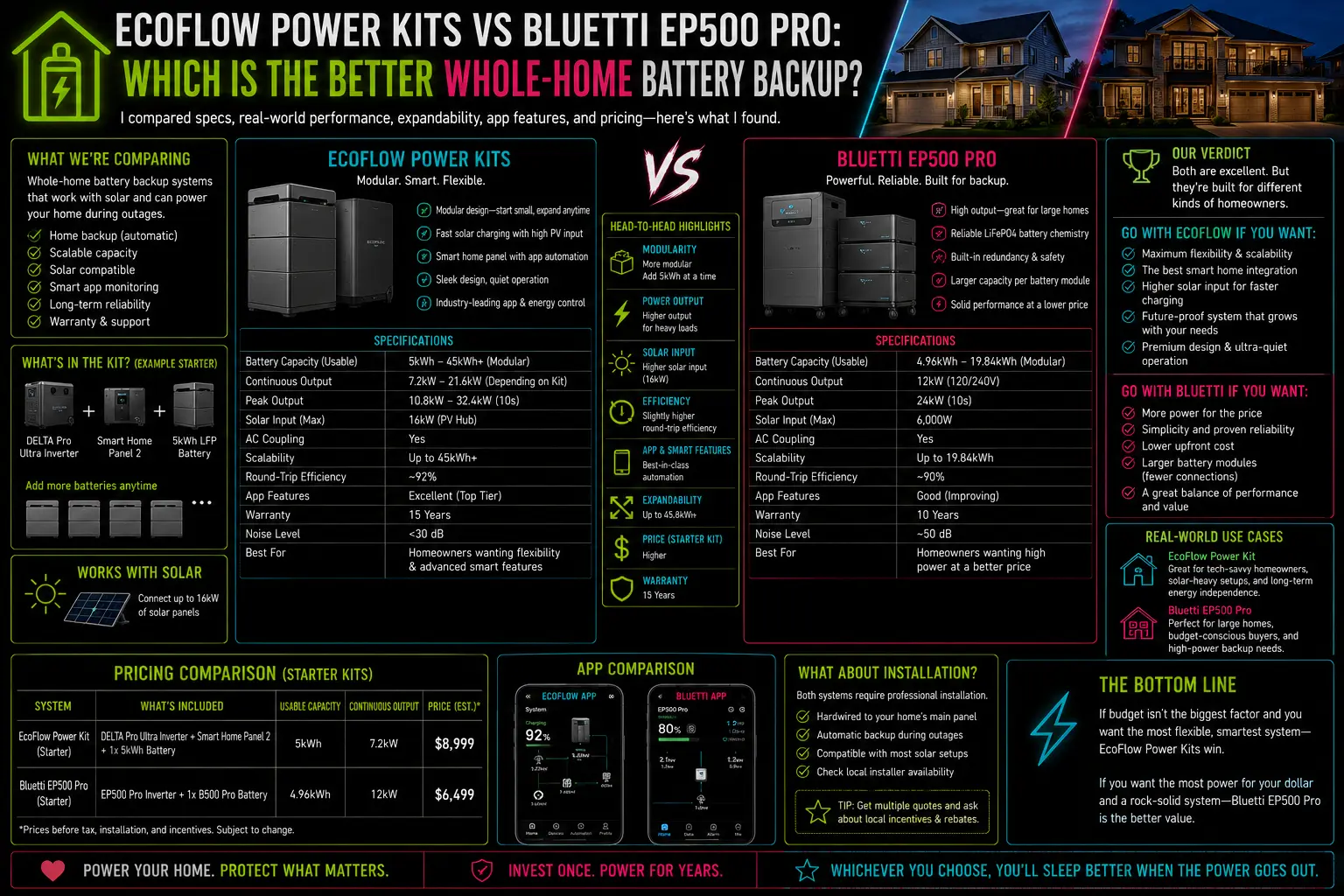
182 pounds. That’s the shipping weight of the Bluetti EP500 Pro. Ray found this out the same way most contractors do — not by reading the spec sheet first, but by watching two delivery men struggle it off a freight pallet and wheel it into a garage while the homeowner stood there looking mildly horrified.
“I asked him if he knew it weighed that much before he ordered it,” Ray told me. “He said he thought it was like a big battery, not like a refrigerator.”
That story captures something important about where this product category is right now. Both the Bluetti EP500 Pro and the EcoFlow Power Kit system — EcoFlow’s DELTA Pro Ultra-based ecosystem — are targeting homeowners who want serious, whole-home-adjacent backup capacity. Not camping gear. Not a unit you carry with one arm. These are systems that live in a designated spot in your garage or utility room and work as semi-permanent infrastructure.
That’s a different purchase than anything I’ve covered so far in this series. And it comes with different considerations that the portable power station playbook doesn’t fully address.
First: What Each Product Actually Is
This matters before comparing specs, because these are not equivalent categories of product.
The Bluetti EP500 Pro is a standalone unit. One box. It contains a 5,100Wh LiFePO4 battery, a 3,000W AC inverter, a solar charge controller, and all the management electronics in one wheeled enclosure. You place it, connect it to your electrical panel or plug in appliances directly, and it operates as a complete system out of the box. Weight: 182 lbs. It doesn’t move easily, but it does move if you have the right dolly and two reasonably fit people.
The EcoFlow Power Kit is a system, not a unit. The core is the EcoFlow Power Hub — a component that handles power distribution, inverter management, and charge control. You connect battery modules to the Hub (each module is 2,000Wh), and the system scales from roughly 2,000Wh to 15,360Wh depending on how many modules you add. The full DELTA Pro Ultra bundle starts around 6,144Wh. This is designed for semi-permanent installation, not casual repositioning. Ray describes it as “the battery version of what people used to do with a bank of golf cart batteries and a Victron inverter — except it’s considerably cleaner to set up.”
These are comparable in purpose but structurally different. One is plug-and-place; the other is a scalable platform.
Capacity: EP500 Pro Is a Single, Fixed Number. EcoFlow Is a Range.
Bluetti EP500 Pro: 5,100Wh. Full stop. You can pair two EP500 Pros together for 10,200Wh combined through Bluetti’s fusion box system, but each unit is a self-contained 5,100Wh. No modular expansion within a single unit.
EcoFlow Power Kit / DELTA Pro Ultra: Starts at 6,144Wh with three 2,048Wh battery modules. Can scale to 25,600Wh by adding more battery modules. The expandability is real and meaningful — if you start at 6,144Wh and find a year later you want more, you add a module rather than replacing the whole system.
For a homeowner who knows exactly how much capacity they need: the EP500 Pro at 5,100Wh is simpler and slightly cheaper as a standalone. For a homeowner who suspects their needs might grow — adding solar, adding an EV charger, planning a home office that needs backup coverage — the EcoFlow system’s scalability is a genuine advantage.
At 3,000W AC output, the EP500 Pro handles a window AC, refrigerator, CPAP, and device charging simultaneously without breaking a sweat. The EcoFlow Power Hub delivers up to 7,200W — enough for a wider range of simultaneous loads, though at that output level you’re approaching small whole-home coverage territory.
Solar Input: EcoFlow’s Clear Lead
The Bluetti EP500 Pro accepts up to 2,400W of solar input. Solid for a unit of this capacity — six 400W panels would theoretically fill it from 0–100% in just over two hours on a perfect clear day. More realistically, four panels on a good Florida day gets you 1,600W of real input and a full charge in around three hours of peak sun.
The EcoFlow Power Kit handles up to 6,000W of solar input with the right configuration. That’s a substantial ceiling — useful if you’re pairing this with a serious rooftop or ground-mount solar array rather than a couple of portable panels.
For a homeowner using portable or semi-permanent ground-mounted panels in the 400–1,200W range, both units handle the load fine. The EcoFlow ceiling matters primarily for homeowners planning a full solar + storage system where the battery is paired with substantial installed capacity.
The Installation Difference — And Why It Actually Matters
This is where Ray’s perspective becomes the most relevant input.
The Bluetti EP500 Pro is designed for direct connection or for use as a plug-in backup station — similar in concept to a large UPS. You can run extension cords and power strips from it, or you can have an electrician wire it into a dedicated circuit for specific loads. It’s not a transfer switch installation; it’s a more manual setup. For most homeowners who want to keep a refrigerator, some lights, and medical devices running without professional installation, this is straightforward.
The EcoFlow Power Kit is designed to connect to your home’s electrical panel with a proper transfer switch or smart panel integration. EcoFlow makes the Smart Home Panel 2 specifically for this — it allows the system to automatically manage which home circuits receive backup power when the grid is down. This requires professional installation; it’s not a DIY job unless you’re a licensed electrician working on your own property.
Ray’s observation from the two EcoFlow Power Kit installs he’s done: “It’s cleaner than wiring in a standby generator because there’s no gas line and no exhaust considerations. But it’s still an electrical job — permit, panel work, load calculation. Nobody should be doing this themselves.”
⚠️ Direct safety point: If you buy an EP500 Pro and want to power hard-wired appliances like a well pump or HVAC, you’re getting into transfer switch territory regardless of which brand you choose. That means a licensed electrician, a permit, and an inspection. The unit itself is not inherently dangerous to plug into; the electrical integration work requires professional involvement. This isn’t optional cautionary language — it’s the legal and safety reality of working with your home’s electrical panel.
Battery Chemistry and Longevity
Both units use LiFePO4 (lithium iron phosphate) chemistry. This is the correct chemistry for stationary backup use — it’s thermally stable, has a long cycle life, and doesn’t carry the fire risk profile of older lithium cobalt oxide cells.
Bluetti EP500 Pro: Rated for 3,500 cycles to 80% capacity. At one full cycle per week (which would be heavy use for a backup system), that’s roughly 67 years of weekly use before the battery hits 80% of original capacity. In practice, most homeowners won’t cycle these units more than 20–40 times per year, making the cycle life essentially irrelevant.
EcoFlow DELTA Pro Ultra (Power Kit): Battery modules rated at 6,000+ cycles to 80% capacity. Higher ceiling, though again — at typical backup use frequency, the difference is academic.
Where chemistry matters more: operating temperature range. Both units should be stored in climate-controlled or at minimum temperature-regulated spaces. LiFePO4 handles cold better than other lithium chemistries, but charging below freezing still requires care. Neither unit should sit in an uninsulated Florida garage in August if you want the battery management system operating in its optimal range — though Ray notes both are more tolerant of heat than people expect at operating temperatures up to 40°C (104°F).
Pricing: Real Numbers, Not MSRP
Both brands run sales constantly. Never buy at full list price.
Bluetti EP500 Pro: MSRP $4,999. Actual purchase price during Black Friday, Prime Day, or seasonal promotions: typically $3,299–$3,499. I’ve seen it as low as $2,999 with bundled panels during peak sale events.
EcoFlow Power Kit / DELTA Pro Ultra bundle: Entry-level bundle (Power Hub + three battery modules + Smart Home Panel 2) starts around $3,499–$4,999 depending on configuration and current promotions. The system gets expensive as you add modules — a 15,360Wh configuration can run $8,000–$10,000 for hardware alone before installation.
For an equivalent comparison — roughly 5,000Wh of capacity with the ability to connect to a home panel — the EP500 Pro wins on upfront cost. If expandability is a priority, the EcoFlow system’s modular structure starts making sense even though the entry price is similar.
Neither price includes professional installation if you want panel integration. Budget $800–$2,000 for electrical work depending on your home’s panel complexity and local permit requirements.
Software and Remote Monitoring
EcoFlow’s app ecosystem is better. This is a consistent pattern across their product line, and it holds at this tier as well. The EcoFlow app gives real-time load monitoring, charge history, solar input tracking, and remote circuit control through the Smart Home Panel 2. Practical and genuinely useful.
Bluetti’s app for the EP500 Pro is functional — you get status, charge level, and input/output monitoring. It doesn’t have the same depth of load management. For homeowners who want to see exactly which circuits are drawing power and actively manage the system from their phone, EcoFlow has the edge.
This gap matters more than it might sound. During a multi-day outage, understanding your actual draw versus your remaining capacity — in real time, from your phone — is the difference between managing the situation calmly and running the battery to 8% at 2am because you weren’t tracking it.
The Move Problem
One more thing Ray mentions to every customer looking at this capacity tier: these units don’t move easily once placed. The EP500 Pro at 182 lbs is technically mobile with its integrated wheels — on a flat, smooth surface. Over a threshold. Up a single step. Not across a gravel driveway, not up a garage step without a ramp, and certainly not without two people or a proper appliance dolly.
Where you place it is largely where it lives. Plan accordingly before delivery. Ray has seen two homeowners decide after installation that they wanted the unit in a different location — both times, it was a significant project to move.
What Ray Would Actually Install
At his own house. His specific answer: “EP500 Pro for a simple plug-and-play setup, EcoFlow system if I’m doing it with panel integration and want room to expand.”
His reasoning: for a homeowner who wants a large backup battery without professional electrical work, the EP500 Pro is the cleaner, less expensive solution. It’s a complete unit. You place it, connect critical appliances directly, and it covers what it covers.
For a homeowner planning a solar + storage system over the next few years — especially one who might add an EV charger or expand coverage — the EcoFlow modular approach makes the upfront investment pay off over time.
Both represent a different category of commitment than the portable power stations I covered in my experience with EcoFlow’s ecosystem starting from the DELTA Pro, and both belong in a conversation that also includes the standby generator comparison for homeowners who’ve already decided on permanent installation.
If you’re undecided between a large portable station and one of these systems — and you don’t have specific whole-home coverage requirements — the DELTA Pro with an expansion battery is still a more flexible, lower-commitment starting point. These are the products you graduate to when you’ve already decided you want more and you know what that more looks like.
Side by Side
| Bluetti EP500 Pro | EcoFlow Power Kit (DELTA Pro Ultra) | |
|---|---|---|
| Capacity | 5,100Wh (fixed) | 6,144Wh+ (expandable to 25,600Wh) |
| AC Output | 3,000W (6,000W surge) | 7,200W continuous |
| Max Solar Input | 2,400W | 6,000W |
| Battery Chemistry | LiFePO4 | LiFePO4 |
| Cycle Rating | 3,500 cycles to 80% | 6,000+ cycles to 80% |
| Weight | 182 lbs (wheeled) | Modular — Hub + separate battery modules |
| Mobile? | Technically yes, barely | No — designed for fixed installation |
| Panel integration | Manual/direct | Smart Home Panel 2 (semi-automatic) |
| App quality | Good | Excellent |
| Sale price range | $2,999–$3,499 | $3,499–$4,999 (entry config) |
| Installation needed | DIY plug-in OK | Electrician for panel integration |
| Ray’s pick | Simple plug-and-play | Panel integration + future expansion |

Lived through four major grid outages since 2021 — including Hurricane Ian (2022) and Helene (2024). Spent over $6,200 testing portable power stations and comparing them against whole-home standby generators before finding a setup that actually works. Not an electrician. Not sponsored by anyone. Just a homeowner who got it wrong the first time and documented everything the second time.
Why I started this blog: I wasted $3,400 on the wrong power station during Ian prep and I couldn’t find a single blog that gave me real runtime numbers — not the ones printed on the box. I decided to test everything myself and write it down.
What I do: I run real-world runtime tests on portable power stations and standby generators. I track how long they actually power a fridge, window AC, CPAP, and phone chargers — not under ideal lab conditions, but during Florida summers with actual loads. I compare real purchase prices, warranty experiences, and manufacturer support against what homeowners actually need after a storm.