
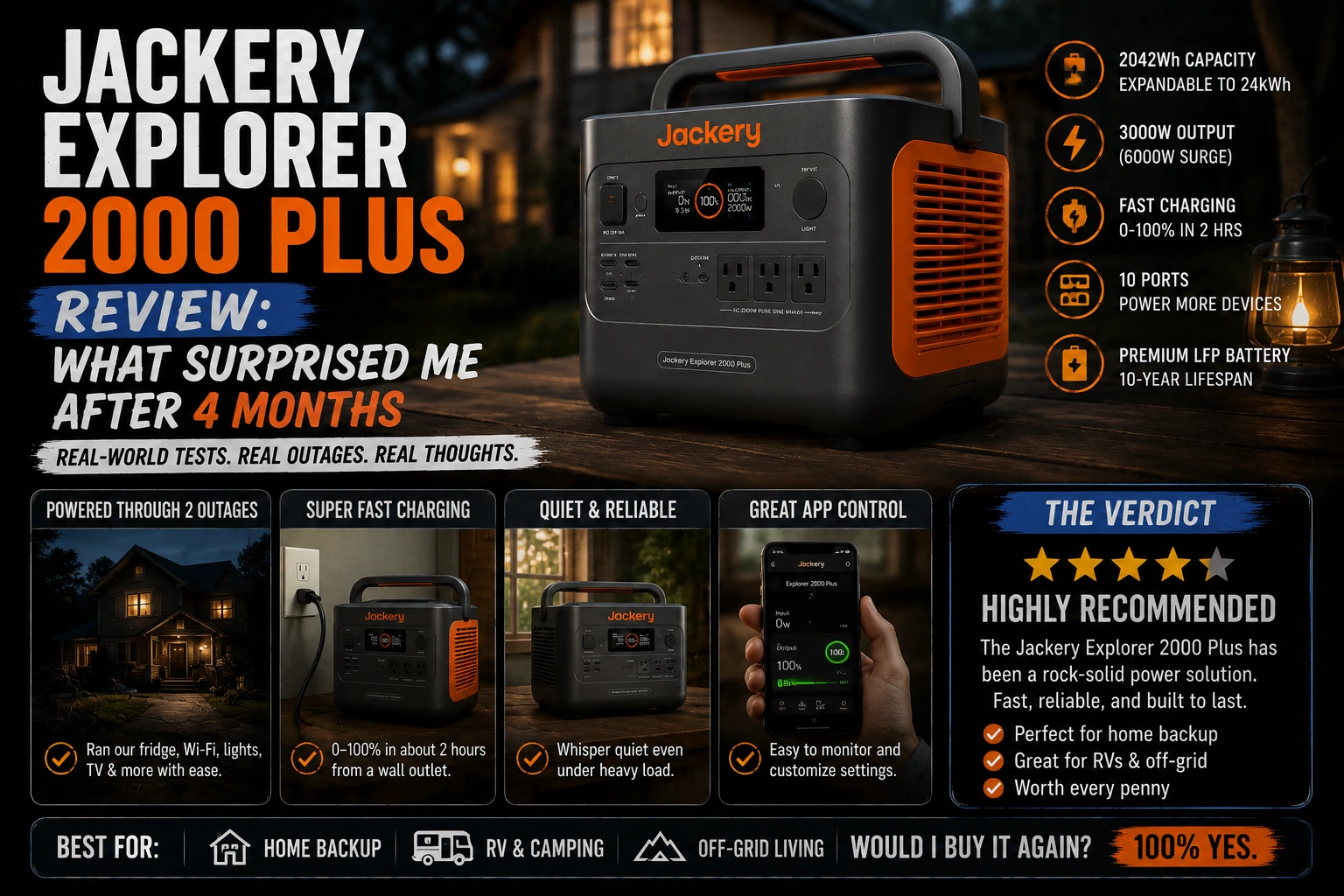
Chris texted me on a Sunday morning — one of those long texts that shows up as a wall of words before you’ve had coffee. He’d just seen my last comparison post and wanted to know why I hadn’t given the Jackery Explorer 2000 Plus more credit. “You made it sound like a consolation prize,” he said. Chris, as I’ve mentioned before, is the guy with the $12,400 Generac in Austin, so his suddenly coming to bat for a $1,000 portable power station was — interesting.
He wasn’t wrong, though. I’d been so focused on the head-to-head against the DELTA Pro that I hadn’t given the Jackery its own proper look. So here it is.
Before I get into it — I genuinely wasn’t sure if I’d be writing this week. I had a fever that flattened me, and I figured I’d just disappear for a day and nobody would notice. Then my inbox started filling up with emails. People asking if I was okay, telling me to rest, a few of them saying they’d been checking the site and were worried. I was not expecting that at all, and I’m not going to pretend it didn’t get me a little emotional — because it did. A lot, actually. Thank you. Really. I’m better now, and that kind of thing makes you want to show up and write even when your throat still sounds like sandpaper.
Okay — Jackery.
Four Months With the Explorer 2000 Plus
I borrowed this unit from a friend who bought it in late 2023 and used it through two outages before moving to a larger setup. Four months of notes, two outage events, and a handful of deliberate load tests.
The first thing worth saying is that the Jackery Explorer 2000 Plus is better built than it looks in product photos. The chassis is solid, the handle is properly reinforced, and the display — which I mentioned holds up better in sunlight than the DELTA Pro’s — is genuinely readable outdoors. At 61 pounds, it’s manageable for one person without wheels. That weight advantage over the DELTA Pro’s 99 pounds is real and matters if you’re moving the unit between a storage room and a living space.
The AC output — three standard outlets at 2,200W continuous — is more than enough for the typical home backup load list. Fridge, lights, CPAP, device charging — no issues whatsoever. The pure sine wave inverter is clean, meaning no buzzing or flickering with sensitive electronics. My friend ran his home office setup (two monitors, desktop, router) off the Jackery during one outage without a single hiccup.
What Surprised Me
Two things I didn’t fully expect going in.
How quiet the cooling fan is. The DELTA Pro gets noticeably loud under heavy load — I’ve mentioned this before. The Jackery 2000 Plus runs meaningfully quieter under the same conditions. For bedroom use with a CPAP, this matters more than any spec sheet suggests. It runs all night without being a presence you’re aware of.
How the solar input performs in practice. The Jackery accepts up to 1,000W of solar, and I went in expecting sub-par MPPT performance based on some community forum feedback I’d read. In practice, on clear Florida days with two 200W panels properly angled, I was seeing 340–370W of real input consistently. That’s solid. It won’t loop through a multi-day outage as efficiently as the DELTA Pro’s higher ceiling — but for a single overnight use with a daytime solar top-up, the Jackery handles that cycle fine.
Where It Falls Short
The runtime gap versus the DELTA Pro is not abstract — it’s visceral when you’re watching the percentage drop. In the original four-way test, the Jackery gave me 6.9 hours under a full overnight load. That’s dinner to roughly 1 a.m. It’s not a full night.
To be fair, the math is just the math — 2,042Wh divided by 165W average draw doesn’t produce a different number no matter how good the unit is. The Jackery isn’t failing at 6.9 hours. It’s doing exactly what its capacity allows. But if you go in expecting “overnight coverage” without running those numbers first, you’ll be surprised in an uncomfortable direction.
The app is the other honest limitation. Functional, not frustrating — but thin. If you want real-time watt draw with a fast refresh rate, a clear solar input breakdown, and the ability to set charge limits remotely, the Jackery app doesn’t deliver that. It tells you what percentage you’re at and a rough input/output figure. That’s it. For a lot of homeowners, that’s enough. For someone who wants to monitor an outage from bed without walking to the garage, it isn’t.
My Take
Chris’s defense of this unit wasn’t wrong. The Jackery Explorer 2000 Plus is genuinely good at what it promises — solid overnight backup for critical loads, reliable build quality, quieter fan than the competition, and a price point that makes it accessible to homeowners who aren’t ready to spend $2,500 on backup power.
It’s not a replacement for the DELTA Pro if you need 48–72 hours of serious coverage. I covered how it stacks up directly against the EcoFlow DELTA Pro in full if you want that comparison. But as a standalone product, evaluated on its own terms at its own price? The Jackery 2000 Plus earns it.
If your budget sits around $1,000–$1,300 and your outage history is “one bad night every couple of years,” this is the unit I’d point you toward without hesitation. Buy it from Jackery’s official site where you can verify warranty terms — five years on the battery, two years on the unit — before purchasing.

Lived through four major grid outages since 2021 — including Hurricane Ian (2022) and Helene (2024). Spent over $6,200 testing portable power stations and comparing them against whole-home standby generators before finding a setup that actually works. Not an electrician. Not sponsored by anyone. Just a homeowner who got it wrong the first time and documented everything the second time.
Why I started this blog: I wasted $3,400 on the wrong power station during Ian prep and I couldn’t find a single blog that gave me real runtime numbers — not the ones printed on the box. I decided to test everything myself and write it down.
What I do: I run real-world runtime tests on portable power stations and standby generators. I track how long they actually power a fridge, window AC, CPAP, and phone chargers — not under ideal lab conditions, but during Florida summers with actual loads. I compare real purchase prices, warranty experiences, and manufacturer support against what homeowners actually need after a storm.