
Okay — ahem — before we get into it. I owe you an apology for yesterday. I had a proper fever. Like, 101.4°F, blanket-on-the-couch, refusing-to-move kind of fever. The kind where even looking at a screen felt like a personal attack. I did not post. I am sorry about that.
I’m better today. Mostly. Cough. Still a little rough around the edges, if I’m being honest — my throat sounds like a gravel road and I’ve had more tea in the last 18 hours than in the previous six months combined. But sitting here doing nothing while I have a draft half-written felt worse than finishing it. Writing is genuinely fun for me, even when my head is mildly foggy. So here we are. Bear with me if a sentence or two reads slightly off — I proofread it twice, which is once more than usual, so we should be fine!
— Marcus
$1,558. That’s the price difference between these two units at their typical sale prices — $2,499 for the EcoFlow DELTA Pro, $999 for the Jackery Explorer 2000 Plus when it’s on promotion. That gap is significant enough to decide the comparison for a lot of homeowners before they read a single spec. And honestly? For some situations, it should.
But the question isn’t just which one costs more. It’s whether the DELTA Pro’s extra $1,558 buys you something real — or whether you’re paying for brand premium and a fancier app.
I’ve run both units through real load tests in Florida heat, and I’ve had six months of real DELTA Pro outage data to build on. This is the head-to-head I’d want to read before spending this kind of money.
The Fundamental Difference Before Anything Else
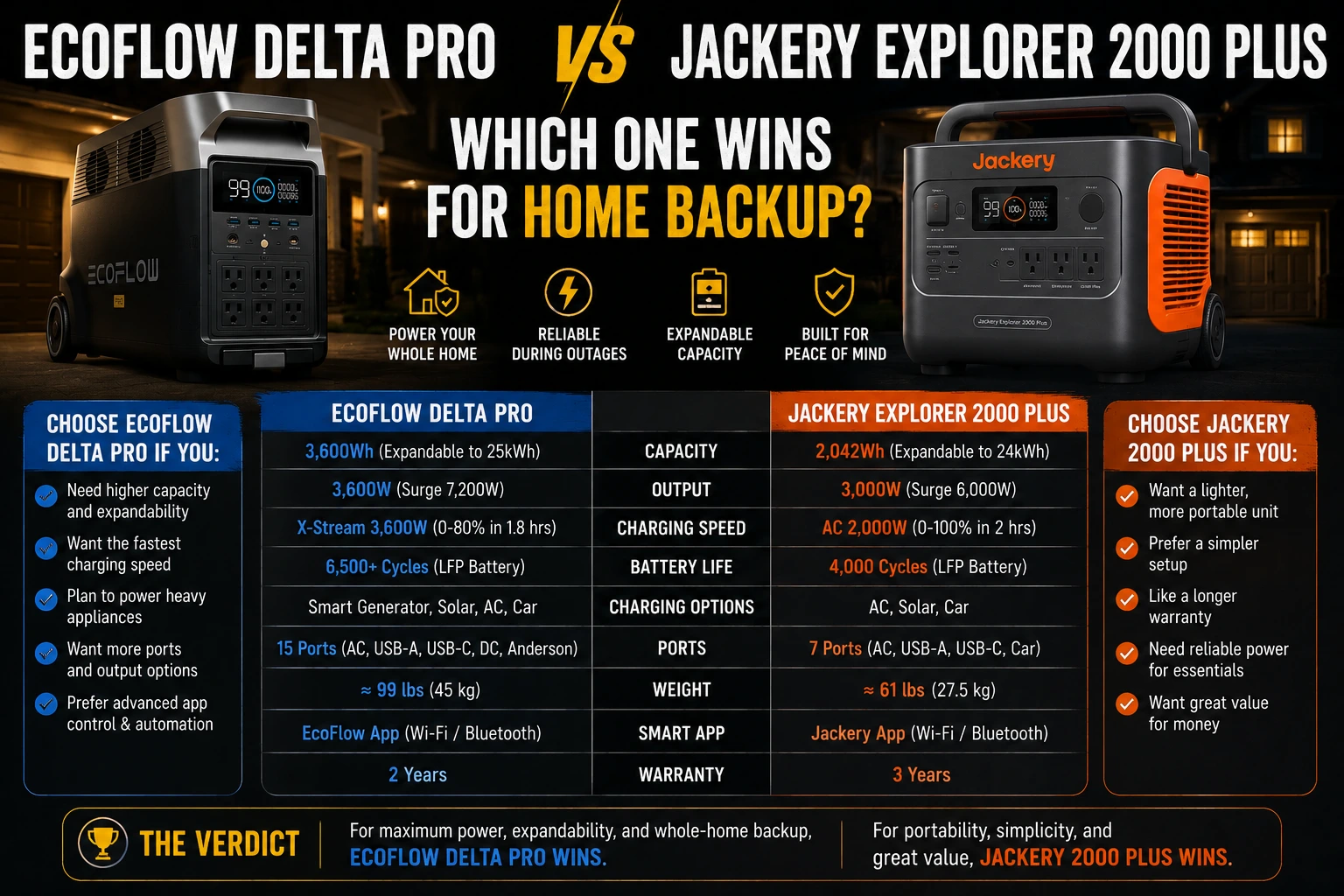
The EcoFlow DELTA Pro is a 3,600Wh unit. The Jackery Explorer 2000 Plus is a 2,042Wh unit. That’s a 76% difference in raw capacity. Everything else in this comparison flows from that gap — runtime, multi-day viability, how much rationing you do during a 48-hour outage.
The two units aren’t really competing for the same homeowner. The DELTA Pro is built for “I want to sleep comfortably through a 48-72 hour outage without making anxious calculations every three hours.” The Jackery 2000 Plus is built for “I need serious coverage for one night and a recharge source for the second day.” Both are legitimate needs. They just aren’t the same need.
Capacity and Real-World Runtime
In my original four-way comparison, I ran both units through the same load — refrigerator, two LED lights, CPAP without humidifier, and device charging. Average draw: 160–175W with fridge cycling spikes to 600W. Testing environment: my Jacksonville garage at 87–93°F ambient.
EcoFlow DELTA Pro: 14.8 hours under that combined load. Jackery Explorer 2000 Plus: 6.9 hours under the same combined load.
That’s more than double the runtime. On a practical level: the DELTA Pro carries you comfortably from dinner to breakfast and into the next morning. The Jackery gets you through the night — but just barely, with limited buffer.
For a 24-hour outage, the Jackery’s result is adequate. You make it through one night, grid comes back the next day, done. For a 48-hour outage — the kind that follows a serious storm — the Jackery math gets uncomfortable. You’ll need a recharge source after that first night, whether that’s solar or a friend with a generator.
The DELTA Pro has enough headroom that a 48-hour outage on critical loads is manageable without stressful rationing. That’s the real difference, and it’s worth paying attention to.
Recharge Speed: Where the Gap Widens Further
This is the spec that most comparison posts underweight. Ahem — I think it’s actually one of the two or three most important specs for home backup use, and here’s why.
After an outage ends — or between storm days when you have partial sun — how fast you recover capacity determines whether you’re ready for the next event. A slow recharge means you might start a second outage night at 60% instead of 100%. That’s a problem.
EcoFlow DELTA Pro (AC wall charge, X-Stream enabled): 20% → 100% in approximately 1 hour 48 minutes.
Jackery Explorer 2000 Plus (AC wall charge): 20% → 100% in approximately 2 hours.
The AC charge speeds are actually close — EcoFlow edges it but not dramatically. Where they diverge is on solar recharge.
The DELTA Pro accepts up to 1,600W of solar input via its combination of XT60 and MC4 connectors. In practice with three 200W panels on a clear day, I’m seeing 480–520W of real input — recovering around 2,000–2,500Wh across a six-hour peak window.
The Jackery 2000 Plus accepts up to 1,000W of solar input. With the same three-panel setup, real-world input runs slightly lower due to the Jackery’s MPPT controller behavior under sub-optimal conditions — I saw 380–420W average across testing. That still recovers meaningful capacity during daylight, but the ceiling is lower.
For multi-day storm scenarios where you’re relying on solar to loop through, the DELTA Pro’s higher solar input ceiling is a genuine advantage.
Inverter Quality and Surge Handling
Both units use pure sine wave inverters, which is what you want for sensitive electronics and motor-driven appliances like refrigerators and AC units. Neither one is going to damage your devices.
The difference shows up in surge handling. My window AC unit (6,000 BTU) pulls approximately 550W running and spikes to around 1,800W on compressor startup. Both units handled this without tripping — good! But the DELTA Pro’s X-Boost technology is designed to intelligently manage startup surge loads up to 7,200W, which means headroom for larger appliances I haven’t even tried yet.
The Jackery’s 4,000W surge rating is more than enough for standard home appliances. If you’re running a fridge, CPAP, lights, and device charging — which covers most homeowners’ needs — you’ll never push the Jackery close to its surge limit.
App and Software Experience
Cough. This section is where I become a bit of a broken record, because I’ve said it before and I’ll say it again: EcoFlow’s app is substantially better.
The EcoFlow app gives you real-time watt draw with a one-second refresh rate. You can see input and output simultaneously, set charge limits, schedule charging windows for off-peak electricity rates, monitor solar panel performance individually, and control the unit remotely over Wi-Fi. I’ve used it to check my garage unit from my bedroom at 2 a.m. during an outage — confirmed the draw rate was normal, saw the projected remaining runtime, went back to sleep. That peace of mind is not trivial.
The Jackery app is functional. It gives you battery percentage, basic input/output data, and a few settings. It doesn’t crash. It’s just… not as informative. The refresh rate feels slow compared to EcoFlow, and the solar monitoring is less detailed.
If you’re the type of person who wants to glance at your phone once during an outage night and get complete information, the EcoFlow app experience is meaningfully superior. If you’re the type who checks the unit’s front display once before bed and sleeps fine, the Jackery app’s limitations won’t bother you.
Build Quality and Physical Design
Both units feel well-built. Neither one has the cheap plastic feel of budget Amazon units.
The DELTA Pro is heavier — 99 pounds versus the Jackery 2000 Plus’s 61 pounds. The Jackery’s lower weight is a genuine advantage if you’re moving the unit frequently. One person can carry the Jackery with some effort. The DELTA Pro’s wheels and handle work well for rolling, but it’s not a unit you lift casually.
The DELTA Pro’s port selection is more extensive: multiple AC outlets, USB-A, USB-C (with fast charge), a 12V car port, and the solar/XT60 input ports. The Jackery 2000 Plus covers the same categories with slightly fewer total ports — three AC outlets versus the DELTA Pro’s five, for example — but for home backup use, the Jackery’s port count is adequate.
One thing Jackery does slightly better: the front display is brighter and more readable in direct sunlight. I mentioned in my DELTA Pro review that the screen dims quickly and goes nearly invisible in outdoor Florida sun. The Jackery’s display holds up better in bright light. Minor, but real.
What Donna Would Tell You
My neighbor Donna — who went from zero backup power to “I will never live without one again” after Ian — bought the EcoFlow DELTA 2 Max, which sits between these two units in capacity. When I showed her the Jackery 2000 Plus price on sale at $999, she said something I thought was pretty astute: “It’s not about the first night. It’s about the third night.”
She’s right. During a minor outage, both of these units are fine. The decision lives in the stress scenario — the 72-hour outage, the multi-day storm, the situation where you really need the backup to work without constant management. For that scenario, the DELTA Pro’s capacity headroom changes how you experience the outage.
That said! Donna also acknowledged that if she’d had a firm $1,200 budget, the Jackery would have been the right call. You don’t get to buy the perfect unit with a budget that doesn’t support it. Buy the best unit your budget actually allows, set it up correctly (setting it up correctly matters more than most people think), and you’ll be dramatically better off than you were.
Side-by-Side Comparison
| EcoFlow DELTA Pro | Jackery Explorer 2000 Plus | |
|---|---|---|
| Capacity | 3,600Wh | 2,042Wh |
| AC Output | 3,600W (7,200W surge) | 2,200W (4,000W surge) |
| Real Runtime (my test load) | 14.8 hours | 6.9 hours |
| AC Recharge Speed | ~1h 48m (X-Stream) | ~2 hours |
| Max Solar Input | 1,600W | 1,000W |
| Weight | 99 lbs (wheeled) | 61 lbs |
| App Quality | Excellent | Adequate |
| Typical Sale Price | ~$2,400–$2,499 | ~$999–$1,299 |
Verdict
Buy the EcoFlow DELTA Pro if: You’re in a storm-prone state, you’ve experienced multi-day outages before, your critical load includes a window AC unit, and you want to sleep through an outage without anxious runtime calculations. The $1,500 premium over the Jackery is real — but so is the capacity difference, and that difference is exactly what determines whether you’re comfortable or rationing on night two.
Buy the Jackery Explorer 2000 Plus if: Your budget has a ceiling around $1,000–$1,300, your outage history is mostly 12–24 hour events, and you have a solar panel or generator recharge source available for multi-day situations. It’s a legitimate product that works as advertised. Don’t let anyone talk you into spending money you don’t have on a capacity you don’t need.
The price gap is large enough that budget has to be part of the honest answer. Both are good units. They serve different outage profiles, and only you know which one matches yours.

Lived through four major grid outages since 2021 — including Hurricane Ian (2022) and Helene (2024). Spent over $6,200 testing portable power stations and comparing them against whole-home standby generators before finding a setup that actually works. Not an electrician. Not sponsored by anyone. Just a homeowner who got it wrong the first time and documented everything the second time.
Why I started this blog: I wasted $3,400 on the wrong power station during Ian prep and I couldn’t find a single blog that gave me real runtime numbers — not the ones printed on the box. I decided to test everything myself and write it down.
What I do: I run real-world runtime tests on portable power stations and standby generators. I track how long they actually power a fridge, window AC, CPAP, and phone chargers — not under ideal lab conditions, but during Florida summers with actual loads. I compare real purchase prices, warranty experiences, and manufacturer support against what homeowners actually need after a storm.