
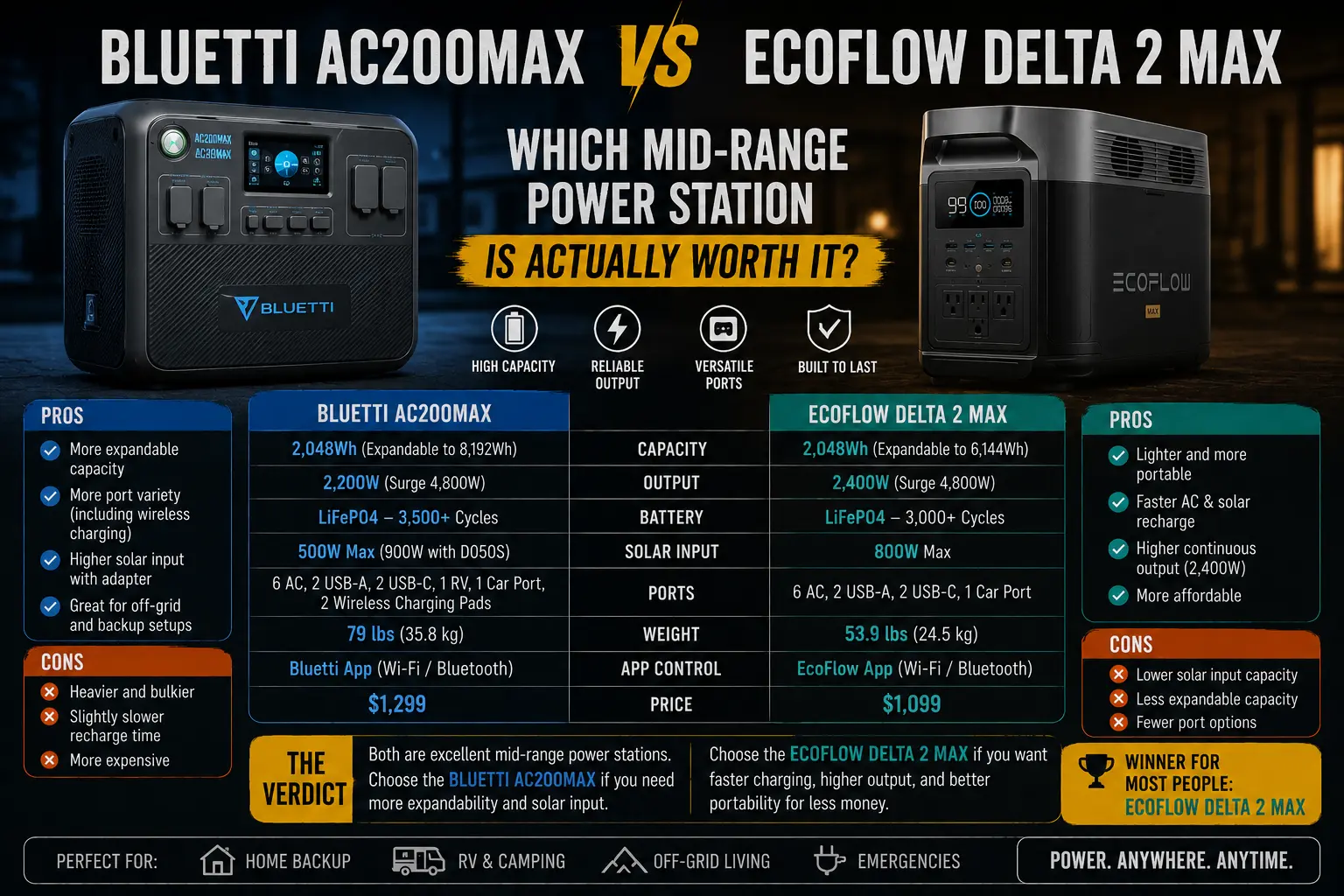
$299. That’s the price difference between these two units at their most common sale prices — the Bluetti AC200MAX at around $1,199–$1,499 and the EcoFlow DELTA 2 Max at $1,499–$1,699. A gap that narrow makes this comparison genuinely difficult, because both units land in the same tier and go after the same homeowner: someone who’s serious about backup power, doesn’t want to spend $2,500 on a DELTA Pro, and isn’t going to settle for a 1,000Wh unit that gives them one nervous night.
I’ve spent time with both. Here’s where they’re different — and which one I’d hand to a specific type of homeowner without hesitation.
The Numbers
Both units are rated at just over 2,000Wh — the AC200MAX at 2,048Wh, the DELTA 2 Max at 2,048Wh as well. Identical on paper. The divergence shows up everywhere else.
The Bluetti AC200MAX outputs 2,200W AC continuous with a 4,800W surge rating. The EcoFlow DELTA 2 Max outputs 2,400W AC continuous with a 5,000W surge. The EcoFlow edges ahead on both, though for the standard home backup load list — fridge, CPAP, lights, device charging — neither unit is being pushed anywhere near its limits.
Where it gets more interesting: expandability. The AC200MAX supports up to two add-on battery modules (B230 at 2,048Wh each or B300 at 3,072Wh each), pushing total system capacity to a maximum of 8,192Wh without replacing the base unit. That’s a legitimate whole-home-ish setup for under $5,000 if you build it out.
The DELTA 2 Max supports one add-on battery (the DELTA 2 Extra Battery, 2,048Wh), doubling your capacity to 4,096Wh total. Useful — but the ceiling is lower than Bluetti’s.
If you’re buying for today and expanding later, that gap matters.
Real Runtime — Same Test on Both Units
In my earlier four-way test I ran the AC200MAX through the same load I use for all my testing: fridge, two LED lights, CPAP without humidifier, phone and laptop charging. Average draw: 160–175W with compressor cycling spikes.
AC200MAX result: 10.1 hours to 10% remaining.
I ran the DELTA 2 Max through the same test more recently, in my Jacksonville garage at 89°F ambient.
DELTA 2 Max result: 9.6 hours to 10% remaining.
The Bluetti came out slightly ahead on efficiency — its inverter handles this kind of cycling residential load cleanly. A gap of half an hour isn’t something you’d notice in an actual outage, but it reinforces what Ray told me when I first started testing these: Bluetti’s hardware team consistently delivers, even when the software team doesn’t keep up.
Recharge Speed — This Is Where EcoFlow Pulls Away
AC wall recharge is where the two units separate most clearly.
The AC200MAX charges from 0–100% in approximately 3.5 hours on standard AC. That’s not slow — but it’s not fast either.
The DELTA 2 Max charges from 0–100% in approximately 1 hour 20 minutes using EcoFlow’s X-Stream fast charging on a standard 120V outlet.
That’s more than twice as fast. For multi-day storm scenarios where you’re recharging between events, the DELTA 2 Max’s recovery speed changes the practical math significantly. You plug in when the grid comes back, it’s full before dinner. The AC200MAX is still charging.
Solar input follows a similar pattern. The DELTA 2 Max accepts up to 1,000W of solar. The AC200MAX accepts up to 900W. Both are adequate; neither is the DELTA Pro’s 1,600W ceiling. For two 200W panels on a clear day, you’re looking at 320–370W of real input on either unit — roughly equivalent in practice.
The App Situation (I’ve Said This Before, But It Bears Repeating)
EcoFlow’s app is better. It has been better every time I’ve compared it. Real-time watt draw, remote control, charge limit setting, solar monitoring with fast refresh. It works the way you want it to work when you’re checking your unit at 2 a.m. during an outage.
Bluetti’s app functions. It gives you percentage, basic input/output, a few settings. It crashed on me twice over a two-week period. The refresh rate makes you feel like you’re reading a slightly delayed ticker rather than live data.
This doesn’t make the AC200MAX a bad product — the hardware genuinely doesn’t care what the app looks like. But if software experience influences how confidently you manage an outage, it’s a real factor. Even Tom’s Guide’s power station coverage has flagged Bluetti’s app as the brand’s most consistent weak point across multiple reviews. It’s not just me.
Build and Portability
The AC200MAX weighs 61.9 lbs. The DELTA 2 Max weighs 53 lbs. Both are one-person portable without wheels, though the DELTA 2 Max is meaningfully lighter — you notice eight pounds when you’re carrying something across the house.
Both have similar port selections: multiple AC outlets, USB-A, USB-C with fast charging, and 12V outputs. Neither is lacking for a home backup scenario.
One physical difference worth noting: the AC200MAX’s display is clear and bright, readable outdoors in decent light. The DELTA 2 Max’s display dims quickly in direct sun — a minor annoyance I’ve mentioned about EcoFlow units before. The app compensates, but it’s a pattern across their lineup.
Who This Is Actually For
Buy the Bluetti AC200MAX if your priority is future expandability. If there’s any chance you’ll want to add battery capacity within the next two years — and you’re in a storm-prone state where outages can stretch past 48 hours — the AC200MAX’s expansion path to 8,192Wh is genuinely valuable and cheaper per watt than buying a second standalone unit. The slower recharge and weaker app are real trade-offs. For a homeowner who plans to grow the system, they’re acceptable ones.
Buy the EcoFlow DELTA 2 Max if you want the best out-of-box experience, you’re not planning to expand, and the recharge speed matters to your situation. Its fast charging, better app, and lighter weight make it the more polished product at a similar price. It also fits naturally into the EcoFlow ecosystem if you already own a DELTA Pro — the accessories, cables, and app experience carry over.
One thing both units share: neither is the Jackery Explorer 2000 Plus, which at $999–$1,299 on sale is the budget entry point to this capacity tier. If $1,500 feels like a stretch, that’s your post to read first.

Lived through four major grid outages since 2021 — including Hurricane Ian (2022) and Helene (2024). Spent over $6,200 testing portable power stations and comparing them against whole-home standby generators before finding a setup that actually works. Not an electrician. Not sponsored by anyone. Just a homeowner who got it wrong the first time and documented everything the second time.
Why I started this blog: I wasted $3,400 on the wrong power station during Ian prep and I couldn’t find a single blog that gave me real runtime numbers — not the ones printed on the box. I decided to test everything myself and write it down.
What I do: I run real-world runtime tests on portable power stations and standby generators. I track how long they actually power a fridge, window AC, CPAP, and phone chargers — not under ideal lab conditions, but during Florida summers with actual loads. I compare real purchase prices, warranty experiences, and manufacturer support against what homeowners actually need after a storm.