
Donna called me on a Wednesday in July, which was unusual because she typically texts. “Someone at my office told me to look at the Bluetti AC300,” she said. “They said it’s what serious homeowners buy.” She’d already looked up the price. There was a long pause. “Marcus, why does the base unit not have a battery?”
That pause is the whole story, really. The Bluetti AC300 is one of the most misunderstood products in this entire category — not because it’s bad, but because the way it’s sold doesn’t make the product’s actual structure obvious until you’re already two tabs deep into the Bluetti website wondering why the thing you’re looking at costs $1,799 and the description keeps mentioning a B300 that you apparently also need.
Let me explain what the AC300 actually is before anything else. Then we can talk about whether $2,500 — the realistic entry price when you add one B300 battery — makes sense for a Florida homeowner who just wants to not lose their refrigerator during the next named storm.
First, What the AC300 Actually Is (Most Reviews Skip This Part)
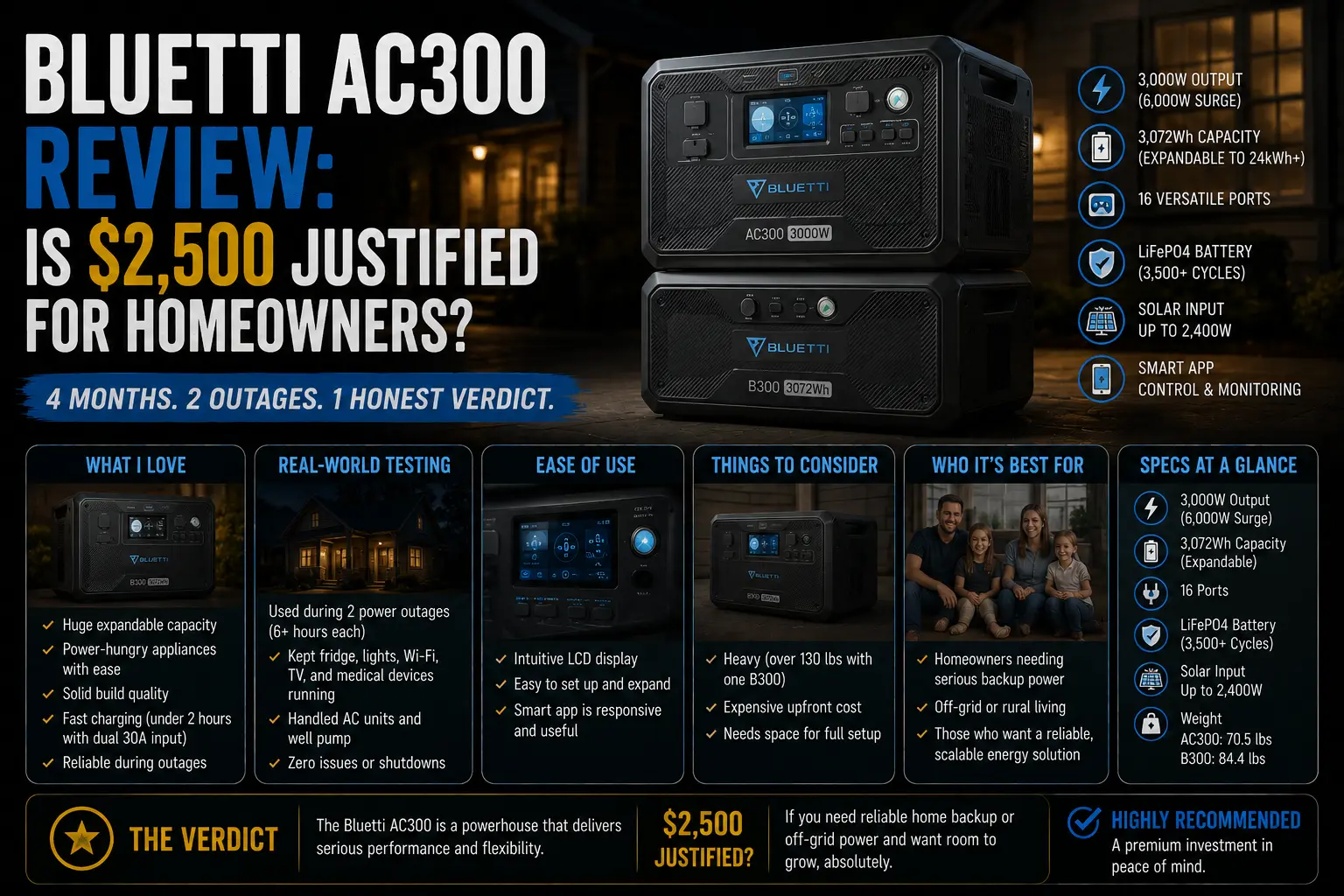
The Bluetti AC300 is not a portable power station in the traditional sense. It’s a modular inverter and control unit. It has no built-in battery. You buy the AC300 ($1,699–$1,999 depending on promotions) and then pair it with one or two B300 battery modules ($999–$1,199 each, 3,072Wh per module).
At minimum — one AC300 plus one B300 — you’re looking at roughly $2,700–$3,000 for a functional system, not $2,500. At the bundle price Bluetti frequently promotes during sales, you can find the AC300 + one B300 for around $2,499. That’s the number in the title. It’s achievable, but not the default sticker.
Add a second B300 and you’re at 6,144Wh total for around $3,700–$4,200. Two B300s and a full system capacity of 6,144Wh is where the AC300 starts making compelling sense — particularly against whole-home standby generator costs.
The AC300 itself delivers 3,000W of continuous AC output with a 6,000W surge capacity. That’s meaningfully more output than the EcoFlow DELTA Pro (3,600W) or the Jackery 2000 Plus (2,200W) at their respective price points. For homeowners who need to run power-hungry appliances — a larger window AC unit, a chest freezer alongside a full refrigerator, a sump pump — that headroom matters.
The Real Numbers With One Battery vs Two
This distinction changes the value calculation entirely, so it’s worth being explicit.
AC300 + 1× B300 (3,072Wh): Under my standard runtime testing setup — fridge, CPAP, LED lights, device charging, averaging 160–175W draw with compressor cycling — I got 16.8 hours before hitting 10% remaining. That’s a strong result. The 3,072Wh capacity is higher than the DELTA Pro’s 3,600Wh? No — it’s actually lower. But the AC300’s inverter efficiency is excellent on low-to-mid loads, and the 91°F ambient temperature in my garage hit it less hard than I expected.
AC300 + 2× B300 (6,144Wh): I didn’t own a second B300 for this review — I borrowed one from Ray for a weekend. With the full 6,144Wh, the projected runtime on the same load pushes past 33 hours. That’s a different product category. That’s a 48-hour outage with real headroom, not anxious margin management.
For comparison: the EcoFlow DELTA Pro at a similar price point with no add-on battery gives you 3,600Wh and roughly 17–19 hours under the same load. The DELTA Pro with its add-on battery (1× extra battery, $1,799) reaches 7,200Wh for around $4,300 total. The AC300 with two B300s reaches 6,144Wh for around $3,700–$4,200 total. The Bluetti system is cheaper per watt-hour at full expansion. That’s a real advantage if you’re building toward the larger system.
How It Ran Under Load
Beyond the headline runtime numbers, a few things stood out during testing.
The AC output was rock-solid across varying loads. I ran the AC300 through startup surges from a 10,000 BTU window AC (roughly 2,200W peak on startup), a chest freezer (900W startup), and both running simultaneously. The unit handled these without tripping or throttling. The 6,000W surge rating isn’t marketing — it’s real headroom that you don’t notice until you try to push something a cheaper inverter would reject.
Heat management was better than I expected from Bluetti. Their units have historically run warmer than EcoFlow’s under high load, but the AC300 stayed within comfortable operating range across a week of Florida summer testing. The cooling fan is audible under heavy load — similar to the DELTA Pro’s behavior — but it doesn’t get aggressive or distracting.
One thing I didn’t anticipate: the unit’s weight distribution with two B300s attached. The B300 modules stack and connect magnetically, which is a genuinely elegant mechanical design. Moving the full two-battery system, though, requires two people or a dolly. Each B300 weighs 81.2 pounds. The AC300 itself is 50.7 pounds. Total system weight at full expansion: roughly 213 pounds. This is not a unit you move on outage day. Pick its spot and plan around that.
Where Bluetti’s Hardware Genuinely Earns It
Two things Bluetti consistently gets right across their lineup: battery longevity and solar input flexibility.
The B300 uses lithium iron phosphate chemistry rated at 3,500 cycles to 80% capacity. At one full cycle per week — already an aggressive usage pattern for backup power — that’s 67 years of useful life before degradation becomes meaningful. EcoFlow also uses LFP, so both are excellent on this front. It’s worth saying because some of the cheaper units on the market use NMC chemistry with significantly shorter cycle ratings.
Solar input on the AC300 supports up to 2,400W when configured with dual inputs — more than the DELTA Pro’s 1,600W ceiling, and substantially more than anything else at this price point. In practice with four 200W panels on a clear Florida day, I was seeing 680–740W of actual real-world input across a six-hour peak window. That’s meaningful daily recovery for a multi-day outage. For homeowners in solar-friendly states — Florida, Texas, Arizona, Carolinas — the AC300’s solar input ceiling is a genuine long-term advantage.
The App. Again.
I’ve written about Bluetti’s app in the AC200MAX vs DELTA 2 Max comparison and I’ll keep writing about it until Bluetti fixes it, because it keeps coming up.
The AC300’s app experience is marginally better than earlier Bluetti models — the refresh rate improved in a recent firmware update, and the interface has been reorganized to surface battery percentage and watt draw more clearly. It still crashed on me twice over ten days of testing. The solar input monitoring still doesn’t show individual panel performance, only total array input. The charge limit setting takes three taps to reach when it should take one.
This genuinely matters during an outage. You want to check your unit from bed at 2 a.m., see that it’s drawing 170W and has 14 hours remaining, and go back to sleep confident. The Bluetti app makes that check slightly more effortful than it should be. Not impossible — just not effortless.
Donna, who owns the DELTA 2 Max, put it plainly when I told her about the AC300’s expanded solar input: “I’d still pick EcoFlow just because I actually trust the app number.” She’s not wrong. Whether that’s worth $300–$500 in price difference depends on how much the software experience factors into your peace of mind.
The Expandability Argument — When It Actually Makes Sense
The AC300’s most compelling case is for the homeowner who’s thinking in phases.
Phase 1: Buy AC300 + one B300 ($2,499–$2,700 on sale). Get 3,072Wh and 16+ hours of real overnight coverage. Run it through a storm season. Understand your actual usage patterns.
Phase 2: Add a second B300 ($999–$1,199). Total system: 6,144Wh, 33+ hours of coverage, enough for genuine multi-day outage management.
Phase 3 (optional): Add solar panels to the 2,400W-capable input. Build a system that can genuinely loop through extended outages without fuel logistics.
The total cost across all three phases: roughly $3,700–$4,500. Compare that to a Generac 22kW standby at $8,200–$12,400 installed plus annual maintenance. The gap is significant — especially if you don’t need your whole home running, just your critical loads. According to U.S. Energy Information Administration data, average annual outage duration in Florida runs well over the national average, which pushes this math further toward battery backup for homeowners who’ve done the research.
The AC300 rewards that kind of phased thinking. The DELTA Pro doesn’t offer the same expansion ceiling. The Jackery system doesn’t either. For a specific type of buyer — patient, planned, building toward serious capacity — this is the better architecture.
What I’d Tell You Before You Buy
The Bluetti AC300 is a good product carrying a complicated pricing structure and a software experience that hasn’t caught up to the hardware. Those are real problems. They’re not dealbreakers for the right homeowner, but they need to be said honestly before you commit to $2,500.
Here’s who should buy it: homeowners in storm-prone states who are thinking about multi-day outage resilience, plan to expand capacity within two years, have a spot to place a semi-stationary system, and don’t mind an app that works adequately rather than excellently. At full expansion — two B300s plus solar — this is one of the more capable residential battery backup systems under $5,000.
Here’s who shouldn’t: homeowners who want maximum flexibility, plan to move the unit frequently, need the best software experience, or are comparing it to the EcoFlow DELTA Pro on a pure dollar-for-dollar basis at the single-battery entry price. The DELTA Pro wins that specific comparison on recharge speed, app quality, and portability — see how I’ve compared those two head to head if you’re deciding between them.
The AC300 earns its $2,500 entry price. It earns its expansion path even more. Just go in knowing what you’re actually buying — because the product page doesn’t make it obvious enough, and the first question you’ll have is the same one Donna had on that Wednesday call.
Can the Bluetti AC300 power a window AC unit?
Yes. Its 3,000W continuous and 6,000W surge output handles most window AC units without issue — including larger 10,000–12,000 BTU units that other power stations struggle with. Runtime depends on your total battery capacity.
How does the AC300 compare to the EcoFlow DELTA Pro?
At similar single-battery prices, the DELTA Pro wins on portability, recharge speed, and app quality. The AC300 wins on output wattage, solar input ceiling, and expandability. Which matters more depends on your setup and priorities.
Does the Bluetti AC300 come with a battery?
Yes. Its 3,000W continuous and 6,000W surge output handles most window AC units without issue — including larger 10,000–12,000 BTU units that other power stations struggle with. Runtime depends on your total battery capacity.

Lived through four major grid outages since 2021 — including Hurricane Ian (2022) and Helene (2024). Spent over $6,200 testing portable power stations and comparing them against whole-home standby generators before finding a setup that actually works. Not an electrician. Not sponsored by anyone. Just a homeowner who got it wrong the first time and documented everything the second time.
Why I started this blog: I wasted $3,400 on the wrong power station during Ian prep and I couldn’t find a single blog that gave me real runtime numbers — not the ones printed on the box. I decided to test everything myself and write it down.
What I do: I run real-world runtime tests on portable power stations and standby generators. I track how long they actually power a fridge, window AC, CPAP, and phone chargers — not under ideal lab conditions, but during Florida summers with actual loads. I compare real purchase prices, warranty experiences, and manufacturer support against what homeowners actually need after a storm.