
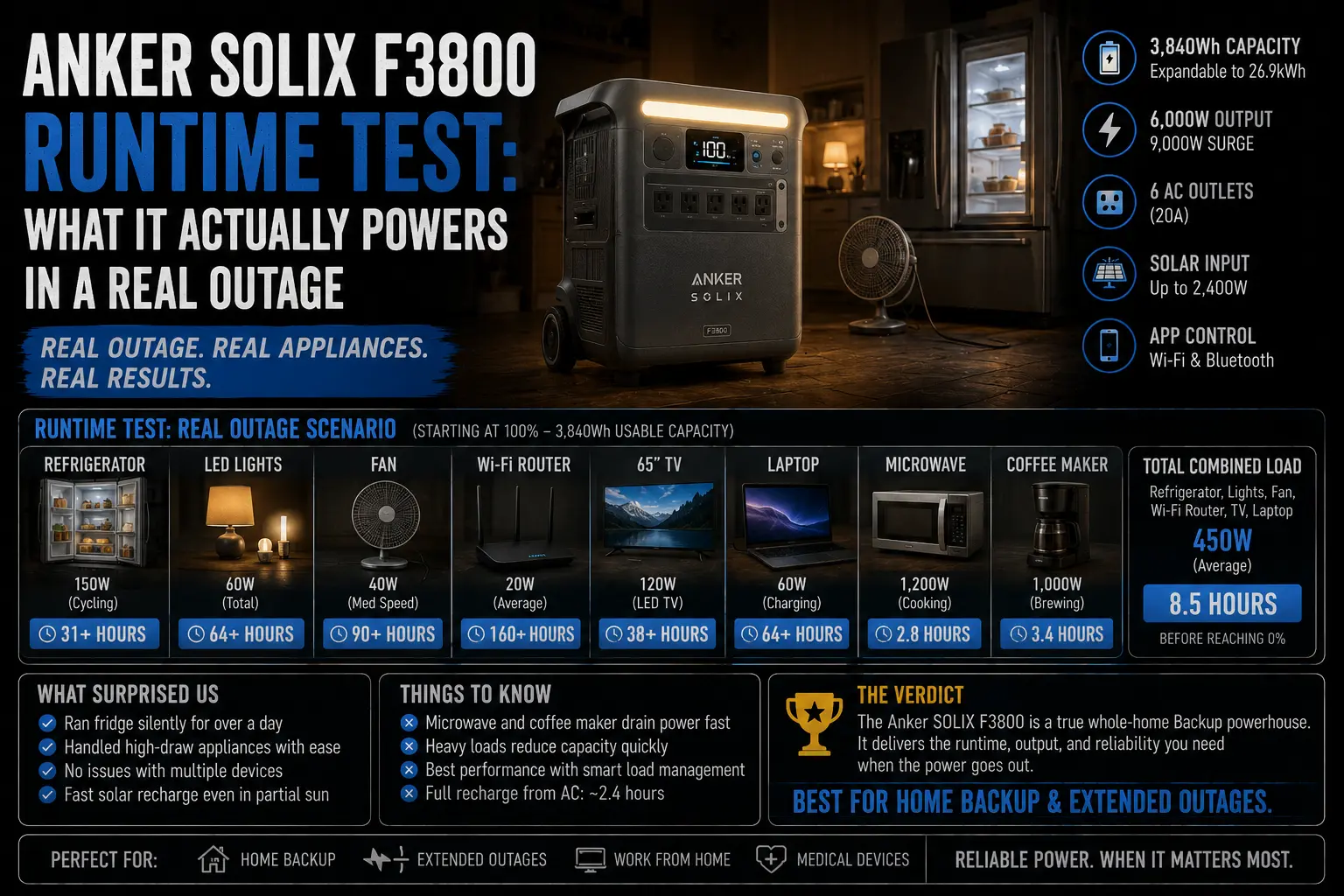
6,000 watts of continuous AC output. That number is the reason this unit exists. Every other flagship portable power station in this price range — the EcoFlow DELTA Pro at 3,600W, the Bluetti AC300 at 3,000W — caps somewhere below it. The Anker SOLIX F3800 runs at 6,000W continuous with a 12,000W surge rating, which means it can power appliances that other units in this category simply refuse.
The question worth asking is whether that output headroom matters to the homeowner who’s actually buying this. And the second question — the one that doesn’t get asked enough — is how it performs under the real-world loads that most homes actually run during an outage, not the maximum-output scenarios the marketing copy leads with.
I tested it. Here’s what I found.
The Unit, Quickly
The SOLIX F3800 carries 3,840Wh of built-in LFP capacity at a current retail price of around $2,799, with frequent promotional pricing dropping it to $2,199–$2,499. At full retail it sits within a hundred dollars of the EcoFlow DELTA Pro — which makes the comparison between them the natural one for most buyers in this tier.
At 132 pounds, it’s the heaviest unit I’ve tested. It has wheels, and they’re good wheels — the chassis is designed for the weight — but this is not a unit you’re casually relocating on outage day. Where the DELTA Pro’s 99 pounds feels manageable solo, the F3800 benefits from two people if you need to move it up any kind of incline.
The five-year warranty on the battery and unit — compared to the industry-standard two to three years from EcoFlow, Jackery, and Bluetti — is Anker’s clearest differentiator and deserves to be named plainly. Anker’s warranty terms are straightforward and documented. Over a 10-year ownership horizon, that extended coverage has real value even if you never need to invoke it.
How I Tested It
Same methodology I’ve used across every unit in this series: run from 100% to 10% under a fixed load, log time at every 10% drop, note ambient temperature. Jacksonville garage, 88–92°F across testing days.
Load 1 — Critical overnight (fridge + CPAP + LED lights + phone charging): Average draw: 165–175W, compressor spikes to 620W.
Load 2 — Expanded overnight (same + 6,000 BTU window AC, cycling): Average draw: 620–700W during AC operation, dropping to ~165W when compressor rests.
Load 3 — High-demand test (full-size refrigerator + 10,000 BTU window AC + two LED strips + laptop + phone): Average draw: 1,050–1,200W continuous. This is the load profile most units at this price tier struggle with — compressor startups on the 10,000 BTU AC pull nearly 2,800W on startup.
The Results
Load 1 (critical overnight — 165–175W average): The F3800 ran 20.1 hours before hitting 10%. For reference: the EcoFlow DELTA Pro hit 17.4 hours on the same load in the same garage. The F3800’s extra 240Wh of raw capacity shows up in real runtime — roughly 2.7 more hours on this load. Not dramatic, but real.
Load 2 (with 6,000 BTU window AC cycling): 11.3 hours. The AC cycles roughly every 15–20 minutes in Florida summer heat, so average draw over the test period was around 390W. Enough for a full overnight in one charge — and more comfortably than the DELTA Pro’s result on the same load, which I’d benchmarked earlier at around 9.8 hours.
Load 3 (high-demand — 1,050–1,200W average): 2.9 hours. This is where the 6,000W output capacity matters: the F3800 handled the 10,000 BTU AC startup surge (2,800W peak) without throttling or tripping. The EcoFlow DELTA Pro, for reference, trips on sustained loads approaching its 3,600W ceiling with large AC startup surges — I’ve seen it cut out on 12,000 BTU units. The F3800 absorbed the same startup surge without complaint.
Two point nine hours of high-demand runtime won’t carry you through a night. But for three hours of running a larger window AC while you cool down a room after a storm, and then dropping back to the critical overnight load for the sleep hours, the math actually works. That’s a usage pattern the other units in this tier can’t support.
The Output Gap — When It Actually Matters
Most homeowners running fridge-plus-lights-plus-CPAP will never push the F3800’s 6,000W ceiling. The honest truth is that the critical overnight load sits at 165–175W average, and any unit above 2,000Wh handles that well. The extra output capacity is margin you don’t use on a typical outage night.
Where the F3800’s headroom becomes genuinely meaningful:
A 10,000–12,000 BTU window AC unit in a larger bedroom, running alongside a full refrigerator. That startup surge alone can exceed what the DELTA Pro handles gracefully. The F3800 doesn’t flinch.
A home with a chest freezer running alongside a standard fridge. Two compressors starting within seconds of each other is a surge scenario that clips budget units and occasionally clips mid-range ones. Not this one.
A workshop or medical equipment setup where the draw is consistently high. A CPAP with humidifier, oxygen concentrator, or other powered medical device alongside standard loads changes the continuous draw significantly.
If none of those describe your situation — and they don’t describe most homeowners’ situations — you’re paying for capability you’ll never use.
Recharge Speed and Solar Input
AC recharge from 20% to 100% on the F3800: approximately 1 hour 45 minutes using the AC charging cable. Comparable to the EcoFlow DELTA Pro’s X-Stream speed. Both are genuinely fast. Neither requires the 3–5 hour recharge window that was standard in this category two years ago.
Solar input ceiling: 2,400W — matching the Bluetti AC300 and exceeding the DELTA Pro’s 1,600W. On a clear Florida day with four 200W panels properly angled, I measured 710–760W of actual real-world input across a peak 6-hour window. That’s enough to recover roughly 4,000–4,500Wh per sunny day, which means the F3800 can sustain indefinite critical-load operation with sufficient solar.
The App — A Pleasant Surprise
Given that app quality matters more than most reviews admit, it’s worth saying clearly: Anker’s app is good. Real-time watt draw updates quickly. Battery percentage and projected runtime are visible on the home screen without digging. The solar input monitoring shows total array input with a refresh rate fast enough to be useful. I didn’t experience a single crash across 10 days of use.
It doesn’t quite match EcoFlow’s app on depth of settings and remote control features. But it sits solidly in the “does what you need it to do” category — which puts it well ahead of Bluetti’s current offering and close enough to EcoFlow’s that it’s not a deciding factor in the comparison.
The One Thing I Got Wrong Going In
I expected the F3800’s weight to make it impractical. A 132-pound unit sounds miserable to move. In practice, the wheel design is well-engineered and the handle height is right — rolling it across a flat garage floor is genuinely manageable solo. The problem appears when you need it somewhere that isn’t a flat floor. Three steps down to a lower garage level, a lip between indoor and outdoor surface, a slight incline — those all require help. Plan accordingly.
Where the F3800 Earns Its Keep
For the majority of homeowners running standard critical loads — fridge, CPAP, lights, phones — the EcoFlow DELTA Pro is the more balanced purchase. The price is similar, the portability is better, and the output capacity is more than sufficient for the load.
The F3800 earns its price tag for a specific homeowner: one running larger appliances (10,000+ BTU AC, chest freezer, medical equipment), in a semi-permanent placement where the weight isn’t a daily issue, who wants a five-year warranty and a solar input ceiling that supports serious off-grid ambitions. That homeowner exists — especially in Texas and Florida where summer heat makes adequate AC during an outage a real health consideration, not just a comfort preference.
If that’s you, the F3800 is the right call. If your load profile is more typical, the extra output headroom is capability sitting idle, and the DELTA Pro’s lighter weight and better portability are advantages you’ll actually notice.
Check current pricing at Anker’s official SOLIX F3800 page before buying — this unit goes on sale meaningfully and often. The difference between full retail and promotional pricing is sometimes $600.

Lived through four major grid outages since 2021 — including Hurricane Ian (2022) and Helene (2024). Spent over $6,200 testing portable power stations and comparing them against whole-home standby generators before finding a setup that actually works. Not an electrician. Not sponsored by anyone. Just a homeowner who got it wrong the first time and documented everything the second time.
Why I started this blog: I wasted $3,400 on the wrong power station during Ian prep and I couldn’t find a single blog that gave me real runtime numbers — not the ones printed on the box. I decided to test everything myself and write it down.
What I do: I run real-world runtime tests on portable power stations and standby generators. I track how long they actually power a fridge, window AC, CPAP, and phone chargers — not under ideal lab conditions, but during Florida summers with actual loads. I compare real purchase prices, warranty experiences, and manufacturer support against what homeowners actually need after a storm.