
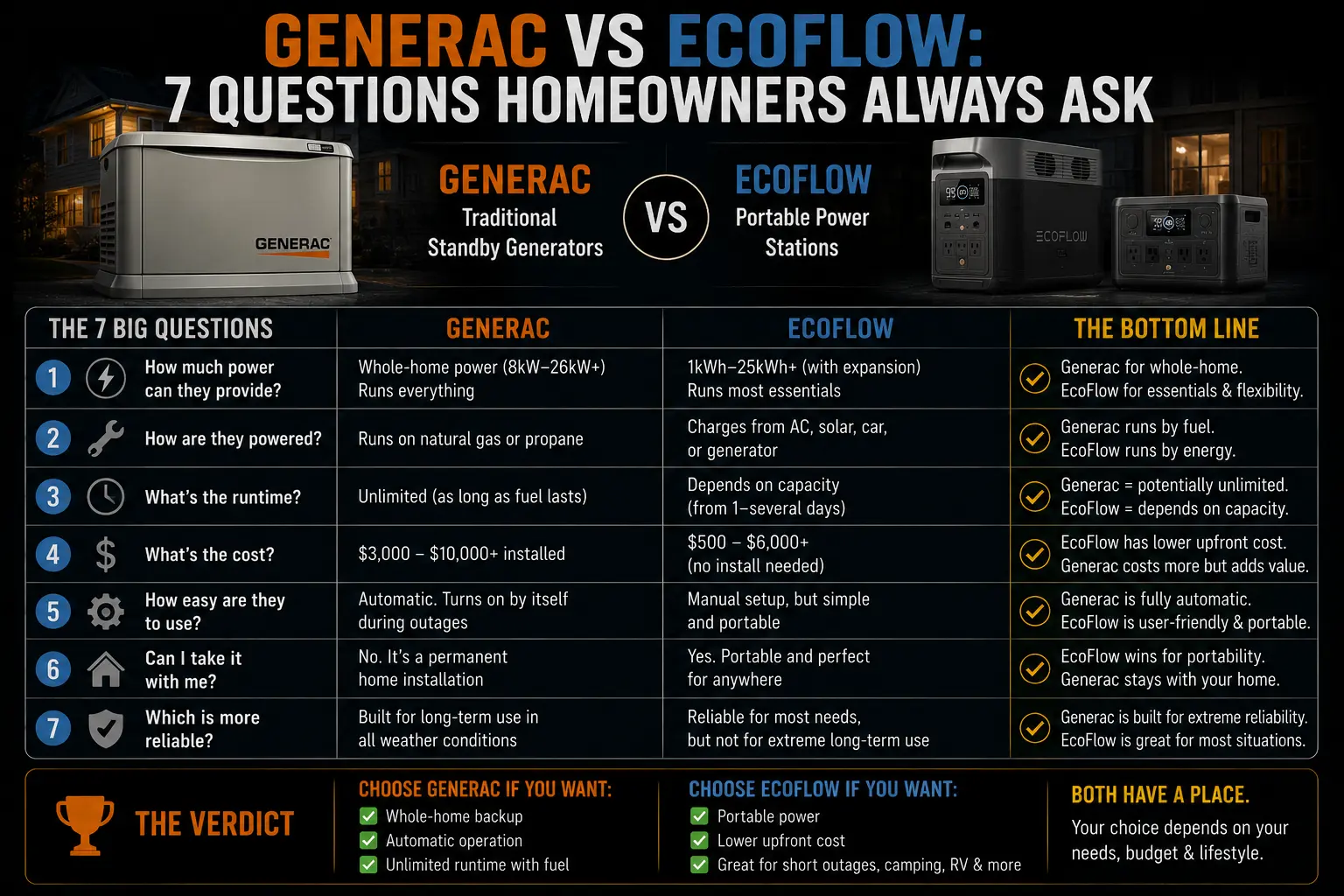
Why does everyone ask me this specific comparison? Probably because Generac is the brand people know from TV ads and neighbors’ yards, and EcoFlow is the brand that keeps showing up in storm-prep Facebook groups with surprisingly compelling prices. They’re not the same type of product — and that’s exactly where the confusion starts.
Here are the questions I field most often. Straight answers, no runaround.
Is Generac or EcoFlow actually better?
Neither. They solve different problems. A Generac home standby generator powers your entire house — HVAC, electric range, well pump, everything — automatically within seconds of a grid failure. An EcoFlow portable power station powers your critical loads: refrigerator, lights, CPAP, device charging, maybe a window AC unit. If “better” means “covers more of my house,” Generac wins. If it means “costs less and requires no installation,” EcoFlow wins. The answer depends on what you actually need covered.
Which one costs less?
EcoFlow. By a lot. A Generac 22kW standby installed runs $8,000–$12,000 depending on your location and existing gas line setup. An EcoFlow DELTA Pro — the closest thing to a whole-home alternative in the portable category — runs $2,400–$2,799. Even paired with solar panels, you’re under $4,000. That’s not a minor gap.
Can EcoFlow power my whole house the way Generac does?
No — and it’s worth being direct about this. A portable power station powers your critical loads, not your whole electrical panel. Central air conditioning, electric stoves, electric dryers, and large well pumps are generally beyond what a standalone portable power station handles. A Generac handles all of it. If running your whole house during an outage is genuinely the requirement, a standby generator is the honest answer. For why most homeowners don’t actually need that, I’ve written that argument out separately.
Which is better for hurricane season?
For outages under 72 hours — which covers most tropical storm and Category 1–2 hurricane events — a properly sized EcoFlow setup handles critical loads well. According to U.S. EIA outage data, most Florida and Carolinas outages from storms resolve within that window. For a direct hurricane hit with multi-day extended outages, a Generac standby with a large propane tank is more resilient — it doesn’t depend on solar recharge or a power grid to refuel.
Does EcoFlow require professional installation?
No. You plug it in. That’s it. A Generac standby requires a licensed electrician for the transfer switch, a gas plumber for the fuel line, permits, inspections, and a professional service visit each year after that. The EcoFlow setup is an afternoon project. That installation gap is a real practical difference for homeowners who want backup power without a multi-week contractor coordination process.
How long does each one last?
The EcoFlow DELTA Pro uses LFP battery chemistry rated at 3,500 charge cycles to 80% capacity — decades of useful life at normal usage frequency. Generac standby units are mechanical systems requiring annual oil changes, air filter replacements, and spark plug service. A well-maintained Generac can last 20–30 years. A poorly maintained one fails when you need it most. The maintenance burden is real and ongoing.
So which should I actually buy?
Run your load list first. Write down everything you need powered during an outage and for how many hours. If the answer is “fridge, CPAP, lights, and phones for one to three days” — see how EcoFlow handles that under real load before spending $10,000 on a standby. If the answer includes central AC, a well pump, or “I need everything running automatically without touching anything” — call a Generac installer. Both answers are correct. The problem is most people don’t run the load list first and end up buying based on fear rather than math.

Lived through four major grid outages since 2021 — including Hurricane Ian (2022) and Helene (2024). Spent over $6,200 testing portable power stations and comparing them against whole-home standby generators before finding a setup that actually works. Not an electrician. Not sponsored by anyone. Just a homeowner who got it wrong the first time and documented everything the second time.
Why I started this blog: I wasted $3,400 on the wrong power station during Ian prep and I couldn’t find a single blog that gave me real runtime numbers — not the ones printed on the box. I decided to test everything myself and write it down.
What I do: I run real-world runtime tests on portable power stations and standby generators. I track how long they actually power a fridge, window AC, CPAP, and phone chargers — not under ideal lab conditions, but during Florida summers with actual loads. I compare real purchase prices, warranty experiences, and manufacturer support against what homeowners actually need after a storm.