
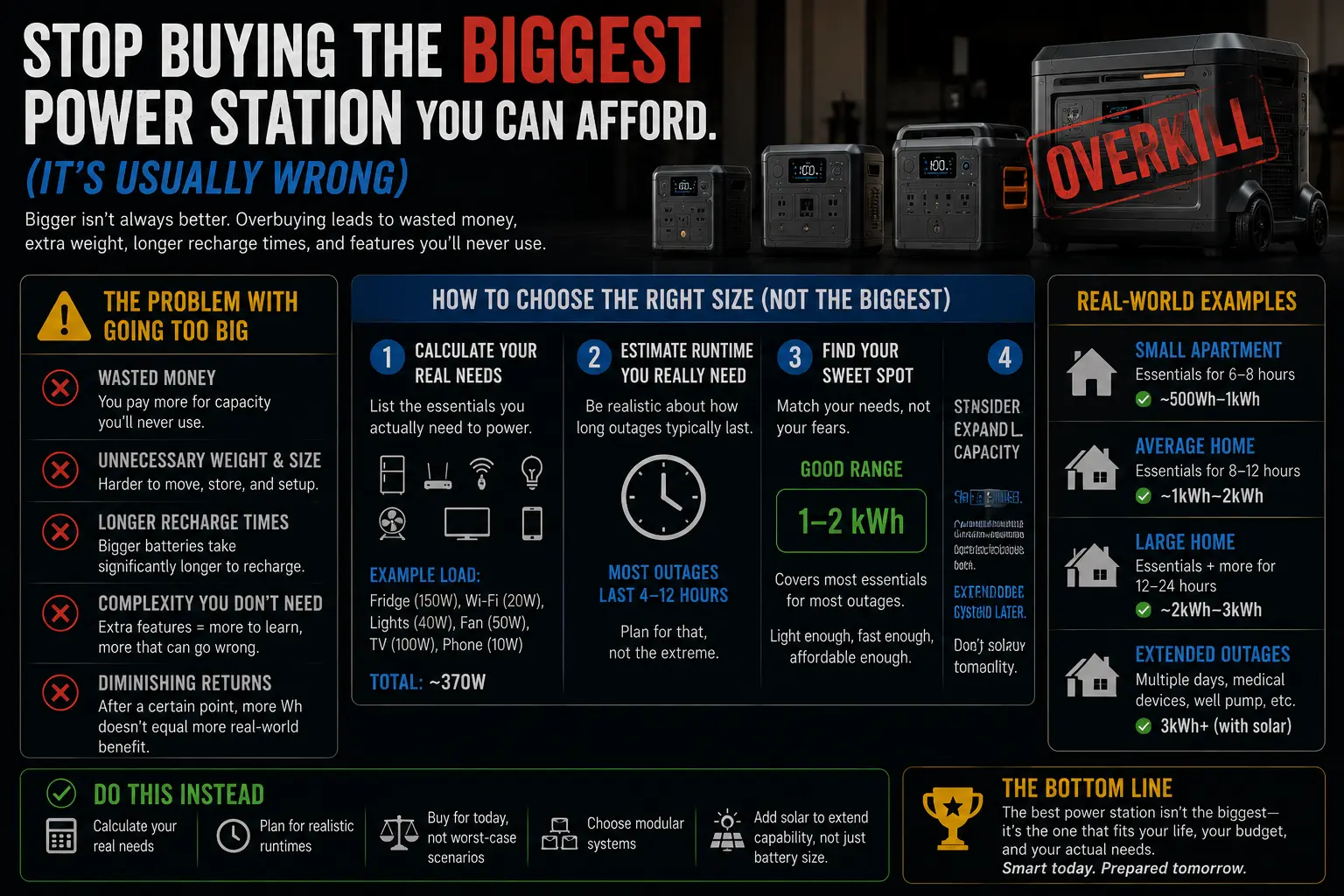
The most common mistake I see homeowners make with portable power stations isn’t buying a bad brand. It’s buying too much capacity for what they’re actually going to do with it.
More watt-hours feels safer. It’s intuitive — bigger battery, longer coverage, more peace of mind. But “biggest I can afford” is not a sizing strategy. It’s anxiety spending. And it routinely leads people to spend $2,500 on a 3,600Wh unit when a $900 unit would have covered every outage they’ve experienced in the past five years.
Let me show you the math.
What Most People Actually Run During an Outage
Sit down and write out what you’d realistically plug in during a storm overnight. Not what you could theoretically run. What you’d actually run.
For most single-family homeowners in Florida and the Carolinas, that list looks something like this:
- Refrigerator: 100–150W average draw, running in cycles (not continuously)
- CPAP machine: 30–60W depending on heat and humidity settings
- Phone and device charging: 20–60W total
- LED lighting in two or three rooms: 20–40W total
Add that up in terms of what you’d actually consume over eight hours:
A typical Energy Star refrigerator draws roughly 1.0–1.5 kWh over 24 hours, which puts an eight-hour overnight consumption at around 350–450Wh. A CPAP runs eight hours at roughly 240–480Wh (the range is wide depending on model and settings). Devices and lighting add another 200–300Wh across the night.
Total realistic overnight load: 800–1,200Wh.
That’s the number that determines what you actually need. And what your refrigerator actually draws under real conditions matters more than the watt rating on the nameplate — I measured several models and the gaps were significant.
What “Maximum Capacity” Actually Costs You
A 1,000Wh portable power station at current pricing runs $500–$750. A 3,600Wh unit runs $2,200–$2,800. Both cover that 800–1,200Wh overnight load. The 3,600Wh unit covers it three times over — which sounds good until you do the math on what that excess cost you.
The weight difference is real. A 1,000Wh unit weighs 22–27 pounds depending on the model — one-person portable, easy to carry between rooms, easy to store in a closet. The EcoFlow DELTA Pro at 3,600Wh weighs 99 pounds. It has wheels for a reason. It’s not moving once you set it down, and if you need to evacuate, it’s not coming with you.
The cost difference buys real things. $1,500–$2,000 in savings covers: a dedicated solar panel for daytime recharge, a second smaller unit for a parent’s house, a window AC unit sized for one room, and several years of storm-prep supplies. Every dollar spent on unused capacity is a dollar that didn’t buy something you’d actually use.
The return on that extra capacity is close to zero for most outages. According to U.S. grid data, most storm-related outages in the Southeast resolve within 24–48 hours. A 1,000Wh unit with a single 200W solar panel and a day of sun is ready for a second night by mid-afternoon. The carrying capacity of a 3,600Wh unit over a 1,000Wh unit effectively doesn’t matter unless you’re in a multi-day post-hurricane scenario — which is real, but not the median case.
When Bigger Actually Makes Sense
None of this applies if your load list looks different than the one above.
If you have a well pump, a large chest freezer, medical equipment with high draw requirements, or a family member who needs home oxygen — size up. The well pump especially: startup surge on a submersible pump can spike to 2,000–3,000W, which a 1,000Wh unit handles poorly and may not handle at all.
If you’re planning to use the unit as a partial whole-home solution with a transfer switch, or if your goal is three-plus days of coverage without solar access — size up. The math changes when the load is bigger or the window is longer.
And if you’ve already run one outage season with a smaller unit and found yourself running out of charge overnight — that’s real data. Size up based on what actually happened, not what you fear might happen.
But if you haven’t run a single outage through a power station yet and you’re trying to decide what to buy for the first time: start with your actual load list. Not your worst-case imagination. Your actual load list.
The Size I’d Actually Tell You to Buy
Run this calculation before you open any product page:
Take your overnight essentials. Estimate each device’s watt draw (check the label or lookup the model). Multiply by the hours you’d run it. Add 20% buffer for inefficiency. That’s your target watt-hours.
For most Florida homeowners whose priorities are fridge, CPAP, and charging: the math lands between 900–1,300Wh. That puts you firmly in the 1,000Wh tier, not the 3,600Wh tier. A well-chosen unit in that range — matched to your actual usage pattern — costs less, weighs less, and covers your realistic outage scenario completely.
Buy the unit that fits what you’ll actually run. Not the biggest one that makes the anxiety stop.
Those are different numbers.

Lived through four major grid outages since 2021 — including Hurricane Ian (2022) and Helene (2024). Spent over $6,200 testing portable power stations and comparing them against whole-home standby generators before finding a setup that actually works. Not an electrician. Not sponsored by anyone. Just a homeowner who got it wrong the first time and documented everything the second time.
Why I started this blog: I wasted $3,400 on the wrong power station during Ian prep and I couldn’t find a single blog that gave me real runtime numbers — not the ones printed on the box. I decided to test everything myself and write it down.
What I do: I run real-world runtime tests on portable power stations and standby generators. I track how long they actually power a fridge, window AC, CPAP, and phone chargers — not under ideal lab conditions, but during Florida summers with actual loads. I compare real purchase prices, warranty experiences, and manufacturer support against what homeowners actually need after a storm.