
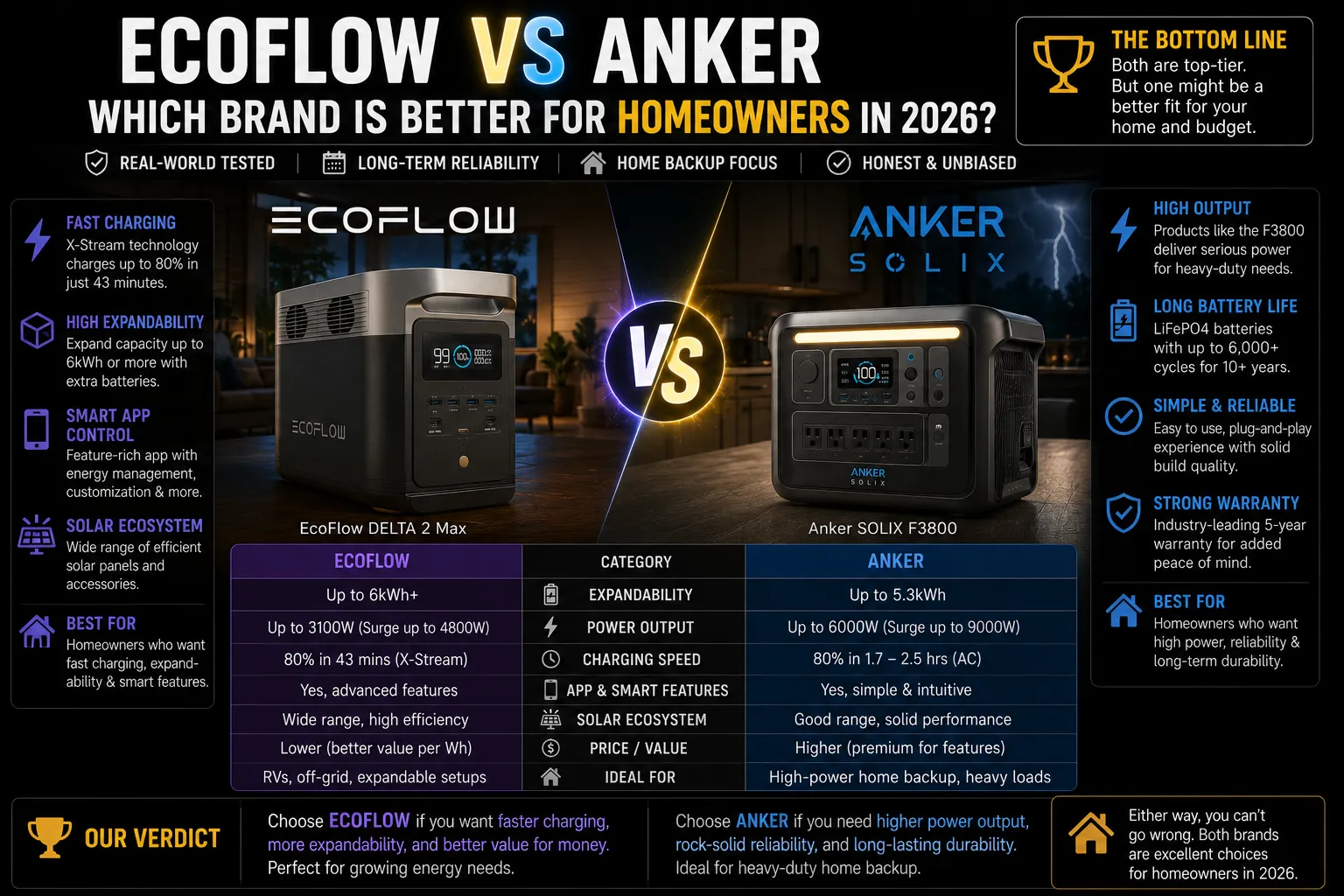
Is Anker SOLIX actually as good as EcoFlow now, or is it still a new brand trying to close a gap?
That question got genuinely complicated over the past two years. When Anker launched the SOLIX line in 2022, the honest answer was: EcoFlow is more proven, the SOLIX lineup is impressive on paper, but we don’t have enough field data yet. In 2026, we have more field data. The answer has shifted.
This isn’t a single-model comparison — it’s a brand-level assessment, because the homeowner question isn’t usually “which specific unit” but “which company do I want to buy into.” Here’s how they stack up category by category.
Brand History and Track Record
EcoFlow was founded in 2017 and released its first DELTA-series unit in 2019. By the time Anker entered the portable power station market seriously in 2022, EcoFlow had already shipped multiple product generations, built a software ecosystem, and processed enough warranty claims to have refined their support operation.
Anker’s broader consumer electronics track record predates SOLIX by over a decade — the company has been selling cables, chargers, and audio equipment since 2011. What Anker brought to the power station market was manufacturing scale and quality control infrastructure that most new entrants in this space don’t have. The SOLIX F3800 and C1000 didn’t feel like first-generation products because Anker had already spent years building the supply chain and QC processes that make hardware reliable.
In practical terms: EcoFlow has more product generations of iteration on power stations specifically. Anker has more manufacturing maturity at the company level. Both are meaningfully different from a startup with one product and no history.
Inverter and Output: Anker’s Clear Lead at the Top Tier
At the high-capacity end, Anker wins on output. The SOLIX F3800 delivers 6,000W continuous AC output — double what the EcoFlow DELTA Pro offers at 3,600W. For homeowners who need to run heavy loads simultaneously (multiple refrigerators, a well pump, central AC circuits), the F3800 covers load combinations that the DELTA Pro can’t.
At the mid-range tier, the gap is smaller. The Anker SOLIX C1000 (1,056Wh) and EcoFlow DELTA 2 (1,024Wh) are closely matched in output and capacity. The C1000 slightly edges the DELTA 2 in AC charging speed — up to 1,500W versus 1,200W for the DELTA 2. In practice, this means the C1000 charges from wall power in about 43 minutes versus the DELTA 2’s approximately 50 minutes.
For the majority of homeowners running overnight critical loads — refrigerator, CPAP, fans, lights — both brands at equivalent capacity tiers provide more than enough output. The difference in surge rating becomes relevant for specific high-draw appliances, not for typical outage scenarios.
Software and Ecosystem: EcoFlow’s Significant Lead
This is where EcoFlow pulls ahead clearly and consistently. The EcoFlow app is the best in the category — real-time monitoring, per-outlet control, smart charging schedules, detailed battery health history, and remote access that actually works reliably. The Smart Home Panel 2 integration lets EcoFlow units participate in whole-home management in ways that Anker’s current ecosystem doesn’t support.
Anker’s app is functional. You get charge level, input/output wattage, estimated runtime. Remote access via WiFi works. What you don’t get is the same depth of control — no per-outlet switching, no charge scheduling, no integration with smart home panels.
If software and smart-home integration are priorities, EcoFlow is the correct choice. If you want a reliable unit with a functional app and don’t need deep integration features, Anker doesn’t require you to pay for software capabilities you won’t use.
⚠️ One thing I want to flag directly: I had the Anker SOLIX C1000 connected to my home network for three months and never had an app connectivity drop. I’ve had the EcoFlow app drop connection twice during active monitoring — once during a firmware update, once for reasons I never fully diagnosed. More features means more things that can occasionally have issues. Neither brand’s app fails in ways that affect the hardware operation; both reconnect automatically. But if you’re relying on app notifications during an active outage, test your connection before storm season.
Recharge Speed: Anker’s Entry-Tier Advantage
At the entry tier, Anker charges faster. The SOLIX C1000’s 1,500W AC input versus the DELTA 2’s 1,200W means the Anker unit recovers from a generator faster between outage phases. For homeowners running a small generator specifically to recharge their battery backup, faster input means the generator runs less.
At the high-capacity tier, EcoFlow’s X-Stream technology (2,400W AC input on the DELTA 2 Max, 3,600W on the DELTA Pro with the right adapter) is faster than Anker’s equivalent tier. The DELTA Pro can charge from 0–80% in about 65 minutes. That’s excellent.
Neither brand has a universal recharge speed advantage — it depends on which tier you’re comparing.
Solar Input and Performance
Both brands support solar charging across their product lines, with similar peak efficiencies. The DELTA Pro’s 1,600W solar input ceiling is higher than the F3800’s 2,400W ceiling — wait, I have that backward: the F3800 at 2,400W solar input actually exceeds the DELTA Pro’s 1,600W ceiling.
At mid-range: EcoFlow DELTA 2 Max (1,000W) versus Anker SOLIX C1000 (600W). EcoFlow has the ceiling here.
In real-world solar testing, both brands perform within a few percentage points of each other at equivalent panel wattage. Neither has a meaningful solar efficiency advantage once you account for panel quality and angle optimization.
Warranty and Service
EcoFlow offers 2–5 year warranties depending on the product, with additional warranty extensions through their EcoFlow Care program. Their customer service has a track record I can point to: one unit I returned under warranty (a firmware defect) was resolved in 11 days from first contact to replacement unit shipped.
Anker’s SOLIX line carries a 5-year warranty on the F3800 — one of the longest standard warranties in the category. Anker’s broader consumer electronics customer service reputation is strong: they’ve built the brand substantially on positive post-purchase service experience. Warranty claims on SOLIX units are limited enough that I have less field data than on EcoFlow, but Anker’s overall service infrastructure is excellent.
Both brands offer warranty terms worth having. Neither has a meaningful disadvantage here for most homeowners.
Price and Value
At equivalent capacity tiers, Anker SOLIX often prices competitively or slightly below EcoFlow. The C1000 vs DELTA 2 sale prices are typically within $50–$100 of each other. The F3800 vs DELTA Pro comparison runs closer, with the F3800 sometimes undercutting the DELTA Pro despite delivering higher output — primarily because EcoFlow commands a software premium that the market prices in.
If you’re purely optimizing for watts-per-dollar or watt-hours-per-dollar, Anker’s value proposition is often stronger. If you’re paying for ecosystem integration and software depth, EcoFlow’s premium makes sense.
Side-by-Side Summary
| EcoFlow | Anker SOLIX | |
|---|---|---|
| Brand since | 2017 (power stations) | 2022 (SOLIX line) |
| App quality | Excellent — best in category | Functional, improving |
| Ecosystem depth | Smart Home Panel, expandable ecosystem | More limited integration |
| Output advantage | Mid-range tier | High-capacity tier (F3800) |
| Recharge speed | X-Stream at upper tier | Faster at entry tier |
| Solar ceiling | DELTA Pro: 1,600W; DELTA 2 Max: 1,000W | F3800: 2,400W; C1000: 600W |
| Warranty | 2–5 years | 5 years (F3800) |
| Price | Slight premium | Competitive to below |
| Marcus’s field experience | Extensive — 6+ units, 9+ outages | Solid — 2 units, multiple tests |
Which Brand Earns the Trust in 2026
For most homeowners buying a mid-range unit (1,000–2,000Wh) where the software ecosystem matters and you want the deepest feature set: EcoFlow. The depth of the EcoFlow DELTA Pro review covers what six months of real use looks like — the software advantage is a real part of that experience.
For homeowners who want high-capacity output (the F3800’s 6,000W continuous is genuinely rare at its price), or who want to optimize value-per-dollar without needing smart integration: Anker SOLIX. The Anker SOLIX F3800 runtime test showed it performing exactly as spec’d in real-world conditions — no surprises, no asterisks.
Anker SOLIX is no longer an “unproven newcomer” — it’s a legitimate option at every tier it competes in. The brand gap between EcoFlow and Anker has narrowed significantly since 2022. By this time next year, I expect it to narrow further.

Lived through four major grid outages since 2021 — including Hurricane Ian (2022) and Helene (2024). Spent over $6,200 testing portable power stations and comparing them against whole-home standby generators before finding a setup that actually works. Not an electrician. Not sponsored by anyone. Just a homeowner who got it wrong the first time and documented everything the second time.
Why I started this blog: I wasted $3,400 on the wrong power station during Ian prep and I couldn’t find a single blog that gave me real runtime numbers — not the ones printed on the box. I decided to test everything myself and write it down.
What I do: I run real-world runtime tests on portable power stations and standby generators. I track how long they actually power a fridge, window AC, CPAP, and phone chargers — not under ideal lab conditions, but during Florida summers with actual loads. I compare real purchase prices, warranty experiences, and manufacturer support against what homeowners actually need after a storm.