
It was August 12th, 91°F ambient temperature in my Jacksonville garage, and I was staring at a power station that had just shut down at 34% capacity. That was my first major purchase, a unit I won’t name here, but it taught me a harsh lesson about the difference between spec sheets and reality. When the power goes out, you don’t care about theoretical maximums. You care about whether your fridge stays cold and your fan keeps running. That experience is exactly why I approach every new unit with a healthy dose of skepticism.
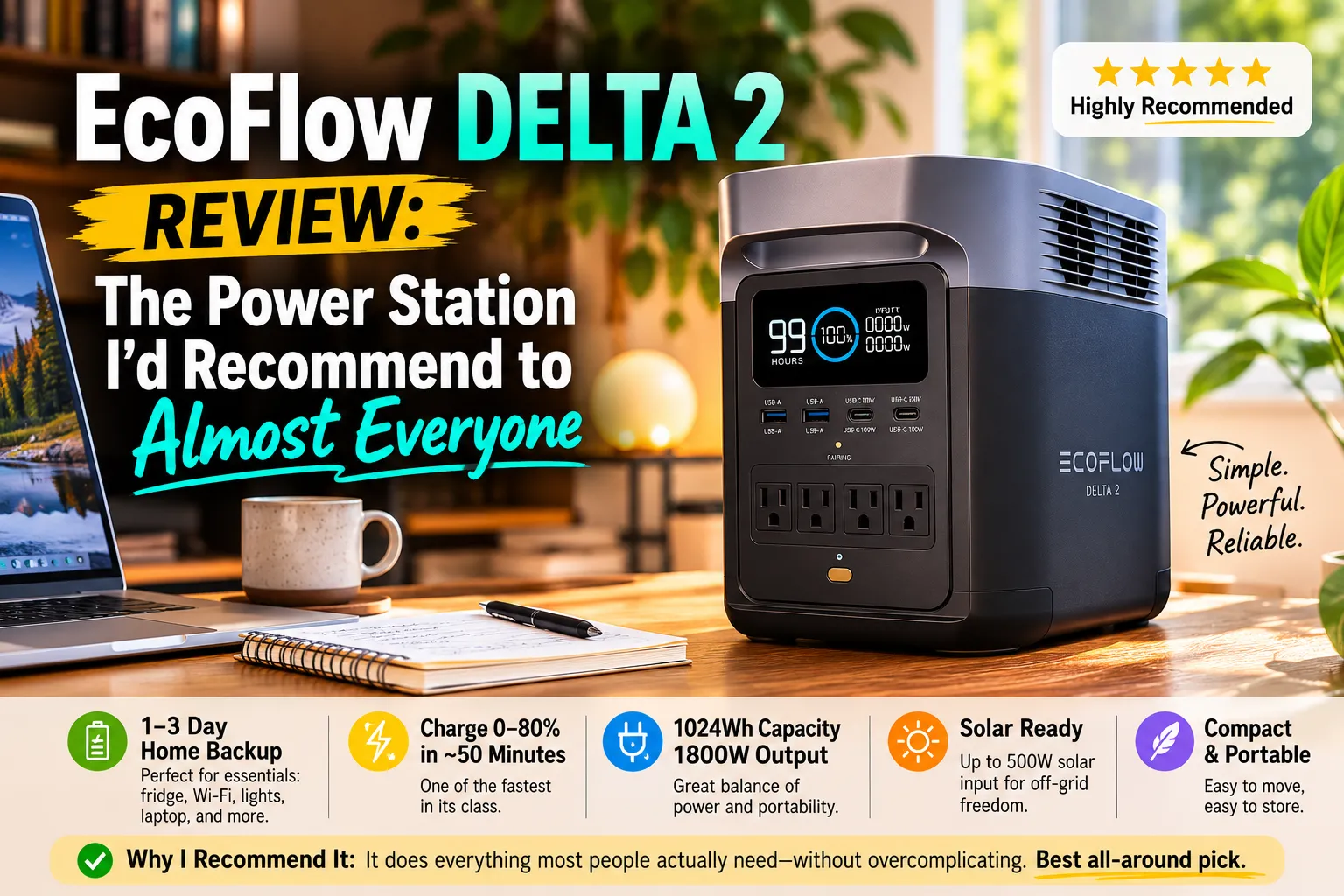
When I first got my hands on the EcoFlow DELTA 2, I expected it to be just another mid-sized box making big promises. I paid $649 for it during a Prime Day sale, which is a fair bit lower than its usual retail price. After putting it through its paces over the last year, including during the 2024 Milton outage, my perspective has shifted. I don’t say this lightly, but if a neighbor asks me what they should buy for their first backup power setup, this is the unit I point them toward.
Let’s get into the actual numbers and why this specific 1,024Wh box hits the sweet spot for most homeowners.
The Reality of 1,024 Watt-Hours
The biggest mistake I see people make is buying too much capacity or too little. If you calculate what size power station you actually need, you will often find that a massive 3,600Wh unit is overkill for keeping the essentials running, while a 500Wh unit won’t get you through the night.
The DELTA 2 sits right in the middle with a 1,024Wh LiFePO4 battery. LiFePO4 is the chemistry you want because it lasts for thousands of cycles before degrading, unlike the older NMC batteries. But what does 1,024Wh actually mean in practice?
Here is what I measured during my own tests, not what the manual claims:
| Appliance | Measured Draw (Watts) | Actual Runtime on DELTA 2 |
| Full-Size Refrigerator (Compressor On) | 140W – 180W | 5.5 to 6.5 hours |
| Box Fan (Medium Speed) | 45W | ~20 hours |
| CPAP Machine (Humidifier Off) | 15W – 20W | ~45 hours |
| 100W LED Work Light | 100W | ~9 hours |
| Coffee Maker (Brewing) | 1,200W | 4-5 pots (short bursts) |
Notice the refrigerator runtime. If you want to run your fridge continuously, 6 hours might not sound like enough. But in a real outage, you don’t run the fridge continuously. You plug it in for an hour to cool it down, then unplug it for three hours. Using that method, the DELTA 2 can easily keep your food safe for a full 24-hour period before needing a recharge.
Where the DELTA 2 Shines: Recharge Speed
If there is one thing EcoFlow gets consistently right, it is their charging technology. The DELTA 2 can pull up to 1,200W from a standard wall outlet. In my testing, it went from 0% to 80% in exactly 52 minutes.
Why does this matter? Because during rolling blackouts or when you are running a gas generator intermittently, you need to bank power fast. If you only have a two-hour window of grid power, the DELTA 2 will be fully topped up and ready for the next outage phase.
Solar charging is a different story. The unit is rated for 500W of solar input. I tested it with a 400W panel on a clear Florida afternoon.
⚠️ The panel surface hits 145–155°F in August Florida sun. I burned the fingertips of my right hand repositioning it bare-handed. Wear gloves.
In real-world conditions, that 400W panel delivered about 300W of actual input. At that rate, it took just under 4 hours to fully recharge the DELTA 2. That is highly practical for a multi-day outage where you are relying on the sun to keep your essentials running.
The Software Experience
I have mentioned before that EcoFlow leads on software and app quality, and the DELTA 2 reinforces that. The app connects via Bluetooth or Wi-Fi, and it is genuinely useful, not just a gimmick.
You can adjust the AC charging speed, which is crucial if you are plugging it into a shared circuit and don’t want to trip a breaker. You can also set charge and discharge limits to prolong the battery life. I usually set mine to stop charging at 90% and stop discharging at 10% when it is just sitting in storage.
However, I do have a specific criticism. The app sometimes struggles to reconnect via Wi-Fi if the router loses power and comes back online. I have had to manually restart the app a few times to get it to see the unit again. It is a minor annoyance, but when you are in the dark trying to check your battery level from the bedroom, it is frustrating.
What It Can’t Do
This is where I have to be clear about limitations. The DELTA 2 has an AC output of 1,800W, with a surge capacity of 2,700W. That is enough to run almost any single 120V appliance in your house, including a microwave or a coffee maker.
But it cannot run your whole house. It cannot run a central air conditioner. It cannot run a 240V well pump.
Donna, a homeowner down in Tampa who bought her setup after watching me struggle through an early storm, asked me if the DELTA 2 could run her window AC unit. I told her yes, technically it can. A small 5,000 BTU window unit pulls about 450W. The DELTA 2 will run it for about two hours. But two hours of AC isn’t going to get you through a humid Florida night. For that, you need significantly more capacity.
I got this wrong initially when I was advising friends. I focused too much on the wattage output and not enough on the total watt-hours. The DELTA 2 has the muscle to start heavy loads, but it doesn’t have the gas tank to run them for long periods.
What I Know Now That I Didn’t Know First
When I first started testing these units, I thought bigger was always better. I assumed everyone needed a massive 3,600Wh system to be truly prepared.
I was wrong. For the vast majority of homeowners, a massive system is too heavy to move easily, too expensive to justify for occasional outages, and often sits unused. The EcoFlow DELTA 2 weighs about 27 lbs. You can pick it up with one hand and carry it to wherever you need power.
It hits the sweet spot of capacity, output, and portability. It is reliable, the app is excellent, and the recharge speed is a lifesaver during intermittent outages. While it won’t power your entire home, it will keep your fridge cold, your phones charged, and your lights on without breaking your back or your bank account. If you are starting fresh and want a dependable core for your backup plan, this is the one I recommend.

Lived through four major grid outages since 2021 — including Hurricane Ian (2022) and Helene (2024). Spent over $6,200 testing portable power stations and comparing them against whole-home standby generators before finding a setup that actually works. Not an electrician. Not sponsored by anyone. Just a homeowner who got it wrong the first time and documented everything the second time.
Why I started this blog: I wasted $3,400 on the wrong power station during Ian prep and I couldn’t find a single blog that gave me real runtime numbers — not the ones printed on the box. I decided to test everything myself and write it down.
What I do: I run real-world runtime tests on portable power stations and standby generators. I track how long they actually power a fridge, window AC, CPAP, and phone chargers — not under ideal lab conditions, but during Florida summers with actual loads. I compare real purchase prices, warranty experiences, and manufacturer support against what homeowners actually need after a storm.