
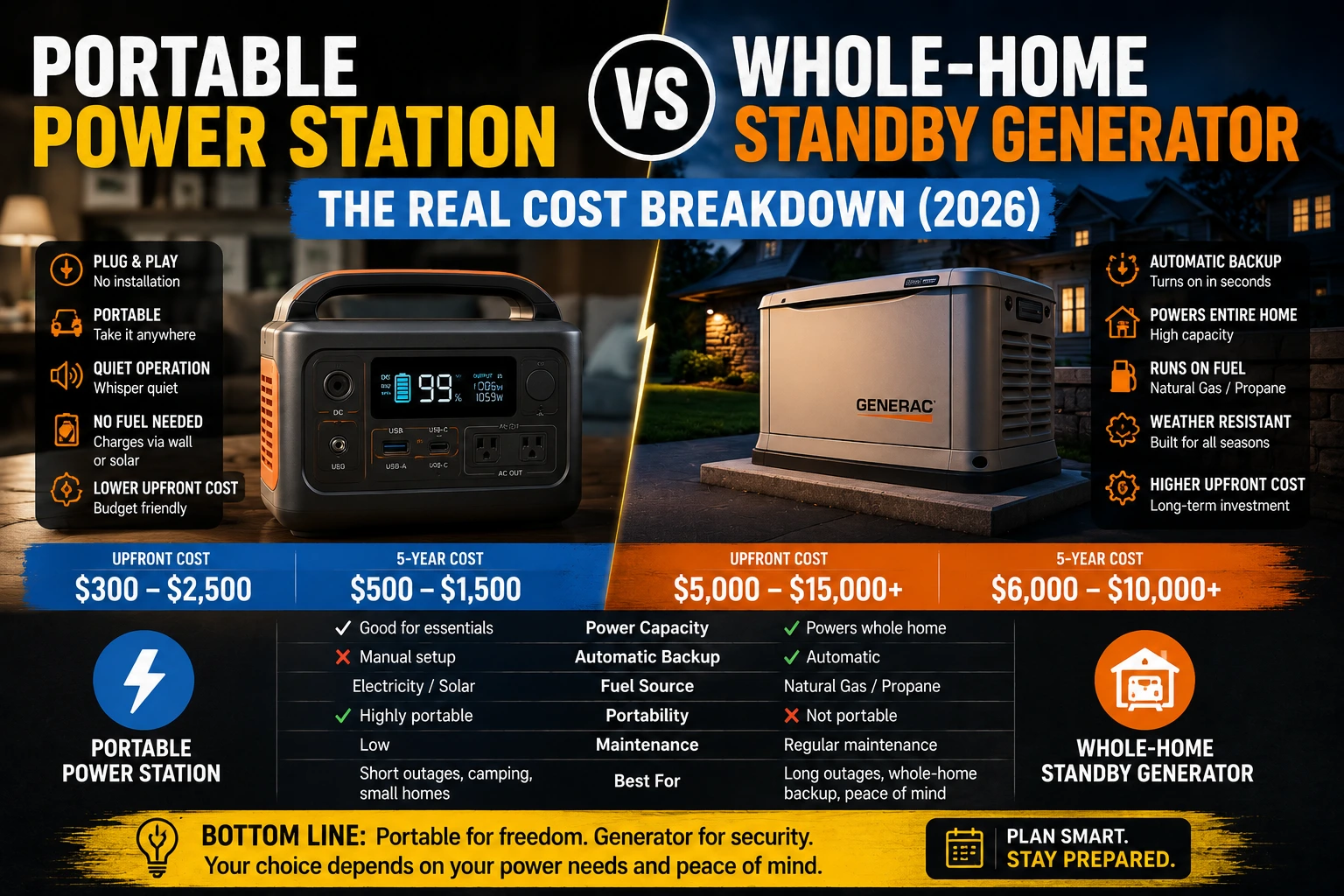
Chris called me in February 2023 — about four months after he’d had his Generac 22kW standby installed in Austin. I asked how it was going. He said, “It runs great. I haven’t thought about it once.” I told him that was the dream. He agreed. Then he paused and said, “But I also haven’t had an outage since they installed it.”
Twelve thousand four hundred dollars. Zero outages in the 12 months after installation.
He’s not bitter about it. The Texas freeze of 2021 was genuinely traumatic for a lot of families, and peace of mind has real value. But that conversation stuck with me, because it captures exactly what makes this comparison so hard for most homeowners: you’re pricing a product you hope never to use, against an event you can’t predict, in a market where fear does a lot of the selling.
I decided to run the real numbers. Not estimates from a sales brochure — actual costs, for a real home, in a storm-prone US state. Here’s what I found.
Setting Up the Comparison
To make this useful, I have to be specific. “It depends on your situation” is true but not helpful.
The home I used as the baseline: My own house in Jacksonville, Florida. Approximately 1,800 square feet. Central HVAC (3.5-ton system). Standard refrigerator, washer/dryer, water heater (gas), and the usual assortment of lights and devices. No well pump, no medical equipment. Two people, one CPAP machine.
The critical load I need covered during an outage:
- Refrigerator (keep food safe): ~100W average draw
- CPAP machine without humidifier: ~30W
- LED lighting for 3 rooms: ~36W
- Phone and device charging: ~30W
- A window AC unit for one bedroom (optional but significant in a Florida summer): ~1,200W
The outage scenarios I’m planning for:
- Most likely: 12-48 hours after a tropical storm
- Worst case (planning reference): 72-96 hours after a direct hurricane hit
With that baseline clear, let’s price both options honestly.
Option A: Whole-Home Standby Generator (Generac 22kW)
The Generac 22kW air-cooled standby generator is one of the most commonly installed units in Florida and Texas. It handles up to 22,000 watts of continuous load — enough for a fully air-conditioned home, well pump, electric range, and everything else running simultaneously.
What It Costs
The unit itself: The Generac 22kW retails around $4,500–$5,200 depending on where you buy it and whether it’s on promotion.
Installation: This is where the sticker shock lives. Installation includes a transfer switch (either a full-panel interlock or a separate subpanel), running gas line to the unit’s location, electrical permitting, inspection, and the labor itself. According to Angi’s 2024 generator installation data, whole-home standby installation runs $3,000–$5,000 for most homes, with complex setups running higher.
For a Jacksonville-area home with existing natural gas service stubbed near the installation point, local installers quoted me $3,400–$4,100 for installation on this specific unit. I called three contractors. The middle quote was $3,720.
Total installed cost (Generac 22kW): approximately $8,200–$9,400 for my situation. Chris paid $12,400 in Austin in late 2022, which included running a new gas line further across his property — that’s on the high end.
Annual maintenance: Generac recommends annual professional service — oil change, air filter, spark plugs, battery check. Plan for $150–$350 per year depending on your service area. Many installers offer annual contracts. This is not optional if you want the warranty to stay valid.
Fuel cost during an outage: A Generac 22kW running at 50% load consumes roughly 2 gallons of propane per hour, or draws equivalently on natural gas. A 72-hour outage at moderate load costs approximately $80–$120 in propane at current prices. Natural gas is metered and harder to estimate, but generally cheaper.
10-year total cost of ownership: Unit + installation + 10 years of maintenance + estimated fuel use across two major outages per decade: approximately $10,500–$13,000 depending on your installation complexity and service contract.
Option B: EcoFlow DELTA Pro + 400W Solar Panel Setup
This is the system I actually use. I’ve written about the EcoFlow DELTA Pro, Jackery, Bluetti, and Anker in detail elsewhere, and I’ve published the real-world fridge runtime numbers from my own testing. Here I’m pricing the full setup as a system.
What It Costs
EcoFlow DELTA Pro (3,600Wh): Currently $2,400–$2,799 depending on sales. EcoFlow runs significant discounts several times a year. I paid $2,499 during a Black Friday promotion.
Solar panels (2× 200W EcoFlow rigid panels): $700–$900 for the pair, depending on promotion. Third-party 200W panels compatible with the DELTA Pro run cheaper — $350–$500 total — if you’re comfortable wiring them yourself. I used EcoFlow panels for simplicity.
Mounting hardware and cables: $80–$150 if you’re setting up panels on a ground mount or angling them on a roof. No professional installation required in most setups — I did mine in an afternoon with basic tools.
Optional: EcoFlow smart home panel (for semi-automatic circuit switching): $1,199. This is not required, but it allows the DELTA Pro to automatically power selected circuits in your home when the grid drops, similar to a transfer switch. It’s worth considering if you want a more “set it and forget it” experience.
Without the smart panel — Total system cost: approximately $3,200–$3,900
With the smart panel — Total system cost: approximately $4,400–$5,100
Annual maintenance: None required beyond storing the unit properly and running a full charge cycle every 3-6 months. No service contracts. No moving parts. The LFP battery is rated for 3,500 charge cycles, which at weekly use translates to decades.
Fuel cost during an outage: Zero, assuming you have sun the next day to recharge via solar. During a cloudy extended storm, you recharge more slowly, but you still recharge — something a generator can’t do without a fuel supply.
10-year total cost of ownership: System cost + zero annual maintenance + zero fuel = $3,200–$5,100 flat. No escalating costs. No service visits.
Side-by-Side Cost Comparison
| Generac 22kW Standby | EcoFlow DELTA Pro + Solar | |
|---|---|---|
| Upfront cost (installed) | $8,200–$12,400 | $3,200–$5,100 |
| Annual maintenance | $150–$350/year | $0 |
| Fuel per major outage | $80–$120 | $0 |
| 10-year total cost | $10,500–$15,000+ | $3,200–$5,100 |
| Installation required | Yes (licensed electrician) | No |
| What it powers | Entire home, including HVAC | Critical loads (fridge, lights, devices, window AC) |
| Startup time | 10–30 seconds (automatic) | Instant (manual or smart panel) |
| Noise | 65–68 dB (significant) | Silent |
| Carbon monoxide risk | Yes (outdoor only) | None |
What the Numbers Actually Tell You
The cost gap is real and it’s large. Over 10 years, a whole-home standby system costs roughly two to four times more than a portable power station setup that handles your critical loads. That gap buys you the ability to run your central HVAC, your electric range, and everything else at full capacity — which is a genuine advantage if those things matter during your specific outage scenario.
For most homeowners in Florida, Texas, and the Carolinas — where outages typically last 24-72 hours and the primary concern is food safety, sleep comfort, and staying connected — the EcoFlow setup covers that scenario at a fraction of the cost.
The question worth asking honestly: do you actually need your whole house running during an outage, or do you need your critical loads covered? For the vast majority of people I’ve talked to, it’s the latter. And the latter doesn’t require a $10,000 system.
I covered who actually needs a whole-home generator in a separate post — it’s a shorter read and worth going through before you call a contractor. The summary: if you have medical equipment, a well pump, or you live somewhere that regularly sees outages over four days, a standby makes sense. If you don’t, the math is pretty clear.
What I’d Do With Chris’s $12,400
If Chris called me in 2026 instead of 2022 and asked what he should buy, here’s what I’d tell him:
Buy the EcoFlow DELTA Pro with the smart home panel and a set of 400W solar panels. All in, call it $4,800 installed. Put the remaining $7,600 toward a separate window AC unit for the bedroom, a chest freezer to maximize food storage during an outage, and a second DELTA Pro battery expansion module for extended capacity.
You’d still have money left over. And you’d have a system that runs silently, indoors, without fuel logistics, with no annual maintenance bill.
That’s not a criticism of Chris’s decision — it was the right call for his circumstances and his risk level after 2021. But if you’re shopping fresh in 2026 without that trauma driving the decision, the portable power station math is hard to argue with.
Can a portable power station replace a standby generator completely?
For most homeowners, yes — with the honest caveat that you’re replacing “whole home power” with “critical load power.” Your central HVAC won’t run on a DELTA Pro. A window AC unit will. Whether that trade-off is acceptable depends on your home, your climate, and how long you expect outages to last.
What happens if the EcoFlow runs out during a multi-day outage?
With 400W of solar panels, you recharge during daylight hours — even partial sun days recover meaningful capacity. On a clear day, 400W of panels can recover roughly 1,600-2,000Wh into the DELTA Pro, which is enough to cover another night of critical load use. Cloudy conditions reduce this significantly; that’s the genuine limitation of solar-paired battery backup versus a fuel-fed generator.
Does the EcoFlow DELTA Pro qualify for any tax credits?
As of 2026, the residential clean energy credit under the Inflation Reduction Act covers battery storage systems paired with solar at 30% of the system cost. A standalone portable power station without solar integration typically does not qualify. Consult a tax professional for your specific situation — the rules here have nuance.
Is a standby generator louder than a portable power station?
Yes, dramatically. A Generac 22kW runs at approximately 65-68 decibels — comparable to a vacuum cleaner running continuously. A portable power station like the EcoFlow DELTA Pro produces no operational noise whatsoever. During a storm when you’re trying to sleep, that difference is not trivial.

Lived through four major grid outages since 2021 — including Hurricane Ian (2022) and Helene (2024). Spent over $6,200 testing portable power stations and comparing them against whole-home standby generators before finding a setup that actually works. Not an electrician. Not sponsored by anyone. Just a homeowner who got it wrong the first time and documented everything the second time.
Why I started this blog: I wasted $3,400 on the wrong power station during Ian prep and I couldn’t find a single blog that gave me real runtime numbers — not the ones printed on the box. I decided to test everything myself and write it down.
What I do: I run real-world runtime tests on portable power stations and standby generators. I track how long they actually power a fridge, window AC, CPAP, and phone chargers — not under ideal lab conditions, but during Florida summers with actual loads. I compare real purchase prices, warranty experiences, and manufacturer support against what homeowners actually need after a storm.