
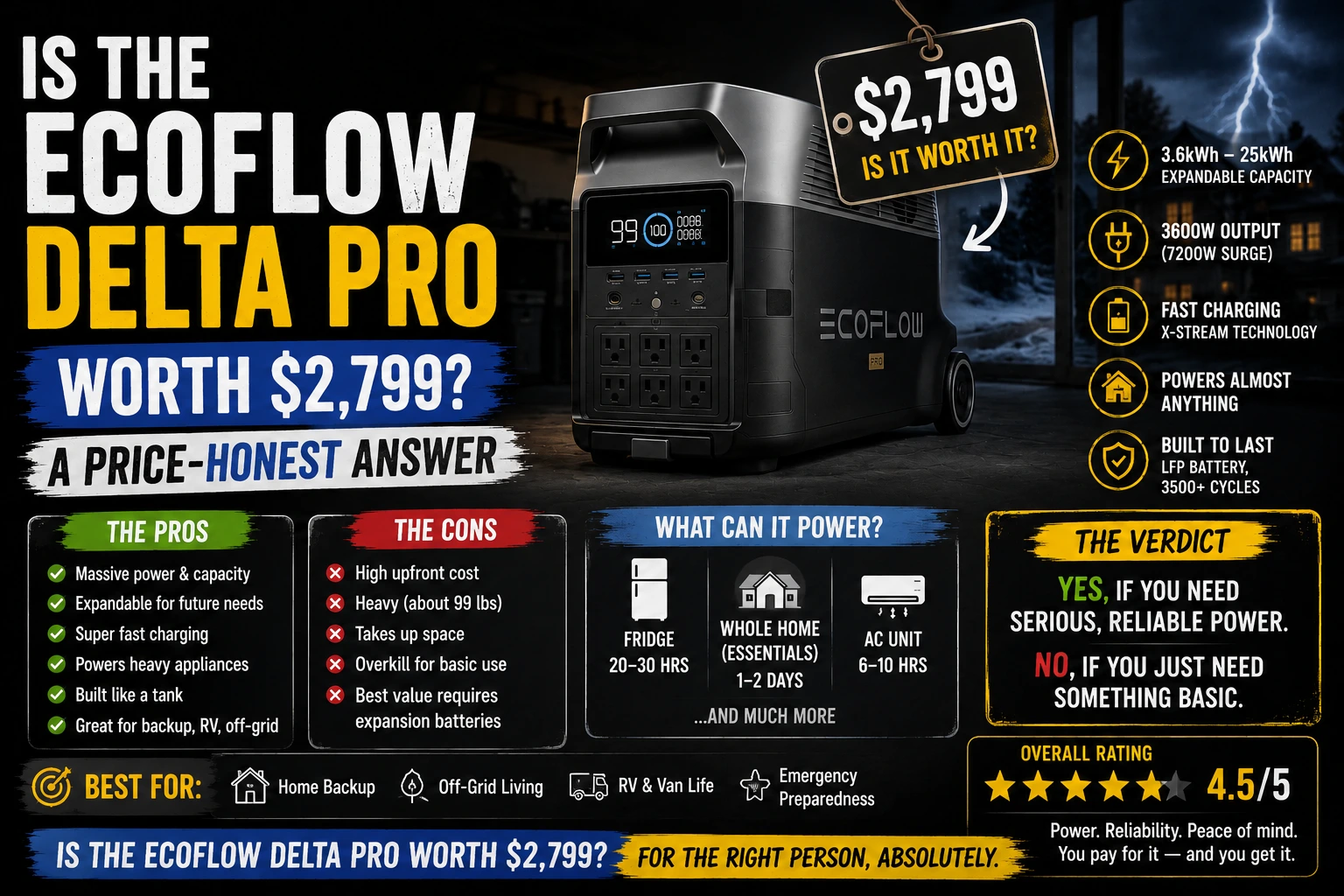
The short answer is yes — but not at $2,799.
The DELTA Pro regularly goes on sale. EcoFlow runs promotions on major US shopping holidays, and the unit frequently drops to $2,200–$2,499. I paid $2,499. Paying full retail when this unit discounts as often as it does would genuinely bother me. Watch it for a few weeks before buying. The discount will come.
At the sale price? Yes. It’s worth it. Here’s the direct case.
What $2,400–$2,499 Actually Buys You
3,600Wh of usable capacity. That’s the spec that matters most for home backup. Under a real overnight load — fridge, lights, CPAP, phone charging — you get roughly 14–15 hours of runtime. That’s a full night and most of the next morning on a single charge. No other unit at this price tier delivers that.
Recharge speed that changes the math. The X-Stream fast charging gets the DELTA Pro from 20% to 100% in under two hours on standard 120V. When an outage ends and you’re resetting for the next one, that speed matters. Competitors at similar capacity take 4–6 hours for the same job. That’s not a minor difference — it’s the difference between being ready for the next storm and being partially charged when it arrives.
An app that actually works. I know that sounds like a low bar! But after using Bluetti’s app and Jackery’s app side by side, EcoFlow’s is meaningfully better. Real-time watt draw, solar monitoring, charge scheduling, remote control over charge rate. During a night outage, monitoring the unit from my phone without walking to the garage is worth something real.
You can read the full breakdown of six months of real outage use if you want the details — three outages, real load numbers, what surprised me, and what I’d change. This post is just the price verdict.
Who Should Think Twice
If your typical outage history is “the power flickers a few times a year and occasionally goes out for four to six hours,” the DELTA Pro is overkill and you know it. A Jackery Explorer 2000 Plus at $1,299–$1,499 on sale handles that scenario with capacity to spare. Buy that instead and keep the $1,000 difference.
If your concern is multi-day outages — the kind that follow a serious hurricane — the DELTA Pro is the right tool, but pair it with at least 400W of solar panels from day one. I made the mistake of starting with 200W and had to add a third panel after my second outage. The panel cost is another $350–$500 on top of the unit. Factor that into your budget upfront.
The Comparison Context
When I tested how it stacked up against Jackery, Bluetti, and Anker across the same real-world load, the DELTA Pro won on every metric that matters for home backup. The only one that gave it meaningful competition was the Bluetti AC200MAX on inverter efficiency — and even that gap closes once you factor in recharge speed and app quality.
At the EcoFlow website you can check the current price and any active promotions. Do not pay $2,799 when $2,399 is six weeks away.
The Verdict
Worth it at sale price. Overpriced at full retail when better prices are available consistently throughout the year. Buy it when it drops — and add that third solar panel to your cart at the same time.

Lived through four major grid outages since 2021 — including Hurricane Ian (2022) and Helene (2024). Spent over $6,200 testing portable power stations and comparing them against whole-home standby generators before finding a setup that actually works. Not an electrician. Not sponsored by anyone. Just a homeowner who got it wrong the first time and documented everything the second time.
Why I started this blog: I wasted $3,400 on the wrong power station during Ian prep and I couldn’t find a single blog that gave me real runtime numbers — not the ones printed on the box. I decided to test everything myself and write it down.
What I do: I run real-world runtime tests on portable power stations and standby generators. I track how long they actually power a fridge, window AC, CPAP, and phone chargers — not under ideal lab conditions, but during Florida summers with actual loads. I compare real purchase prices, warranty experiences, and manufacturer support against what homeowners actually need after a storm.