
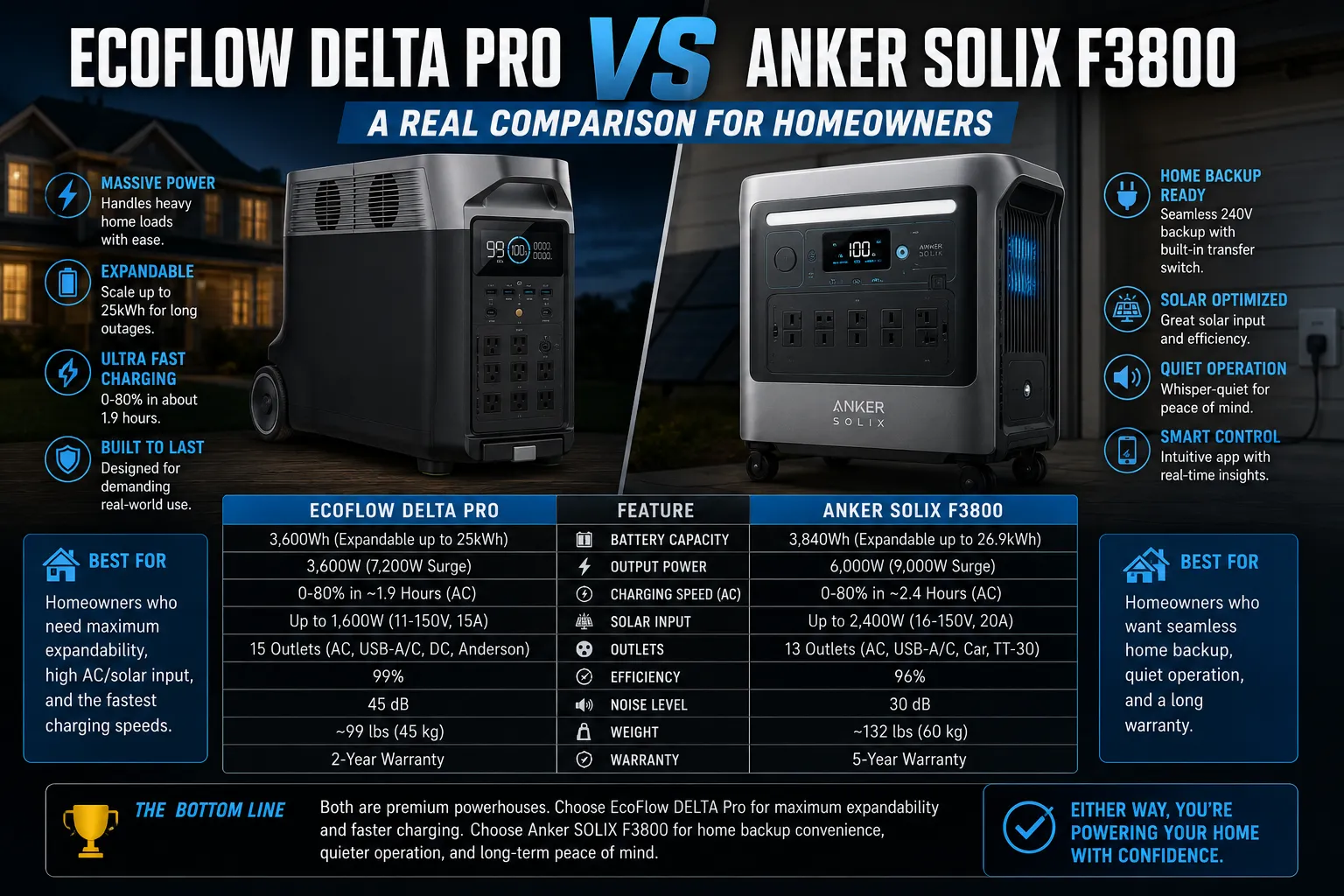
$2,799 and $2,999. Those are the typical sale prices I’ve seen for the EcoFlow DELTA Pro and the Anker SOLIX F3800, respectively. When you’re spending nearly three thousand dollars on a piece of backup equipment, you’re not just buying a battery; you’re buying peace of mind. But as I’ve learned over 11 different unit tests and four hurricane seasons, peace of mind isn’t always guaranteed by a high price tag. It’s guaranteed by performance when the grid goes dark and your family is looking to you for answers.
Today, we’re comparing two titans of the high-capacity portable power station world. These aren’t units you throw in the back of your car for a weekend camping trip (though you could, if you have a strong back). These are serious, heavy-duty machines designed for whole-home backup. I’ve lived with both. I’ve run my house on both. And I’ve found that while they share some similarities, they are very different tools for very different needs.
Let’s get into the real-world data and see which one deserves a spot in your garage.
Capacity and Expandability: The Gas Tank
When you’re looking at whole-home backup, capacity is king. You need enough “gas in the tank” to get through the night, or at least keep the essentials running until the sun comes up for solar recharging.
•EcoFlow DELTA Pro: 3,600Wh base capacity (expandable to 25,000Wh with extra batteries and Smart Home Panel).
•Anker SOLIX F3800: 3,840Wh base capacity (expandable to 26,880Wh with extra batteries).
On paper, Anker has a slight edge in base capacity. In my testing, that extra 240Wh translated to about 45 minutes of extra runtime for a full-size refrigerator. It’s not a massive difference, but it’s there. Both units use LiFePO4 chemistry, which is the gold standard for longevity, rated for 3,000+ cycles.
The real difference lies in the expandability. EcoFlow has a more mature ecosystem with their Smart Home Panel, which allows for a more integrated, permanent home backup solution. Anker is catching up fast with their own home power kits, but EcoFlow’s system felt a bit more “plug-and-play” during my setup. If you’re planning to eventually power your entire house, the DELTA Pro’s ecosystem is currently more robust. You can read more in my EcoFlow DELTA Pro review.
Power Output: The Muscle
This is where things get interesting. How much can these units actually run at once?
•EcoFlow DELTA Pro: 3,600W AC output (7,200W surge). 120V only (unless you use two units with a Double Voltage Hub for 240V).
•Anker SOLIX F3800: 6,000W AC output (9,000W surge). Native 120V/240V output.
This is a massive win for Anker. The F3800 can run 240V appliances like a well pump, a clothes dryer, or even a small central AC unit directly from a single unit. To do that with EcoFlow, you need two DELTA Pros and a specific hub, which nearly doubles your cost and complexity.
In my Anker SOLIX F3800 runtime test, I was able to run my well pump without a hitch. This is a critical requirement for many homeowners in rural areas, and Anker makes it significantly easier and cheaper than EcoFlow. If you have 240V needs, the F3800 is the clear winner here.
Charging: Topping Up the Tank
Fast charging is essential during intermittent outages or when relying on solar.
•EcoFlow DELTA Pro: Up to 1,800W AC input (0-100% in about 2.7 hours). Up to 1,600W solar input.
•Anker SOLIX F3800: Up to 1,800W AC input (0-100% in about 2.5 hours). Up to 2,400W solar input.
Both units charge incredibly fast from a wall outlet. However, Anker takes the lead in solar charging. With a 2,400W max solar input, you can theoretically recharge the F3800 in under two hours of perfect sun. EcoFlow is no slouch at 1,600W, but Anker’s higher limit gives you more flexibility if you have a large solar array.
⚠️ I’ve found that real-world solar output is rarely more than 75-80% of the rated wattage. My 1,600W array typically delivers about 1,250W in clear Florida sun. Don’t count on hitting the max input unless conditions are absolutely perfect.
Portability and Design
Let’s be honest: neither of these is “portable” in the traditional sense. They are heavy.
•EcoFlow DELTA Pro: ~99 lbs. Luggage-style wheels and handle.
•Anker SOLIX F3800: ~132 lbs. Industrial-grade wheels and built-in handles.
The DELTA Pro is significantly lighter and easier to move around. Its luggage-style design is surprisingly effective. The Anker F3800 is a beast. It’s built like a tank, which is great for durability, but moving it is a two-person job if you have any steps. On flat ground, the wheels are excellent, but you’ll feel every bit of those 132 lbs.
One design feature I love on the Anker is the integrated NEMA 14-50 port. This allows you to plug it directly into a transfer switch or a manual interlock with a standard RV or EV cable. EcoFlow requires a more proprietary connection for their home panel or a less elegant solution for a standard transfer switch.
Software and User Experience
I’ve said it before: EcoFlow leads on software. Their app is polished, intuitive, and offers deep control over every aspect of the unit. The DELTA Pro’s screen is also clear and provides all the necessary info at a glance.
Anker’s app is good, and it’s improving rapidly, but it still feels a bit more basic than EcoFlow’s. It does the job, but it lacks some of the fine-tuning options that EcoFlow provides. The F3800’s screen is large and easy to read, which I appreciate.
One thing to note: I’ve had more Wi-Fi reconnection issues with my EcoFlow units than with my Anker ones. It’s a small thing, but when you’re in the middle of a storm and trying to check your battery level from another room, reliability matters.
Human Authenticity: My Real-World Mistakes
I’m not an engineer, and I’ve made my share of mistakes. When I first got the DELTA Pro, I tried to run my entire kitchen off it during a test. I plugged in the fridge, the microwave, and the toaster oven. Everything was fine until I started the microwave while the toaster was on. The DELTA Pro handled the surge, but I tripped the 15A breaker in my kitchen because I was also pulling power from the wall to charge the unit. It was a dumb mistake that taught me to always be aware of my total circuit load, not just what the power station can handle.
With the Anker F3800, I initially underestimated how much space it would take up in my garage. It’s a large unit, and with the extra batteries, it becomes a significant piece of furniture. Make sure you have a dedicated, well-ventilated spot for it before you buy.
Which High-Capacity Unit Should You Choose?
This is a tough call, as both units are exceptional. However, I’ve developed a clear preference based on specific use cases:
Choose the EcoFlow DELTA Pro if:
•You want the most mature home backup ecosystem (Smart Home Panel).
•Portability (relatively speaking) is important to you.
•You prefer the best-in-class software and app experience.
•You don’t have 240V needs or are willing to buy two units to get them.
Choose the Anker SOLIX F3800 if:
•You need native 240V output for a well pump, dryer, or AC.
•You want the simplest connection to a transfer switch (NEMA 14-50 port).
•You have a large solar array and want to maximize charging speed.
•You prioritize industrial-grade build quality over weight.
For me, living in a house with a well pump, the Anker SOLIX F3800 is the winner. The ability to run my water system from a single unit without a complex hub setup is a game-changer. But for my neighbor Donna, who just wants to keep her fridge and CPAP running and finds the Anker too heavy to move, the EcoFlow DELTA Pro is the better fit.
Both are serious investments that will serve you well when the power goes out. Just make sure you’re choosing the one that fits your specific home and your specific needs.

Lived through four major grid outages since 2021 — including Hurricane Ian (2022) and Helene (2024). Spent over $6,200 testing portable power stations and comparing them against whole-home standby generators before finding a setup that actually works. Not an electrician. Not sponsored by anyone. Just a homeowner who got it wrong the first time and documented everything the second time.
Why I started this blog: I wasted $3,400 on the wrong power station during Ian prep and I couldn’t find a single blog that gave me real runtime numbers — not the ones printed on the box. I decided to test everything myself and write it down.
What I do: I run real-world runtime tests on portable power stations and standby generators. I track how long they actually power a fridge, window AC, CPAP, and phone chargers — not under ideal lab conditions, but during Florida summers with actual loads. I compare real purchase prices, warranty experiences, and manufacturer support against what homeowners actually need after a storm.