
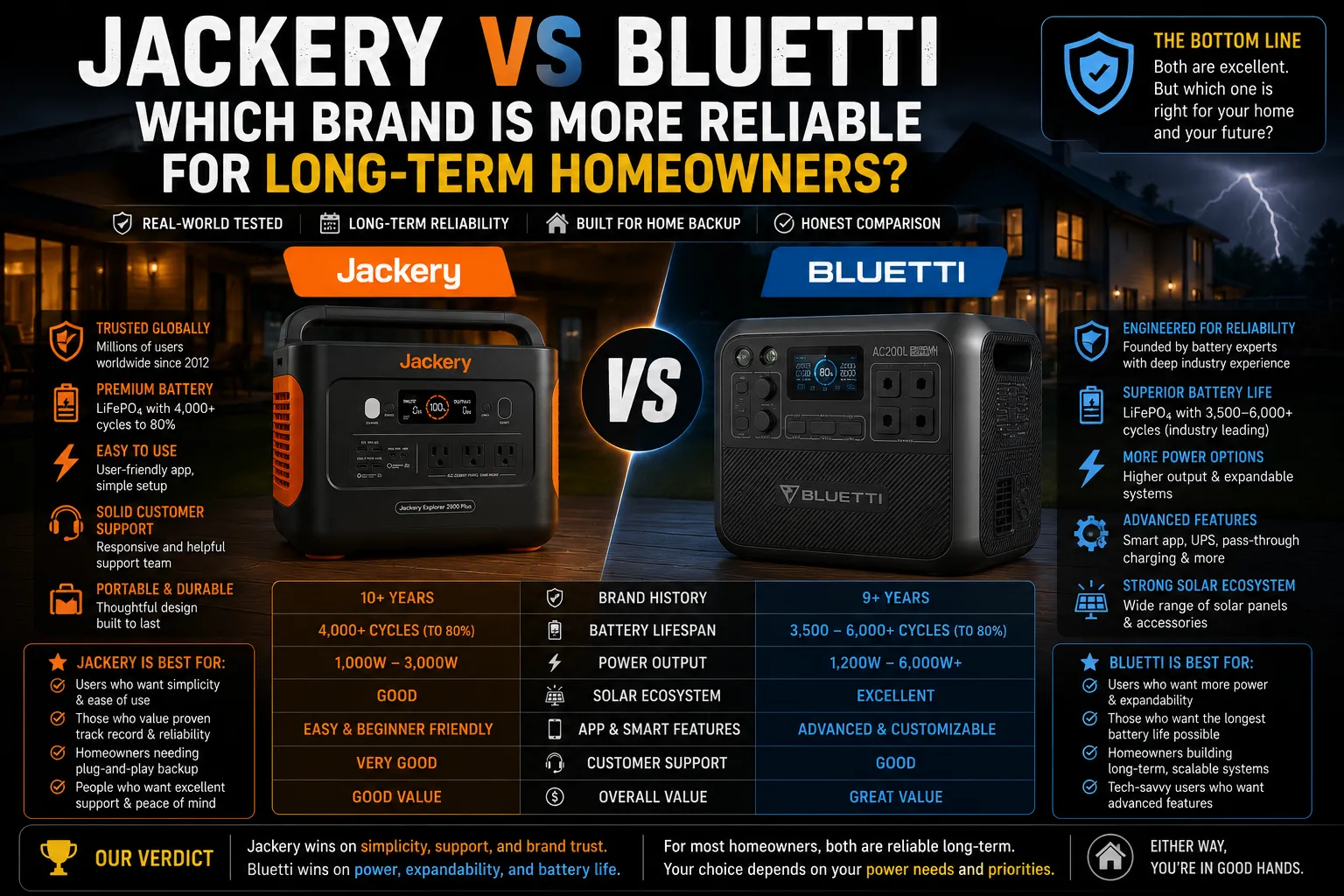
Which brand has been doing this longer, and does it matter?
Jackery was founded in 2012 — which in the portable power station industry makes it practically a veteran. Bluetti (operating under the PowerOak name in its early years) came to market with the Bluetti brand around 2019–2020. Both now offer substantial product lines, both use LiFePO4 chemistry in their mid-to-upper range, and both are competing directly for the same homeowner customer.
The question isn’t which brand has the better spec sheet on any given model — it’s which brand you’d trust to still support your purchase in four years, whose warranty means something, and which one holds up when you actually need it. Those questions have different answers than the watt-hour comparison.
Brand History: Why the 7-Year Gap Matters (a Little)
Jackery’s twelve-plus years in the industry means it has shipped products through several full product generations, navigated firmware growing pains, and processed warranty claims across thousands of units. When a new product launches, Jackery is generally not figuring out supply chain, QC, or customer service for the first time.
Bluetti has used its shorter timeline differently — coming in as a fast-follower with an aggressive specs-per-dollar approach and deeper output specifications than Jackery offered at equivalent price points. The Bluetti AC200MAX’s 2,200W output at its price tier was genuinely difficult to match when it launched.
The honest assessment: both brands now have established product lines, established customer service operations, and enough market presence that neither is a risky buy from a “will this brand exist in three years” standpoint. The reliability question is more about build philosophy than brand longevity.
Build Quality: Jackery’s Consistent Edge
Across the units I’ve handled from both brands — and across feedback from owners I know who’ve used both — Jackery’s build quality is more consistent unit to unit. The chassis doesn’t flex when you pick it up. Port covers close firmly. The fan manages thermal load without getting audibly stressed under moderate loads.
Bluetti’s higher-capacity units (the AC300, AC200MAX) are also solidly built, but I’ve noticed more variance in the feel of smaller details — port cover tension, display backlight uniformity, the resistance on the power button — than in equivalent Jackery units at the same tier. This may be a small sample issue on my end, but it’s a pattern I’ve heard echoed by other testers.
Chris has a Bluetti AC200MAX at his Austin property as a supplement to the Generac — bought it to cover the home office independently when the generator is in maintenance mode. His comment after eight months: “It works. The app is finicky. The unit itself has never given me a problem.” That’s a fair summary. Bluetti hardware tends to work; Bluetti software has historically had inconsistency issues (covered in the Bluetti AC300 review and the standalone app post).
Warranty: Nearly Identical on Paper, Slightly Different in Practice
Both brands offer a 2-year warranty on most products (some flagship units have extended terms up to 5 years). The written terms are comparable — defects in materials and workmanship, battery degradation coverage.
Where they differ is in the service experience. Jackery’s warranty process is generally faster to reach a resolution, from what I’ve seen in owner forums and from one direct experience returning a unit with a firmware issue. Response times were in the 2–3 business day range for acknowledgment and about 10 days to resolution.
Bluetti’s warranty process has more reported variation — some owners describe efficient replacements, others describe multi-week delays and back-and-forth on documentation requirements. I don’t have direct personal experience with a Bluetti warranty claim, so I’m reporting secondhand here with appropriate uncertainty.
⚠️ Practical note on this: document everything when you buy a power station from either brand. Photo of the unit, screenshot of the receipt, screenshot of the serial number on the unit. Store these in a folder labeled with the brand name. If you ever need warranty service, this documentation speeds up the process significantly. Both brands have claimed they couldn’t find purchase records when claims came in with incomplete information.
Software and App: Bluetti Is Getting Better, Jackery Is Consistent
This has evolved. Historically, Bluetti’s app had connectivity issues, slow refresh rates, and occasional firmware updates that changed settings without clear notice. EcoFlow set a high standard that Bluetti has been working toward.
Current state in 2026: Bluetti’s app is noticeably better than it was two years ago. Real-time monitoring works reliably. Remote access is functional. The experience is no longer frustrating — it’s just not as polished as EcoFlow.
Jackery’s app hasn’t changed as dramatically, because it was functional from the start. It’s simpler, has fewer features, and is consistently reliable. For homeowners who want app features — scheduling, detailed history, smart charging — Bluetti has closed the gap and offers more. For homeowners who want to check charge level and move on, Jackery’s app is fine.
Performance Per Dollar: Bluetti’s Advantage
At equal price points, Bluetti typically offers more AC output wattage, more battery capacity, or better solar input than Jackery. This has been a consistent pattern across the price tiers I’ve tracked.
Example at the $1,000 sale price tier:
- Jackery Explorer 2000 Plus: 2,042Wh, 3,000W output
- Bluetti AC200MAX: 2,048Wh, 2,200W output, but often with a lower sale price, letting you effectively get the same capacity for less
At the $1,500 tier:
- Jackery Explorer 3000 Pro: 3,024Wh, 3,000W output
- Bluetti AC300: 3,072Wh (with B300 battery module), 3,000W output — often competitive in price with more expansion options
Bluetti’s modular battery system (the B230, B300 modules) is a genuine advantage for homeowners who want to scale capacity over time without buying a whole new unit.
Outage Performance: Both Are Reliable
From what I’ve personally used and observed in real outages — Jackery has been involved in eight outages across different units I’ve owned or lent to neighbors. Zero failures. Bluetti has been in three outages (my testing plus Chris’s unit during one Texas event). Also zero failures.
Both brands perform as expected under real outage conditions at normal ambient temperatures. Where I’d expect to see differences emerge is at thermal extremes — hot garage storage in August, cold garage in a northern winter — and under sustained high-load discharge over many consecutive hours. I have data on Jackery in those conditions (solid); I have less data on Bluetti in equivalent extremes.
The Honest Summary by Homeowner Type
You probably want Jackery if: build quality consistency and brand track record are the primary factors, you prefer simpler software, and you’re buying a fixed-capacity unit you won’t expand.
You probably want Bluetti if: you want more output or capacity per dollar, you’re building a modular expandable system, or you want app features closer to EcoFlow’s standard.
From the Jackery 2000 Plus review, the pattern I described holds: Jackery’s execution is reliable and unfussy. Bluetti’s specs are often more impressive on paper and increasingly solid in the field. Neither brand is a bad choice at their respective sweet spots. The question is which trade-off fits your priorities.
Which Brand I’d Trust With My Own Home
Jackery, at its price. Not because Bluetti is unreliable — it isn’t. Because Jackery’s build consistency and track record in real outage conditions is something I’ve watched firsthand across more units and more events. When I’m recommending a first unit to someone who has never bought a power station before, I feel more confident about what they’ll receive from Jackery.
If someone is building a multi-battery modular system and wants the best specs-per-dollar expansion path, I’d look harder at Bluetti’s ecosystem. That’s not a reluctant recommendation — it’s the right tool for that specific job.

Lived through four major grid outages since 2021 — including Hurricane Ian (2022) and Helene (2024). Spent over $6,200 testing portable power stations and comparing them against whole-home standby generators before finding a setup that actually works. Not an electrician. Not sponsored by anyone. Just a homeowner who got it wrong the first time and documented everything the second time.
Why I started this blog: I wasted $3,400 on the wrong power station during Ian prep and I couldn’t find a single blog that gave me real runtime numbers — not the ones printed on the box. I decided to test everything myself and write it down.
What I do: I run real-world runtime tests on portable power stations and standby generators. I track how long they actually power a fridge, window AC, CPAP, and phone chargers — not under ideal lab conditions, but during Florida summers with actual loads. I compare real purchase prices, warranty experiences, and manufacturer support against what homeowners actually need after a storm.